The I-70 Strangler: An Unsolved Series of Murders
The I-70 Strangler is the name given to an unidentified serial killer believed to have murdered boys and men in Indiana and Ohio between 1980 and 1991. The case should not be confused with the I-70 Killer, an unidentified gunman who attacked store clerks during a separate series of crimes. The Strangler’s victims were connected by the manner in which they were killed, the isolated places where their bodies were abandoned, and their proximity to Interstate 70.
Investigators associated at least eleven, and possibly twelve, victims with the series. Most were last seen in Indianapolis or had connections to the city. Several had visited gay bars, and some survived through sex work or other unstable circumstances. Their vulnerability may have made them easier for the killer to approach without immediately attracting attention.
Pattern of the Crimes
The victims were generally strangled and left in rural ditches, creeks, or other isolated areas. Many were found nude or partially clothed. The disposal sites were usually close to Interstate 70 or roads that provided access to the highway. The locations stretched from central Indiana into western Ohio, suggesting that the killer was comfortable traveling between the two states.
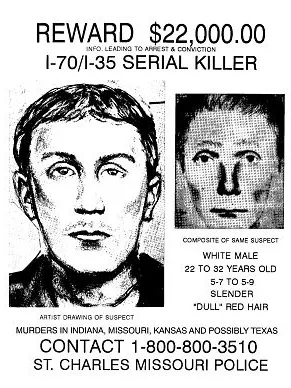
Witnesses in several cases remembered seeing a victim enter a vehicle shortly before disappearing. Descriptions included a blue van, a Jeep, and a Chevrolet Blazer. Some witnesses described a white male with a prominent or bushy mustache. The varying vehicle descriptions made it difficult for detectives to determine whether witnesses had seen the same offender.
Known and Suspected Victims
- Michael Sean Petree, 15 — June 16, 1980, Hamilton County, Indiana: Petree was reported missing on June 7. He was reportedly seen several days later riding in a stranger’s car in Indianapolis. His nude body was discovered in rural Hamilton County on June 16. An examination determined that he had been strangled. June 16 is the verified date his body was found; his exact date of death was not established publicly.
- Maurice Allen Taylor, 22 — July 21, 1982, Weasel Creek, Hamilton County, Indiana: Taylor’s partially clothed body was discovered in Weasel Creek near Atlanta, Indiana. He had lived in the boiler room of an Indianapolis apartment building and was known to spend time near gay bars. Decomposition prevented authorities from establishing the cause of death with complete certainty, but investigators suspected strangulation. July 21 is the verified recovery date rather than a confirmed date of death.
- Delvoyd Lee Baker, 14 — October 3, 1982, Hamilton County, Indiana: Baker was last heard from on October 2, when he called his parents and said he would be home late. Witnesses reported seeing him enter a blue van driven by a white man with a bushy mustache. Baker’s partially clothed body was found near a river the next day. He had been strangled. Because he disappeared the previous evening, investigators believed he was killed during the night of October 2 or the early hours of October 3.
- Michael Andrew “Mick” Riley, 22 — June 5, 1983, Hancock County, Indiana: Riley disappeared on May 28 after visiting an Indianapolis nightclub. He was last seen leaving with an unidentified man. His nude body was discovered in a drainage ditch southeast of Greenfield on June 5. Investigators determined that he had been strangled, possibly with a towel or another piece of fabric. His precise date of death remains uncertain.
- Eric Allen Roettger, 17 — May 1985, Preble County, Ohio: Roettger vanished on May 7 after leaving home for what his parents believed would be a day of summer job interviews. Witnesses saw him near a bus stop and reported that he accepted a ride instead of boarding a bus. His shirtless body was found several days later near a stream east of Lewisburg. He had been strangled with a rope and had a burn injury on his shoulder. Public accounts do not provide a consistently verified calendar date for the discovery, so his death is best recorded as occurring in May 1985.
- Michael Allen “Mike” Glenn, 29 — August 15, 1986, near Eaton, Ohio: Glenn’s body was found in a roadside ditch while he was wearing only underwear. Marks on his neck indicated that he had probably been strangled with a rope. Glenn lived alone near Indianapolis and worked occasional handyman jobs, so no reliable date for his disappearance could be established. He remained unidentified for approximately three years before fingerprints confirmed his identity. August 15 is the verified date his body was recovered, not a confirmed date of death.
- James Boyd Robbins Jr., 21 — October 17, 1987, Shelby County, Indiana: Robbins left his mother’s Indianapolis home at about 10:00 p.m. on October 15. His nude body was discovered two days later in a rural ditch south of Gwynneville. He had been strangled. Witnesses gave conflicting descriptions of a vehicle seen near the area, identifying it as either a red Jeep Wrangler or a Chevrolet Blazer. Robbins is believed to have died between his disappearance on October 15 and the discovery of his body on October 17.
- Jean Paul Talbot, 26 — May 1989, Defiance County, Ohio: Talbot was found strangled near a stream in rural Defiance County. His body was discovered much farther north than most of the other victims, making the location unusual within the series. The publicly available record identifies May 1989 as the discovery period but does not provide a reliably confirmed exact date of death.
- Steven Lynn Elliott, 26 — August 12, 1989, Preble County, Ohio: Elliott’s body was found near Interstate 70 while he was wearing only underwear. Investigators believed that he had been strangled with a rope. Elliott had left his family home after coming out as gay and later experienced alcoholism and financial instability. August 12 is the verified discovery date; the precise date on which he was killed was not publicly established.
- Clay Russell Boatman, 32 — August 1990, near Eaton, Ohio: Boatman, a licensed practical nurse, disappeared after leaving his Richmond, Indiana, apartment on August 14 to visit a local gay bar. His body was later found in a ditch near Eaton by a group of children. Evidence indicated that he had been strangled. The exact recovery and death dates have not been consistently reported, although his disappearance is verified as August 14, 1990.
- Thomas Ray Clevenger Jr., 18 — September 1990, near Greenville, Ohio: Clevenger disappeared on September 6. His partially clothed body was later discovered near an abandoned railroad track outside Greenville. Investigators connected him to the series because of the condition and location of his body, his strangulation, and his reported involvement in sex work around Indianapolis. His exact date of death and the exact date his body was recovered have not been publicly established with consistency.
- Otto Gary Becker, 42 — August 6, 1991, Henry County, Indiana: Becker’s body was found in a ditch beside a gravel road in rural Henry County. Witnesses reported seeing him earlier that day inside a vehicle with another man while traveling near Indianapolis. Although some accounts have listed a later discovery date, detailed case summaries identify August 6, 1991, as the verified recovery date. Becker was the oldest person associated with the series and one of its final known victims.
The Investigation
Indianapolis police formed a task force in 1982 after recognizing similarities among the early cases. The Federal Bureau of Investigation later helped develop profiles of possible offenders. Investigators initially reviewed several additional murders of gay men, but differences in the causes of death and disposal methods suggested that more than one killer was operating in the region.
The investigation was complicated by the social conditions of the period. Several victims were gay, homeless, involved in sex work, or estranged from their families. Some were not reported missing immediately. Others remained unidentified for months or years. Fear of discrimination also made potential witnesses reluctant to discuss visits to gay bars or encounters with strangers.
Herb Baumeister as the Principal Suspect
Indiana businessman Herbert Richard Baumeister eventually became the most prominent suspect. Baumeister owned thrift stores and lived with his wife and children at Fox Hollow Farm, an isolated property near Westfield, Indiana. During the 1990s, investigators began examining reports that he approached men in Indianapolis gay bars and invited them to his home.
Human remains were discovered on the Fox Hollow Farm property. Investigators recovered thousands of burned and fragmented bones belonging to multiple men. Baumeister fled to Canada while authorities were preparing to arrest him and died by suicide on July 3, 1996. He left no confession and was never tried for murder.
Police publicly identified Baumeister as a prime suspect in the I-70 Strangler investigation in 1999. He had access to vehicles resembling some of those described by witnesses, traveled regularly through Indiana and Ohio, and was believed to have selected victims from the same Indianapolis nightlife district connected to several of the disappearances.
Investigators also noted that roadside murders associated with the I-70 Strangler apparently ended around the period when Baumeister obtained Fox Hollow Farm. The property would have provided a private place to conceal victims without leaving their bodies beside highways. This timing strengthened suspicions, but it did not establish his responsibility for every murder.
An Unresolved Case
The I-70 Strangler case remains officially unsolved. No physical evidence publicly disclosed by investigators has conclusively connected Baumeister to all of the roadside victims. Differences between accounts, uncertainty about several death dates, and the possibility of multiple offenders have prevented a definitive resolution.
The victims were more than entries in a murder timeline. They were teenagers and adults whose lives ended in isolated places, often after periods of hardship and social exclusion. Modern DNA testing and forensic genealogy may eventually clarify whether the same person killed them, identify additional victims, or establish the true extent of Baumeister’s involvement. Until then, the I-70 Strangler remains one of the Midwest’s most disturbing unresolved serial murder investigations.