The Jeff Davis 8 Murders
Overview
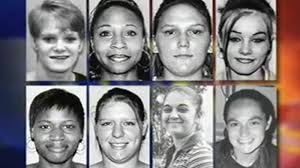
The Jeff Davis 8, also known as the Jennings 8, is the name given to eight women whose bodies were discovered in and around Jennings, Louisiana, between May 2005 and August 2009. The victims were found in canals, drainage ditches, rural fields and other isolated locations throughout Jefferson Davis Parish. Authorities publicly investigated the deaths as the possible work of a serial killer, although no individual has been proven responsible for all eight cases.
The exact dates on which most of the women died could not be conclusively established because several bodies were significantly decomposed when discovered. For that reason, the dates listed below are the verified dates on which their bodies were found rather than presumed dates of death. Four deaths were classified as homicides, while the causes or manners of death in the remaining cases could not be determined with certainty.
The victims knew one another through family relationships, friendships and their shared social environment in Jennings. Several struggled with poverty, substance dependence and exploitation. Some had worked in the local sex trade, and several reportedly supplied information to law-enforcement officers about drug activity. These overlapping relationships created an unusually complicated investigation involving victims, witnesses, suspects, informants and members of law enforcement who frequently knew one another.
Victims
- Loretta Lynn Chaisson Lewis, 28 — Found May 20, 2005: A fisherman discovered Lewis floating in the Grand Marais Canal south of Jennings, Louisiana. She had reportedly last been seen on May 17 near the Boudreaux Inn in Jennings. Lewis was the mother of two sons. Decomposition prevented investigators from establishing a precise date and cause of death, although authorities treated the circumstances as suspicious.
- Ernestine Marie Daniels Patterson, 30 — Found June 18, 2005: Patterson’s body was discovered by people searching for frogs in a drainage canal near Louisiana Highway 102, outside Jennings. Her throat had been cut, and her death was classified as a homicide. Investigators arrested Byron Chad Jones and Lawrence Nixon on second-degree murder allegations, but the charges were eventually dismissed after evidentiary problems weakened the case. No one has been convicted of killing Patterson.
- Kristen Gary Lopez, 21 — Found March 18, 2007: Lopez was discovered in a rural canal near Welsh, Louisiana, west of Jennings. She had last been seen leaving a residence with individuals who later became subjects of investigative attention. Her body was badly decomposed, and the precise cause and date of death were not established. Lopez was a cousin of later victim Brittney Gary.
- Whitnei Dubois, 26 — Found May 12, 2007: Dubois was found near the intersection of two secluded dirt roads in a rural area of Jefferson Davis Parish. She had been missing for several days before her discovery. The condition of her remains prevented a definitive determination of how or exactly when she died. Dubois had children and was closely connected to several people who also appeared in the broader investigation.
- Laconia “Muggy” Brown, 23 — Found May 29, 2008: Brown’s body was discovered near a rural roadway outside Jennings. Her throat had been cut, and investigators classified the death as a homicide. Witness accounts later suggested that Brown feared for her life shortly before she disappeared. Her killing intensified public concern that the deaths were connected and that someone was deliberately targeting women from the same social circle.
- Crystal Shay Benoit Zeno, 24 — Found September 11, 2008: Zeno’s remains were discovered in a roadside ditch near Jennings. She had reportedly been missing for several weeks. Decomposition made it impossible to determine her exact date or cause of death. Zeno knew several of the other victims and had allowed Brittney Gary to stay with her shortly before Gary disappeared.
- Brittney Gary, 17 — Found November 15, 2008: Gary disappeared from Jennings on November 2, 2008. Searchers found her body approximately two weeks later in a wooded area near Louisiana Highway 1126. The remains were formally identified on November 17. Authorities classified her death as a homicide, and suffocation or asphyxiation was reportedly considered a possible cause. Gary was the youngest of the eight victims and the cousin of Kristen Gary Lopez.
- Necole Guillory, 26 — Found August 19, 2009: Guillory’s body was discovered near Interstate 10 outside Jennings, approximately ten miles from the city. She had reportedly expressed fear that she might become another victim before her disappearance. Her remains were decomposed, preventing investigators from determining an exact date or cause of death. Guillory was the final woman officially included among the Jeff Davis 8.
Similarities and Connections
The victims were not strangers randomly selected from unrelated communities. Many knew each other personally, lived together at various times or were connected through relatives and mutual acquaintances. Kristen Lopez and Brittney Gary were cousins. Gary had stayed with Crystal Zeno, while Loretta Lewis, Laconia Brown and Necole Guillory were reportedly seen together or associated with the same locations and individuals.
Several women frequented inexpensive motels and residences where drugs were sold or sex work occurred. They also had repeated contact with the Jefferson Davis Parish criminal-justice system. Some had been arrested, jailed or used as confidential informants. Their vulnerability allowed potential offenders to approach them without attracting immediate attention, while their complicated relationships made it difficult for investigators to separate reliable information from rumors, threats and conflicting witness statements.
The Serial-Killer Theory
As the number of bodies increased, the Jefferson Davis Parish Sheriff’s Office announced that investigators were considering the possibility of a serial killer. The rural disposal sites, shared victim characteristics and connections among the women appeared to support the theory that one offender might have been responsible.
However, significant differences existed among the cases. The bodies were found in different conditions, and a common cause of death could not be established. Ernestine Patterson and Laconia Brown suffered fatal cuts to the throat, while other victims had no conclusively identified cause of death. Investigators and journalists have therefore questioned whether one killer committed all eight crimes or whether several offenders operating within the same interconnected community were responsible.
Suspects and Arrests
Numerous people were questioned, but no person was successfully prosecuted for any of the eight deaths. Frankie Richard, a Jennings-area nightclub operator and suspected drug dealer, became one of the most frequently discussed figures in the investigation. Richard acknowledged knowing most of the victims and having sexual relationships with several of them. He was reportedly among the last people connected to Kristen Lopez before her disappearance, but he denied killing the women and was never charged with their murders.
Byron Chad Jones and Lawrence Nixon were arrested in connection with Ernestine Patterson’s death. Investigators alleged that Patterson had been killed at a residence and then transported to the drainage canal where she was found. Both men remained jailed for months, but prosecutors ultimately abandoned the case when forensic testing failed to establish that the alleged residence was the murder scene. The unsuccessful prosecution contributed to public criticism of the investigation.
Allegations of Investigative Misconduct
The case became controversial because of accusations that evidence was mishandled, witnesses were ignored and people connected to law enforcement may have interfered with the investigation. Witnesses made conflicting allegations involving deputies, informants and local drug figures. Some claimed that evidence connected to Kristen Lopez’s death had been removed or destroyed. These accusations have not resulted in criminal convictions, but they severely damaged public confidence in the investigation.
Another controversy involved a pickup truck reportedly associated with the transportation of Lopez’s body. A senior sheriff’s investigator purchased the vehicle after it had been identified as potentially relevant to the case. The transaction became the subject of an ethics proceeding and reinforced suspicions among relatives who believed authorities had failed to preserve important evidence.
In response to accusations involving members of the sheriff’s office, investigators working on the case were reportedly asked to provide DNA samples. Authorities did not publicly announce evidence proving that a law-enforcement officer committed the murders. Nevertheless, the allegations created lasting distrust between investigators, victims’ relatives and members of the Jennings community.
Formation of the Task Force
In December 2008, after the discovery of Brittney Gary, a multiagency task force was established. It included representatives from local, state and federal agencies. Investigators reviewed witness statements, examined relationships among the victims and compared evidence from the different recovery locations.
The task force faced substantial obstacles. Some physical evidence had deteriorated or had not been collected promptly. Witnesses were sometimes frightened, intoxicated, incarcerated or involved in the same drug activity being investigated. Years had passed since the first deaths, and rumors had become mixed with verifiable information. Despite hundreds of interviews and extensive public attention, the task force did not identify an offender who could be prosecuted.
Continuing Questions
The central question remains whether the Jeff Davis 8 were victims of one serial killer, several offenders or a network of people protecting one another. The similarities among the victims suggest a connection, but the available forensic evidence has never conclusively demonstrated that a single person committed every killing.
Relatives and advocates have continued to demand an independent and transparent accounting of the evidence. They have argued that the women’s struggles with addiction and sex work caused their disappearances to receive less urgency than other cases might have received. The victims were mothers, daughters, sisters and friends whose circumstances made them particularly vulnerable but did not make their lives less valuable.
Case Status
No one has been convicted of murdering Loretta Lewis, Ernestine Patterson, Kristen Lopez, Whitnei Dubois, Laconia Brown, Crystal Zeno, Brittney Gary or Necole Guillory. Although the deaths are frequently described collectively as a serial-killer case, the identity and number of offenders remain unknown.
The Jeff Davis 8 investigation endures as one of Louisiana’s most disturbing unsolved crime series. Eight women disappeared from the same small community, their bodies were discarded in isolated locations, and years of investigation failed to produce justice. Until reliable evidence identifies who was responsible, the deaths of the Jeff Davis 8 remain unresolved.