Louise Lindloff: The Fortune-Telling Poisoner
Background
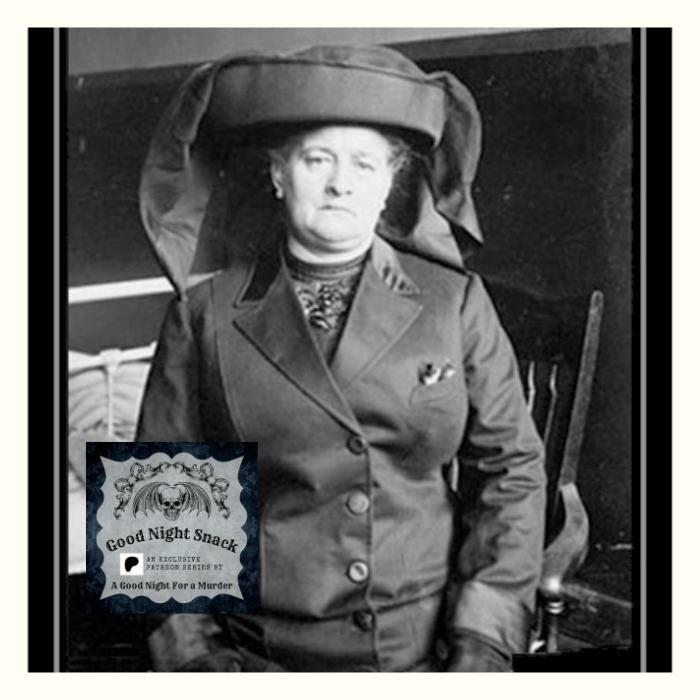
Louise Lindloff, also identified in historical accounts as Louisa Lindloff, was a German-born fortune teller, spiritualist and convicted poisoner whose family was surrounded by an extraordinary succession of deaths during the early twentieth century. She lived first in Milwaukee, Wisconsin, and later in Chicago, Illinois. Although authorities investigated her in connection with numerous suspicious deaths, she was ultimately convicted only of murdering her fifteen-year-old son, Arthur Lindloff.
Lindloff presented herself as a woman who could communicate with spirits, predict future events and see visions inside a crystal ball. After restrictions complicated her fortune-telling business, she reportedly offered forms of spiritual healing and electrical treatment. Her theatrical claims of supernatural knowledge became especially disturbing when witnesses recalled that she had predicted the deaths of relatives shortly before they became fatally ill.
Behind the mystical performances was a repeated financial pattern. Several people who died while living with or being cared for by Lindloff carried insurance policies naming her as beneficiary. Deaths that were originally attributed to sunstroke, fever, heart trouble and other natural causes were reconsidered after Arthur’s death revealed evidence of arsenic poisoning.
The Death of Julius Graunke
Louise’s first husband was Julius Graunke, with whom she operated a saloon and boarding establishment in Milwaukee. On August 12, 1905, Julius died suddenly after an illness that was officially attributed to sunstroke. Because his symptoms occurred during warm weather and his death did not initially appear criminal, no immediate murder investigation followed.
Louise reportedly collected approximately $2,000 in insurance following Julius’s death. Years later, after investigators began examining the deaths surrounding her, his body was exhumed. Chemical testing reportedly discovered arsenic in his remains despite the fact that he had been buried for nearly seven years. The finding caused investigators to reject the earlier assumption that his death had resulted solely from excessive heat.
The Death of Charles Lipschow
Charles Lipschow, a cigar maker who had boarded with the Graunke family in Milwaukee, died around August 28, 1905, approximately two weeks after Julius Graunke. Accounts described Lipschow as a longtime resident of the household and possibly a close companion of Louise. She cared for him during his final illness and maintained payments connected to an insurance benefit from a cigar makers’ organization.
Lindloff collected money following Lipschow’s death, although part of it was used for funeral expenses. Historical reports differ concerning the later laboratory examination of his body. Some reported that arsenic was detected after exhumation, while another account stated that investigators failed to find a conclusive trace. He was nevertheless included among the deaths examined by authorities because of his relationship with Louise, the rapid timing of his death and the financial benefit she received.
The Death of Frieda Graunke
Frieda Graunke, Louise’s twenty-two-year-old daughter, died on January 11, 1908. Her death was originally attributed to fever, with some reports identifying the illness as typhoid fever. As with the other deaths, Frieda’s symptoms did not immediately lead doctors or authorities to suspect deliberate poisoning.
Louise was reportedly the beneficiary of an insurance policy worth approximately $1,350 on Frieda’s life. After Arthur Lindloff’s death brought renewed scrutiny to the family, Frieda’s body was among those considered in the broader poisoning inquiry. Doctors reviewing the circumstances believed the reported symptoms could have been consistent with slow arsenic poisoning rather than an infectious fever.
The Death of John Otto Lindloff
John Otto Lindloff, also identified in contemporary reports as John O. Lindloff or John G. Lindloff, was the brother of Louise’s second husband, William Lindloff. He died in Milwaukee on October 17, 1908. Some later summaries placed his death in 1907, but contemporary reporting associated with the investigation gave the date as October 17, 1908.
John carried an insurance policy reportedly worth approximately $2,000 that benefited his sister-in-law. Following the opening of the Lindloff investigation, his remains were exhumed. Chemists reportedly discovered arsenic in his organs, making his death one of the cases that prosecutors considered especially suspicious. Louise was investigated in connection with the death but was never separately convicted of killing him.
The Death of William Lindloff
After Julius Graunke’s death, Louise married William Lindloff. William died on August 3, 1910, and his death was officially blamed on heart trouble. Witnesses later described Louise as exercising unusually strict control over the treatment given to sick members of her household. According to testimony, she sometimes resisted medicines supplied by physicians and preferred to prepare remedies herself.
William carried insurance valued at approximately $1,025. His body was later exhumed as investigators attempted to determine whether his apparent heart condition had concealed arsenic poisoning. Reports from the investigation indicated that arsenic was found in the remains of more than one deceased member of the Lindloff family. His death contributed heavily to the prosecution’s claim that Louise repeatedly poisoned relatives for insurance proceeds.
The Death of Alma Graunke Lindloff
Alma Graunke Lindloff, Louise’s nineteen-year-old daughter, died on August 4, 1911, one year and one day after William Lindloff’s death. Her death was initially attributed to heart disease, and one account suggested that her condition had been worsened by excessive dancing. The explanation attracted greater suspicion once the sequence of deaths in the family became publicly known.
Alma was reportedly insured for approximately $2,300, with Louise benefiting from the policy. Witnesses later claimed Louise had spoken about Alma’s approaching death before the young woman became fatally ill. Investigators viewed the prediction not as evidence of supernatural ability but as a possible indication that Louise already knew what would happen because she was administering poison.
The Murder of Arthur Lindloff
Arthur Lindloff, Louise’s fifteen-year-old son, became the victim whose death finally brought the suspected poisoning scheme to an end. He died on June 13, 1912, after becoming severely ill at the family residence at 2044 Ogden Avenue in Chicago. His illness included symptoms that physicians recognized as potentially consistent with arsenic poisoning.
Arthur was taken to a hospital despite his mother’s reported objections. Medical personnel notified the Cook County coroner, and a postmortem examination found a substantial quantity of arsenic in his body. Arthur had recently obtained a life insurance policy worth approximately $3,375, with Louise named as beneficiary. Evidence showed that she had taken an active role in obtaining the policy and had allegedly instructed him to misrepresent his age during the application process.
A household employee provided damaging testimony about Arthur’s final illness. She recalled that the boy complained that water his mother gave him tasted or felt “sandy.” Arsenic compounds can leave a gritty residue, and prosecutors argued that the sensation Arthur described was consistent with poison having been mixed into the drink.
Authorities also disputed any suggestion that arsenic had entered Arthur’s body through embalming materials. The undertaker testified that arsenic had not been used on the body. The concentration discovered in Arthur’s liver and kidneys, together with his symptoms and the insurance arrangement, gave prosecutors a far stronger case than they had concerning the earlier deaths.
Suspected Victims and Verified Death Dates
- Julius Graunke — Louise’s first husband; died August 12, 1905, in Milwaukee, Wisconsin. His death was initially attributed to sunstroke. Arsenic was reportedly discovered after his body was exhumed.
- Charles Lipschow — A Milwaukee cigar maker and boarder in the Graunke household; died around August 28, 1905, approximately two weeks after Julius Graunke. Reports conflict over whether later testing conclusively detected arsenic.
- Frieda Graunke — Louise’s twenty-two-year-old daughter; died January 11, 1908, reportedly in Milwaukee, Wisconsin. Her death was originally blamed on fever or typhoid fever.
- John Otto Lindloff — Brother of Louise’s second husband; died October 17, 1908, in Milwaukee, Wisconsin. Arsenic was reportedly detected after his remains were examined.
- William Lindloff — Louise’s second husband; died August 3, 1910. His death was originally attributed to heart trouble.
- Alma Graunke Lindloff — Louise’s nineteen-year-old daughter; died August 4, 1911. Her death was initially attributed to heart disease.
- Arthur Lindloff — Louise’s fifteen-year-old son; died June 13, 1912, in Chicago, Illinois. His autopsy revealed arsenic poisoning, and Louise was convicted of his murder.
Insurance and Financial Motive
Investigators calculated that Louise had received more than $10,000 in life insurance benefits over a period of approximately seven years. Had Arthur’s final policy been paid, the total connected with the deaths would have been considerably higher. The repeated appearance of insurance policies was central to the prosecution’s theory of motive.
Arthur’s policy was particularly damaging because Louise had allegedly arranged it shortly before his death. Investigators also learned that she was nearly penniless when arrested, yet she had been preparing for an expensive trip and had reportedly purchased clothing or a disguise that could help her travel without attracting recognition. Prosecutors suggested that she expected Arthur’s insurance payment to finance her plans.
Claims of Fortune-Telling and Predicted Deaths
Louise’s reputation as a spiritualist gave the case a sensational quality. She claimed to see spirits and communicate with deceased relatives through her crystal ball. Witnesses said she occasionally announced that a family member would die on a particular day or within a particular period, only for the person to fall ill and die close to the predicted time.
Cook County Coroner Peter Hoffman reportedly used her spiritualist beliefs while questioning her. Posing as someone interested in supernatural visions, he looked into her crystal ball and told her that he saw the spirits of her dead husbands, daughters and son accusing her of murder. Louise insisted that the spirits were positioned on the side that signified her innocence. The unusual exchange ended with investigators placing her under arrest.
During her trial, Louise continued to claim that supernatural forces had assured her she would be acquitted. Prosecutors portrayed the predictions as a calculated performance used to intimidate, impress or mislead those around her. They argued that her supposed knowledge of approaching deaths came not from spirits but from her control over the poison being administered.
Evidence of Arsenic Poisoning
Arsenic was an especially dangerous murder weapon during the period because its symptoms could resemble natural disease. Victims might experience stomach distress, weakness, dehydration, heart problems and a gradual decline that could be mistaken for fever or gastrointestinal illness. When administered in repeated small doses, it could produce a prolonged sickness rather than an immediately recognizable poisoning.
Witnesses testified that Louise had an unusual interest in poisons and may have gained knowledge while working around a drugstore. A neighbor claimed she experimented with poisonous substances on dogs, while another account accused her of poisoning chickens. These allegations were used to show that she understood how arsenic acted and had opportunities to test its effects.
The exhumations strengthened the case. Arsenic reportedly remained detectable in the organs of several people long after burial. Prosecutors emphasized that the substance could persist in human remains for years, allowing chemists to uncover evidence that had not been recognized when the victims originally died.
Trial and Conviction
Louise Lindloff went on trial in Cook County for Arthur’s murder in 1912. The state presented medical evidence, insurance records, testimony concerning the gritty water and accounts of the earlier deaths. Prosecutors also introduced evidence that Louise had predicted deaths, interfered with prescribed medical treatment and personally prepared substances for relatives during their illnesses.
Her defense maintained that she was innocent and challenged the reliability of the poisoning evidence. Louise repeatedly denied killing Arthur or anyone else. She claimed that the repeated deaths represented tragic misfortune and that the accusations against her were unjust.
On November 4, 1912, the jury found Louise Lindloff guilty of murdering Arthur. Her punishment was fixed at twenty-five years in the Illinois penitentiary. She reportedly reacted with laughter or a sneer when the verdict was announced, but later collapsed and wept while insisting that there was no justice and that she would eventually prove her innocence.
Suspicions Beyond the Conviction
Police and newspapers connected Louise with as many as eight or nine suspicious deaths. Not every person included in contemporary lists was supported by the same level of evidence. Some bodies produced reported traces of arsenic, while other accusations rested primarily on insurance arrangements, unusual illnesses or the fact that Louise had cared for the person before death.
For this reason, the names commonly associated with the case should be distinguished from legally confirmed victims. Arthur Lindloff was the only person Louise was convicted of murdering. The earlier relatives and associates remained suspected victims, even where exhumation evidence appeared to support the theory that they had also been poisoned.
Death and Legacy
Louise remained imprisoned while her attorneys pursued an appeal. Her health deteriorated dramatically in custody. Contemporary descriptions stated that she lost a great amount of weight, declining from approximately 200 pounds to less than 100 pounds.
She died in the Cook County Jail on March 15, 1914, before the legal process produced any broader reckoning for the other suspected deaths. Her death prevented prosecutors from pursuing additional trials that might have clarified the cases of Julius Graunke, Frieda Graunke, William Lindloff, Alma Graunke Lindloff, John Otto Lindloff and the other people associated with her household.
The Lindloff case remains notable because it combined calculated insurance fraud, arsenic poisoning and an elaborate public identity built around fortune-telling. Behind claims of spirits and prophetic visions was a series of family deaths that repeatedly left Louise with financial benefits. Although the full number of her victims was never established in court, the murder of Arthur and the arsenic reportedly discovered in other exhumed remains created a powerful historical picture of a poisoner who concealed violence behind illness, superstition and supposed communication with the dead.