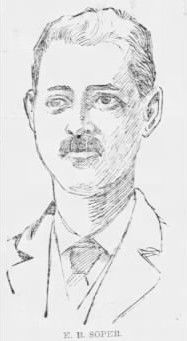
Edward Bates Soper: Murder, Deception and Flight Across Two States
Early Life and Criminal Behavior
Edward Bates Soper was born on February 7, 1855, near Kearney in Clay County, Missouri. He was the second of eight children born to John Lewis Soper and Sarah Hyatt Estes Soper. Although surviving accounts provide few reliable details about his childhood, his adult life became marked by theft, deception, assumed identities and repeated acts of violence against members of his own family.
As a young man, Soper stole a horse and sold it in Kansas City. He was eventually convicted of horse theft and served approximately two years in prison. His later confessions, however, revealed that his criminal history had already escalated to murder before that imprisonment. Over a period of seventeen years, Soper killed five known victims in Missouri and Oregon. Four of the victims were children, and every confirmed victim was a member of his immediate family.
The Murder of John Lewis Soper
Soper's first known victim was his father, John Lewis Soper. The killing occurred on January 30, 1880, near the Soper family farm approximately four miles south of Kearney, Missouri. Soper reportedly organized a literary society gathering and invited his father to attend. Before John reached the meeting, Edward concealed himself near a feeding lot and waited for him to approach.
When his father came into view, Soper fired several shots, killing him at the scene. He then discarded the revolver in a creek and returned to the gathering, where he behaved as though nothing unusual had happened. His attempt to establish an appearance of normal activity helped divert suspicion away from him.
Another man, Thomas Maib, was convicted on circumstantial evidence and imprisoned for John Soper's murder. Edward Soper did not publicly admit responsibility until years later, after his own arrest for the murders of other family members. His confession established that the wrong man had been punished for a killing Soper had carefully planned and concealed.
Marriage and Life in Archie, Missouri
After serving his sentence for horse theft, Soper married Adelia Hunt, who was commonly called Delia and was also identified in some accounts as Ardela. The couple lived with two young children, Maude and Gillis, on a farm near Archie in Cass County, Missouri. Historical accounts differ over some details concerning the children's exact relationship to Soper, but contemporary and genealogical records identify them as members of the Soper household.
Soper worked as a butcher and maintained the outward appearance of a settled family life. Behind that appearance, disagreements reportedly developed between him and Delia. One frequently repeated account states that tension increased when she became interested in joining a Christian church. Soper, who described himself as a spiritualist, strongly opposed her decision.
The Archie Family Murders
On April 21, 1891, Soper killed Delia and the two children inside their home near Archie. The victims were attacked while they were sleeping or otherwise defenseless. Soper used an axe, striking each victim repeatedly. After committing the murders, he remained at the property long enough to write several letters.
In those letters, Soper attempted to explain his actions by claiming that he could no longer support his family and believed death was preferable to allowing them to live in poverty. His statements did not describe a sudden accident or moment of panic. Instead, they showed that he understood what he had done and was preparing to disappear before the bodies were discovered.
Soper locked the house and left Archie. He reportedly told people that he was leaving because he had discovered an illegal saloon and disapproved of the supposed immorality surrounding it. The explanation gave him time to escape while his wife and children remained inside the closed residence.
Approximately three days later, concerned neighbors forced their way into the house. They found the bodies of Delia, Maude and Gillis. By then, Soper had already fled. Authorities issued a warrant for his arrest, but he successfully avoided capture for approximately six years.
Confusion Over Soper's Supposed Death
In June 1891, fishermen recovered a badly decomposed body from the Missouri River. The dead man was mistakenly identified as Edward Soper. A coroner's inquiry accepted the identification, leading authorities and members of the public to believe that the fugitive had drowned or taken his own life.
The error effectively ended the immediate search for him. Soper was able to travel through other parts of the country and establish a new life. He reportedly passed through Kansas City and the Pacific Northwest before settling in the Portland, Oregon, area.
A New Identity in Oregon
In Oregon, Soper used names including R. S. “Sandy” Soper, Homer Lee and Prentice. He lived in Albina, which later became part of Portland, and worked cleaning railroad cars for the Pullman Company. To those around him, he appeared to be an ordinary laborer rather than a Missouri fugitive accused of murdering his wife and two children.
Soper married Catharina Henriette Bronleewe, whose surname was rendered in several different ways in historical newspaper reports. The couple had a son named Gillis. For several years, Soper concealed the truth about his former life, his abandoned Missouri identity and the three bodies discovered in the Archie farmhouse.
The Murder of Two-Year-Old Gillis Soper
On April 16, 1897, Soper left the family's Oregon home with his two-year-old son, Gillis. He reportedly told his wife that he was taking the child to see a shoemaker. Neither father nor son returned.
Soper later sent Catharina a letter stating that Gillis had been placed somewhere he would receive good care. The statement was false. Soper subsequently admitted that he had taken the child to the Willamette River, thrown him into the water and allowed him to drown. He then recovered the body and concealed it in a shallow burial place near the family property.
The child's disappearance prompted Catharina to seek information about her husband and son. Public notices concerning the missing pair eventually reached Missouri officials. The name Soper attracted the attention of Kansas City police officer Sam E. Lowe, who recognized a possible connection to the Archie murders and the fugitive who had supposedly died six years earlier.
The Manhunt and Arrest
After leaving Portland, Soper used the alias Homer Lee and obtained work as a farmhand near Ashland, Oregon. Officer Lowe traveled west and traced him to the farm. Soper was arrested on June 10, 1897. His capture proved that the body recovered from the Missouri River in 1891 had been misidentified.
During the journey back toward Missouri, Soper admitted killing Delia, Maude and the first Gillis in Archie. He also confessed to murdering his young Oregon son. He initially denied responsibility for his father's death but later acknowledged that he had shot John Lewis Soper in 1880.
Authorities asked Soper to identify the location where he had concealed his son's body. His directions led investigators to the remains of two-year-old Gillis. The child had died on April 16, 1897, although his body was not recovered and buried until several weeks later.
Confirmed Victims
- John Lewis Soper — Killed on January 30, 1880, near Kearney in Clay County, Missouri. He was Edward Soper's father and was shot several times after being lured toward a literary society meeting.
- Adelia “Delia” Hunt Soper — Killed on April 21, 1891, at the family farm near Archie in Cass County, Missouri. She was attacked with an axe inside the residence.
- Maude Soper — Killed on April 21, 1891, near Archie, Missouri. Maude was approximately six years old and was murdered inside the family home.
- Gillis Soper — Killed on April 21, 1891, near Archie, Missouri. The child was approximately three years old and was murdered during the same attack that killed Delia and Maude.
- Gillis Soper — Killed on April 16, 1897, in the Portland, Oregon, area. Soper's two-year-old son was drowned in the Willamette River and later buried near the family's residence.
Possible Additional Suspicion
Some family accounts later raised suspicion about the 1887 death of Soper's brother, Samuel Soper. Samuel reportedly became violently ill and died after Edward, who had worked around medicines, brought him a special prescription. The death was attributed to malaria, and Edward Soper was never charged with causing it. Because the allegation was never proven, Samuel is not included among Soper's five confirmed victims.
Trial and Insanity Defense
Missouri authorities extradited Soper to Cass County, where he was prosecuted for the murder of his wife. The state did not need to try every admitted killing to obtain a death sentence. The evidence concerning the Archie farmhouse, Soper's letters, his prolonged flight and his confessions gave prosecutors a strong case.
Soper pleaded insanity. Members of his family testified in an effort to support the defense, but the jury rejected the claim. In December 1897, he was convicted of first-degree murder and sentenced to death. His attorneys appealed to the Supreme Court of Missouri, arguing that errors had affected the proceedings, but the conviction and sentence were upheld.
Execution
Edward Bates Soper was executed by hanging on March 30, 1899, in Harrisonville, Missouri. Approximately forty official witnesses were present. Before the execution, he ate a substantial final meal and declined religious assistance.
When given an opportunity to make a final statement, Soper reportedly said only, “All is done.” The trap was released early that morning, and an examination determined that his neck had been broken by the fall. He was forty-four years old.
Legacy of the Case
Soper's crimes combined patricide, familicide and child murder with years of calculated evasion. He repeatedly targeted people who trusted him most, then used letters, false explanations and assumed names to delay discovery or escape responsibility. His ability to disappear was aided by the mistaken identification of a body recovered from the Missouri River.
The case also exposed the consequences of weak identification methods in the nineteenth century. Because officials accepted the unidentified river victim as Soper, a man wanted for three murders was able to create another household more than a thousand miles away. That mistake placed a second wife and another child in danger and allowed Soper's final confirmed murder to occur in Oregon.
Edward Bates Soper ultimately confessed to five murders committed between January 30, 1880, and April 16, 1897. His victims included his father, his wife and three young children. Although he was formally executed for only one of the Archie murders, his confessions and the recovery of his Oregon son's body established the broader pattern that led to his classification as an American serial killer.