Mose Gibson: Crimes, Victims, and a Contested Murder Record
Who Was Mose Gibson?
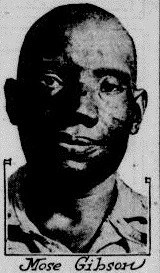
Mose Gibson was a Louisiana-born burglar and convicted murderer whose name became connected to a series of violent killings across the United States during the early twentieth century. Born around 1883, Gibson spent much of his adult life moving between states, committing burglaries and serving or escaping from prison sentences. After his arrest in 1920 for the murder of California rancher Roy G. Trapp, Gibson confessed to several earlier killings in Louisiana, Florida, and Arizona. Newspapers consequently portrayed him as a wandering serial killer who murdered people while robbing their homes or businesses. The surviving historical record, however, is complicated. Some of Gibson's confessions matched real unsolved murders, while other details were inconsistent, and evidence in at least one case reportedly contradicted his involvement.
Victims and Related Attacks
- Joseph Isadore Rivet, also reported as J. R. Rivet, Reavis, Revis, or similar spellings December 24-25, 1908 Addis, West Baton Rouge Parish, Louisiana. Rivet was a restaurant keeper who was found dead around Christmas morning after suffering severe blows from a heavy or sharp-edged object. His property had been disturbed and a trunk associated with the robbery was reportedly found in a nearby field. Historical sources disagree by one day on the date: some place the killing on December 24, while contemporary summaries of Gibson's later confession dated it December 25. Gibson was not identified as the killer until years afterward, and another man had previously been suspected.
- Unidentified sugar-mill night watchman November 1910 Gramercy, St. James Parish, Louisiana. Gibson later claimed that he killed a watchman at a sugar mill while committing a robbery. Contemporary reports recorded the month and location but did not preserve a reliable name or exact day of death. Because the surviving documentation is sparse, this killing is considerably less certain than the Trapp case.
- Unidentified storekeeper November 1910 reported as "Wagoner, Louisiana." Gibson's confession was also said to include the killing of a storekeeper at a Louisiana location newspapers called Wagoner. An exact date was not recorded beyond November 1910. Later researchers have had difficulty identifying a Louisiana community matching the reported place name or finding a clearly corresponding murder, making this one of the most questionable crimes attributed to Gibson.
- Susan B. Clark November 11, 1919 Orange City, Volusia County, Florida. Clark, an elderly grocery-store proprietor, lived in rooms above her business. On the night of November 11 she was attacked and killed, and her living quarters were ransacked. Contemporary accounts described evidence of a violent struggle and an apparent search for money or valuables. Gibson was later connected to Clark's death through confession, although his first description placed a murdered woman at nearby Orange City Junction rather than Orange City itself. That discrepancy caused local officials and residents to question whether he actually knew the crime firsthand.
- Laura A. Marshall attacked November 11, 1919 Orange City Junction, Florida survived. Marshall was attacked, beaten, tied up, and robbed on the same night Susan Clark was murdered nearby. She survived. The existence of these two separate incidents may help explain why parts of Gibson's later confession appeared to mix the locations and circumstances of the Clark murder and the Marshall assault.
- Jacob Erhardt and Mrs. Erhardt night of June 6 into early June 7, 1920 Phoenix, Arizona. The elderly couple were beaten to death in their Phoenix home during what appeared to be a burglary or robbery. Sources differ slightly in dating the deaths: many accounts place the murders on the night of June 6, while some contemporary summaries of Gibson's confession list June 7. The most accurate description is that the attack occurred overnight between those dates. Gibson later confessed to the double killing, but his responsibility has long been questioned because fingerprints reportedly recovered from the crime scene did not match him and another suspect had already become involved in the investigation.
- Roy G. Trapp July 15, 1920 Fullerton, Orange County, California. Trapp, a prosperous rancher, was killed during a nighttime invasion of his home. Reports described him as being struck with a heavy implement, variously identified as a miner's pick, hammer, or similar tool. His wife was also brutally beaten and sexually assaulted but survived. Unlike several of the older crimes later attributed to Gibson, the Trapp murder immediately produced a manhunt, Gibson's arrest, a confession, and the conviction that resulted in his execution.
- Mrs. Roy Trapp attacked July 15, 1920 Fullerton, California survived. Trapp's wife was struck until unconscious and sexually assaulted during the same home invasion in which her husband was killed. Her survival made the Fullerton attack different from several murders Gibson later claimed, and information gathered after the crime helped authorities reconstruct the attack and pursue the fleeing suspect.
...
MEMBER ACCESSContinue reading the complete profile
Unlock the full profile for Mose Gibson, complete victim information, available sources, videos, and member discussions.
Unlock Full Access — $3.97/month Already a member? Log in