Mattie Troy Thomas: The Kansas Insurance Poisoner
Background
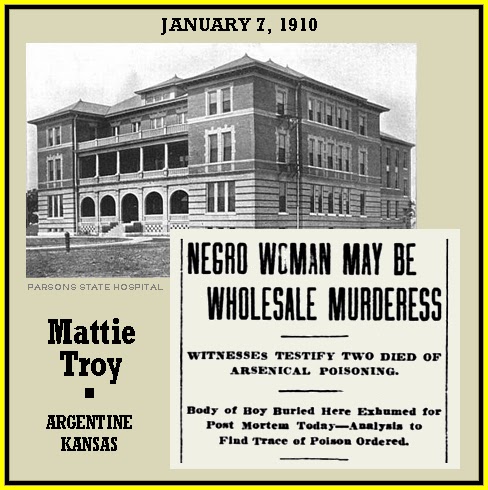
Mattie Troy Thomas, more commonly identified in contemporary newspaper accounts as Mattie Troy or Mary Troy, was an early twentieth-century suspected serial poisoner associated with Kansas City, Kansas, and Topeka, Kansas. She reportedly lived in the Argentine district of Kansas City and was married at different times to men whose families could potentially be insured for her financial benefit. Historical descriptions portrayed her as an imposing woman who weighed approximately 300 pounds, but surviving records provide little reliable information about her childhood, birth date, or early family life.
Thomas became notorious for an alleged scheme involving vulnerable children, assumed identities, fraudulent life-insurance policies, and arsenic. Rather than attacking strangers impulsively, she was accused of selecting people whose deaths could be converted into insurance payments. Children were particularly useful to the scheme because she could present them as sons, daughters, or stepchildren, obtain policies under false names, and then take them away from relatives who might otherwise recognize the deception.
The Death of Jessie Watson
One of the earliest deaths later connected to Thomas was that of Jessie Watson, a 12-year-old Black girl living in Kansas City, Missouri. Jessie died on April 24, 1909, at 621 Holmes Street. Her officially recorded cause of death was meningitis, and she was buried the following day. Years later, historical researchers examining Thomas’s activities identified Jessie as a possible earlier victim.
The precise evidence connecting Thomas to Jessie’s death remains incomplete. No surviving record establishes that arsenic was detected in Jessie’s body, and the child’s recorded death from meningitis was not formally replaced by a homicide ruling. Nevertheless, researchers found Jessie’s name while investigating reports that Thomas had insured children, presented them as relatives, and profited when they died. Jessie is therefore generally treated as a suspected victim rather than a judicially confirmed murder victim.
The Luring of David Marshall
The case that exposed Thomas involved David Marshall, a 16-year-old orphan who lived with his grandparents and an uncle in Kansas City, Kansas. David was described as an intelligent student who had completed, or was close to completing, high school. In late October 1909, Thomas persuaded him to leave with her by promising additional schooling, clothing, money, and improved opportunities.
Thomas allegedly told David’s relatives that she intended to take him to Chicago. Instead, she transported him to Topeka with a young girl whose identity and eventual fate have never been conclusively established. Thomas registered at the Washam Hotel and represented the children as her stepchildren. David was falsely identified as “Willard Troy,” the name of Thomas’s actual stepson.
According to the subsequent investigation, Thomas administered arsenic to David while they were in Topeka. He became seriously ill and died on November 6, 1909. Thomas continued the deception after his death, allowing him to be buried under the false name Willard Troy in Shawnee County. She then attempted to collect approximately $550 from a Metropolitan Life Insurance policy issued on the person she claimed had died.
The Insurance Fraud Is Discovered
The scheme began to collapse when an insurance-company employee investigated the claim and discovered that the real Willard Troy was alive and living in Illinois. The company’s finding meant that the body buried in Topeka could not have been the insured stepson identified by Thomas. Authorities arrested her on suspicion of fraudulently attempting to obtain insurance money.
Investigators then worked to determine the dead boy’s true identity. David Marshall’s relatives eventually identified him, and his body was exhumed in January 1910 after approximately two and a half months in the ground. Dr. Frank Dains, a chemistry professor associated with Washburn College, examined samples from the remains. On January 27, 1910, he testified before a coroner’s jury that arsenic had been found and that the poison had caused David’s death.
The discovery transformed what had initially appeared to be an insurance-fraud investigation into a murder case. Thomas was charged with first-degree murder in David Marshall’s death and with obtaining money under false pretenses. The circumstances indicated preparation rather than an accidental poisoning: David had been lured away from his family, given another person’s name, insured under that identity, poisoned in a city away from home, and buried before Thomas attempted to collect the policy.
Suspected Pattern of Insurance Murders
Once David’s identity and cause of death became known, investigators began examining other deaths associated with Thomas. Reports suggested that she had married several men, particularly men with children, and encouraged them to purchase life-insurance policies naming her as beneficiary. She was suspected of using marriages and claimed family relationships to gain access to people whose deaths could produce financial payments.
Only weeks after David’s death, Thomas reportedly married another man in December 1909. The man had several children, and Thomas allegedly pressured him to obtain insurance on himself and the children for her benefit. Her arrest prevented investigators from learning whether she intended to poison members of this family or whether the demands for insurance were merely part of a broader financial scheme.
Authorities and later researchers also suspected that one or more of Thomas’s husbands, children, stepchildren, or other dependents might have died under suspicious circumstances. Some historical accounts have placed her possible victim count between three and seven or more. However, most of those suspected victims have never been reliably identified, and no complete collection of death certificates, insurance records, autopsies, or court findings has survived to confirm the full number.
Known and Suspected Victims
- Jessie Watson — April 24, 1909 — Kansas City, Missouri: Jessie was a 12-year-old girl who died at 621 Holmes Street. Her recorded cause of death was meningitis, and she was buried on April 25, 1909. Historical researchers later identified her as a suspected victim of Thomas, but the poisoning allegation was never conclusively established through an autopsy or criminal judgment.
- David Marshall — November 6, 1909 — Topeka, Kansas: David was a 16-year-old orphan from Kansas City, Kansas. Thomas allegedly lured him away by promising education, clothing, and financial assistance. She registered him at the Washam Hotel as her stepson “Willard Troy,” poisoned him with arsenic, buried him under the false name, and attempted to collect a $550 insurance policy. His exhumed remains tested positive for arsenic, and Thomas was charged with his murder.
- Unidentified young girl — November 1909 — Topeka, Kansas: A girl reportedly traveled with Thomas and David Marshall and was presented as another of Thomas’s stepchildren. Researchers have been unable to establish the child’s name, what happened to her, or whether she survived. She remains a possible victim because she was exposed to the same circumstances that preceded David’s poisoning.
- Unidentified husbands, children, or stepchildren — Kansas and possibly Missouri: Investigators suspected Thomas of involvement in additional deaths connected to insurance policies. The names, dates, locations, and causes of these deaths have not been conclusively documented, preventing them from being listed as confirmed victims.
Mental Competency and Commitment
Thomas did not receive a conventional murder trial resulting in a verdict for David Marshall’s death. During the legal proceedings, she was evaluated and declared insane. She was consequently committed to the Kansas State Hospital in Topeka rather than tried and sentenced in an ordinary criminal court.
The insanity finding left the murder accusation legally unresolved. Although the arsenic evidence, false identity, insurance policy, and attempt to collect the proceeds created a strong circumstantial case, Thomas was never convicted of David’s murder. This distinction is important because descriptions of her as a serial killer are based on historical investigations and suspected patterns rather than multiple murder convictions.
Escape From the State Hospital
On or shortly before January 3, 1911, Thomas escaped from the state hospital. Newspaper reports stated that officials believed she might have reached Topeka by streetcar and was hiding somewhere in the city. Hospital personnel and law-enforcement officers searched for her, emphasizing the danger and embarrassment created by the disappearance of a woman who had been charged with poisoning a child.
The surviving public record does not clearly establish how long Thomas remained free, whether she was quickly recaptured, or what ultimately happened to her. Her date and place of death are unknown. The lack of a completed trial, a readily available institutional file, and a documented final disposition has left large portions of her life unresolved.
Modus Operandi
Thomas’s alleged method depended on social manipulation as much as poison. She first gained control over a victim by marriage, guardianship, persuasion, or a promise of a better life. She then created a false family relationship that allowed her to purchase insurance or present herself as the lawful beneficiary. Moving the victim away from familiar relatives reduced the possibility that someone would expose the assumed identity.
Arsenic was well suited to such a crime in the early 1900s. Symptoms could resemble severe gastrointestinal disease or other natural illnesses, particularly when attending physicians had no reason to suspect poisoning. Unless a body was exhumed and chemically analyzed, an arsenic death could be recorded as disease and followed by a routine burial. In David Marshall’s case, the insurance clerk’s discovery of the living Willard Troy prompted the investigation that Thomas had apparently hoped to avoid.
Historical Assessment
Mattie Troy Thomas occupies an uncertain place in American criminal history. The death of David Marshall contains the strongest evidence of intentional murder: he was deceived, removed from his home, assigned a false identity, insured, poisoned with arsenic, and buried under another child’s name. The attempted collection of the policy provided an apparent financial motive and exposed the organized nature of the scheme.
The other deaths attributed to Thomas are less certain. Jessie Watson may have been another insurance victim, but her official cause of death remained meningitis. The unidentified girl seen with Thomas and David may have survived, disappeared, or died without her connection to Thomas ever being recognized. Allegations involving husbands and children suggest a broader series of poisonings, yet insufficient documentation survives to identify all of them responsibly.
For these reasons, Thomas is best described as an accused poisoner and suspected serial killer whose activities may have claimed several lives between 1909 and 1911. Her case illustrates how fraudulent identities, limited communication between cities, loosely regulated insurance practices, and the difficulty of detecting arsenic could be exploited. It also demonstrates how a single skeptical insurance employee could uncover a deception that ordinary death investigations had failed to recognize.