Henry Howard Holmes: Crimes, Victims, and the Truth Behind the Legend
Early Life and Criminal Career
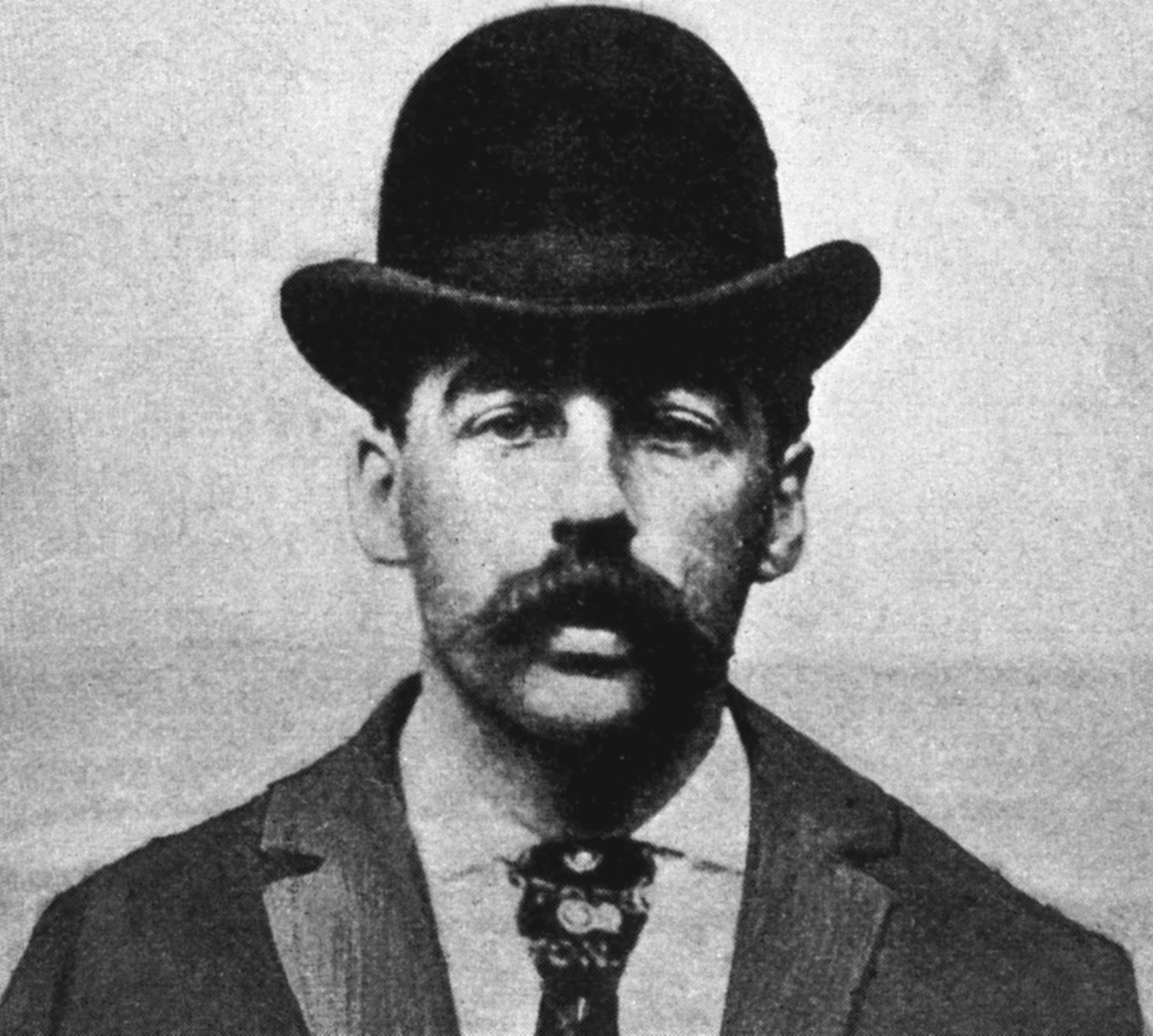
Henry Howard Holmes, more commonly known as H. H. Holmes, was born Herman Webster Mudgett on May 16, 1861, in Gilmanton, New Hampshire. He studied medicine at the University of Michigan and graduated in 1884. His medical education gave him knowledge of human anatomy, poisons, chemicals, and methods of preparing bodies for dissection. It also placed him in an era when medical schools purchased human remains for teaching, sometimes from questionable sources.
After graduating, Mudgett moved frequently, abandoned his first wife, committed fraud, and used several false names. By the time he arrived in Chicago in 1886, he was calling himself Dr. Henry Howard Holmes. He found work at a pharmacy in the Englewood neighborhood and eventually took control of the business. Across the street, at the corner of Wallace and 63rd Streets, he constructed a large mixed-use building that later became known as the “Murder Castle.”
The So-Called Murder Castle
Holmes’s building contained stores on the ground floor, rented rooms above them, and an unfinished third floor that he claimed would become a hotel. Later accounts described confusing passageways, rooms without windows, doors that opened onto walls, concealed staircases, a large walk-in vault, gas connections, trapdoors, and chutes leading toward the basement. Newspapers claimed that Holmes used these features to imprison, suffocate, and dispose of victims.
Some parts of this story are supported by contemporary investigations, but many of the most gruesome descriptions were exaggerated by sensational newspapers. There is no reliable evidence that Holmes killed hundreds of visitors to the 1893 World’s Columbian Exposition. His building was primarily a place for commercial activity, fraud, and rented accommodation. Nevertheless, several women connected to Holmes disappeared, and investigators later found human remains and personal possessions inside or near the property.
Fraud, Manipulation, and Murder
Holmes gained control over people by presenting himself as a respectable doctor, businessman, employer, or romantic partner. He frequently lied about his identity and marital status. He persuaded associates to sign financial documents, transfer property, purchase life insurance, or enter business arrangements that benefited him. Several women who trusted him disappeared after placing money or property under his control.
Holmes later confessed to twenty-seven murders, but the confession was filled with contradictions. Some people he claimed to have killed were still alive, while other alleged victims could not be identified. Modern historical examinations generally connect him convincingly to approximately nine deaths, although he was convicted of only one murder: that of Benjamin Pitezel.
Victims With Verified Death Dates
- Benjamin Freelon Pitezel — September 4, 1894 — 1316 Callowhill Street, Philadelphia, Pennsylvania: Pitezel was a carpenter, inventor, and longtime criminal associate of Holmes. The two planned to defraud the Fidelity Mutual Life Association of $10,000. Pitezel was supposed to pretend that he had died in an accidental chemical explosion, after which Holmes would provide another body as evidence. Instead, Holmes killed Pitezel and used his real corpse to complete the fraud. Pitezel was found lying on the floor of a rented building, with burns and chemical evidence arranged to suggest an accident. Medical testimony indicated that he had been exposed to chloroform before his body was burned. Holmes was later tried and convicted for this murder.
- Howard Robert Pitezel — October 10, 1894 — Irvington, Indianapolis, Indiana: Howard was one of Benjamin and Carrie Pitezel’s children. After killing Benjamin, Holmes persuaded Carrie that her husband was alive and hiding. He took custody of Howard and his sisters Alice and Nellie, supposedly to reunite them with their father. In Indianapolis, Holmes rented a small house in Irvington. He later admitted that he killed Howard, dismembered the child’s body, and burned the remains in a stove. Detective Frank Geyer traced Holmes’s movements to the house, where investigators recovered burned teeth, fragments of bone, and other evidence associated with Howard.
- Etta Alice Pitezel — October 25, 1894 — 16 St. Vincent Street, Toronto, Ontario, Canada: Alice, usually known by her middle name, was the eldest of the three Pitezel children traveling with Holmes. During the journey, she wrote letters to her mother describing her confusion and concern. Holmes often kept the children only a short distance from their mother while preventing them from meeting. In Toronto, he placed Alice and Nellie inside a large trunk or confined space and connected a gas supply to it. Their bodies were later buried beneath the cellar floor of a rented house. Detective Geyer found their remains on July 15, 1895.
- Nellie Pitezel — October 25, 1894 — 16 St. Vincent Street, Toronto, Ontario, Canada: Nellie was Alice’s younger sister. She was killed alongside Alice after Holmes brought the girls to the rented Toronto house. Investigators found both children buried together in the cellar. Nellie had been born with unusually large feet, and Holmes apparently removed them in an attempt to make identification more difficult. Clothing, hair, teeth, and physical characteristics nevertheless helped authorities identify the sisters.
Other Victims Strongly Associated With Holmes
Several additional people are widely believed to have been murdered by Holmes, but surviving records do not establish exact dates of death with the same certainty as the Pitezel cases. For that reason, precise death dates are not assigned to them here.
- Julia Smythe Conner and her daughter, Pearl Conner — Chicago, Illinois: Julia worked in Holmes’s building and became involved in a relationship with him while married to one of his employees. Julia and Pearl disappeared around Christmas 1891. Holmes later gave conflicting stories about what happened. He claimed at one point that Julia died during an illegal abortion that he performed and that he killed Pearl afterward. A human skeleton believed to have been connected to Julia was reportedly sold to a medical institution, although the identification was never conclusively established.
- Emeline Cigrand — Chicago, Illinois: Cigrand was a young stenographer who began working for Holmes in 1892. She was last known to be alive in December of that year. Holmes reportedly told different people that she had married and moved away. Soon afterward, a carefully prepared female skeleton was sold to a medical school. Investigators suspected that the remains were Cigrand’s, but the available evidence did not produce a legally certain identification.
- Minnie R. Williams — Chicago, Illinois: Minnie was a former actress and property owner who became romantically involved with Holmes. In 1893, Holmes persuaded her to transfer valuable property in Fort Worth, Texas, to a business controlled by him. She disappeared after spending time in Chicago during the World’s Columbian Exposition. Holmes later used her name and property in additional fraudulent transactions.
- Nannie Williams — Chicago, Illinois: Nannie was Minnie Williams’s sister. She visited Chicago in 1893 and also disappeared. Holmes claimed in one version of his confession that he killed Nannie after striking her during an argument. Investigators suspected that both sisters died inside the Englewood building, but neither woman’s body was conclusively recovered or identified.
The Pitezel Insurance Scheme
The murder of Benjamin Pitezel became the central case against Holmes because it produced physical evidence, insurance documents, witnesses, and a clearly identified body. After Pitezel’s death, Holmes arranged for Carrie Pitezel to receive the insurance payment. He then took most of the money as his supposed fee. He continued deceiving Carrie by telling her that Benjamin was still alive.
Holmes traveled through several cities while keeping Carrie and some of her children separated from Alice, Nellie, and Howard. At times, the two groups stayed in the same city without knowing how close they were to each other. Holmes maintained control by delivering false messages, inventing travel plans, and promising an eventual family reunion. Instead, he killed the three children, apparently because they knew too much about their father’s death and the insurance scheme.
Investigation and Arrest
Holmes’s plans began to collapse after he cheated another criminal associate, Marion Hedgepeth, out of a promised payment. Hedgepeth informed authorities about the insurance fraud. The Pinkerton National Detective Agency followed Holmes’s movements, and he was arrested in Boston on November 17, 1894. He was initially held in connection with an outstanding horse-theft accusation and the Pitezel fraud.
Philadelphia detective Frank Geyer was assigned to locate the missing Pitezel children. Using hotel records, letters, rental agreements, witness statements, and travel information, Geyer reconstructed Holmes’s journey through the United States and Canada. His investigation led first to the bodies of Alice and Nellie in Toronto and later to evidence of Howard’s death in Indianapolis. The discoveries transformed Holmes from a suspected fraudster into one of the most notorious murderers in the country.
Trial, Conviction, and Execution
Holmes went on trial in Philadelphia on October 28, 1895, for the murder of Benjamin Pitezel. Prosecutors demonstrated that the supposed accidental death had been deliberately staged and that Holmes had benefited financially from it. The jury found him guilty of first-degree murder on November 2, 1895. He was sentenced to death.
While awaiting execution, Holmes sold different versions of his life story to newspapers. In one confession, he claimed responsibility for twenty-seven deaths. The account was unreliable because several supposed victims were alive, certain names appeared to be invented, and Holmes repeatedly altered important details. His statements seemed designed to attract attention, earn money, confuse investigators, or increase his frightening reputation.
H. H. Holmes was executed by hanging at Moyamensing Prison in Philadelphia on May 7, 1896. He was thirty-four years old. At his request, his coffin was filled with cement and buried deeply, supposedly because he feared that grave robbers would steal and dissect his body. His remains were buried at Holy Cross Cemetery in Yeadon, Pennsylvania.
Legacy and Historical Uncertainty
Holmes is often called America’s first serial killer, although murderers who killed multiple victims operated in the United States before him. His lasting notoriety comes from the combination of confirmed killings, insurance fraud, missing women, the deaths of three children, his unusual Chicago building, and the dramatic newspaper coverage surrounding his case.
The frequently repeated claim that Holmes killed as many as two hundred people is not supported by reliable evidence. It developed from speculation about missing World’s Fair visitors and sensational stories about the Murder Castle. The strongest historical evidence connects Holmes to Benjamin Pitezel, the three Pitezel children, Julia and Pearl Conner, Emeline Cigrand, and Minnie and Nannie Williams. Even within that group, only some deaths were supported by recovered bodies and exact dates.
Holmes was dangerous not because every legend about him was true, but because he combined intelligence, medical training, charm, financial deception, and a willingness to kill people who trusted him. His crimes reveal a pattern of calculated manipulation rather than the enormous, mechanically operated murder factory later portrayed in popular culture. The verified deaths of Benjamin, Howard, Alice, and Nellie Pitezel remain the clearest record of his brutality and the human cost of his schemes.