Edmund Emil Kemper: The “Co-ed Killer”
Early Life and Escalating Violence
Edmund Emil Kemper III was born on December 18, 1948, in Burbank, California. He became one of the most notorious American serial killers of the twentieth century, eventually admitting responsibility for ten murders committed between 1964 and 1973. Exceptionally tall and physically imposing, Kemper stood approximately six feet nine inches and possessed above-average intelligence. These qualities contrasted sharply with the friendly, articulate personality he displayed to acquaintances, police officers and many of the young women who entered his vehicle.
Kemper described an unhappy childhood dominated by conflict with his mother, Clarnell Elizabeth Strandberg. After his parents separated, he spent periods living with different relatives before being sent to his paternal grandparents’ ranch near North Fork, California. On August 27, 1964, when he was 15 years old, Kemper shot and killed his grandmother following an argument in the kitchen. When his grandfather returned home, Kemper shot him as well. Kemper later claimed that he killed his grandfather so the older man would not have to discover his wife’s body.
Following the murders, Kemper telephoned his mother and then contacted authorities. He was found legally insane and committed to Atascadero State Hospital, a secure psychiatric institution in California. While confined, he learned how psychiatric examinations were conducted and reportedly assisted staff members with psychological testing. Hospital officials eventually concluded that he had improved sufficiently to be released. He left the institution in December 1969 at the age of 21 and was placed in his mother’s care, despite warnings that their deeply troubled relationship could create further danger.
The Beginning of the “Co-ed Killer” Murders
After his release, Kemper lived in the Santa Cruz County area and attempted to establish an ordinary adult life. He worked at several jobs and spent time in bars frequented by local police officers. Because he appeared intelligent, cooperative and interested in law enforcement, officers sometimes spoke openly around him about criminal investigations. Kemper became familiar with police procedures while carefully concealing his own violent fantasies.
During the early 1970s, hitchhiking was common among students attending colleges in and around Santa Cruz. Kemper initially picked up young women without harming them, using these encounters to study their behavior and determine how easily he could gain their trust. He later began carrying weapons and restraints in his vehicle. His large size could have appeared threatening, but he often presented himself as polite, calm and helpful until his passengers were isolated.
On May 7, 1972, Kemper picked up Fresno State students Mary Ann Pesce and Anita Luchessa as they were hitchhiking. Instead of taking them to their intended destination, he drove them to an isolated area near Alameda, California. He murdered both women and transported their bodies back to his residence, where he dismembered them. Their remains were later abandoned in separate locations in the Santa Cruz Mountains and along California’s coastline.
Continued Murders in Santa Cruz County
Kemper’s next known victim was 15-year-old Aiko Koo. On September 14, 1972, Koo missed her bus while traveling to a dance class in San Francisco and began hitchhiking. Kemper offered her a ride but drove her to a secluded location instead. He killed her and placed her body in the trunk of his car. During the encounter, Kemper accidentally locked himself out of the vehicle, but Koo unlocked the door after he persuaded her that he would not harm her. He then overpowered and murdered her.
On January 8, 1973, Kemper encountered 18-year-old Cynthia Ann “Cindy” Schall near Cabrillo College in Aptos. He offered her a ride and killed her after driving to an isolated area. He transported her body to his mother’s home and concealed it in his room before dismembering it. Parts of Schall’s remains were later thrown from a cliff near the Pacific Ocean. Other remains were buried on or near property associated with Kemper’s mother.
By this stage, Kemper had learned that appearing cooperative and unremarkable could protect him from suspicion. He continued associating casually with police officers while listening to discussions about the unsolved murders. His familiarity with investigative techniques helped him avoid leaving obvious connections among the crime scenes. The scattered condition of the victims’ remains also made identification and reconstruction of the crimes more difficult.
On February 5, 1973, Kemper picked up two students, 23-year-old Rosalind Heather Thorpe and 20-year-old Alice Helen Liu, near the University of California, Santa Cruz. Thorpe entered his car first, and Liu accepted the ride after seeing another young woman inside. Kemper shot both victims and transported their bodies away from the area. He later disposed of their remains in locations around California, including near the coastal community of Eden Canyon in Alameda County.
The Murder of His Mother and Sally Hallett
Kemper’s relationship with his mother remained intensely hostile throughout the killing period. They lived together in Aptos, where their arguments reportedly became increasingly bitter. During the early morning hours of April 21, 1973, Kemper entered his mother’s bedroom while she slept and killed her with a hammer. He then cut her throat and decapitated her. The murder was the culmination of years of resentment that Kemper repeatedly connected to his hostility toward women.
After killing his mother, Kemper telephoned her friend, 59-year-old Sara Taylor “Sally” Hallett, and invited her to the house. He told Hallett that his mother wanted her to come over for dinner. When Hallett arrived, Kemper strangled her and left her body inside the residence. He attempted to create the impression that the two women had gone away together before fleeing California in his car.
Known Victims
- Maude Matilda Hughey Kemper – Kemper’s paternal grandmother, killed on August 27, 1964, at the family ranch near North Fork in Madera County, California. Kemper shot her following an argument inside the house.
- Edmund Emil Kemper Sr. – Kemper’s paternal grandfather, killed on August 27, 1964, near North Fork, California. Kemper shot him after he returned home from shopping.
- Mary Ann Pesce – An 18-year-old Fresno State student killed on May 7, 1972, after she and Anita Luchessa accepted a ride from Kemper. They were taken to an isolated area near Alameda, California.
- Anita Mary Luchessa – An 18-year-old Fresno State student killed on May 7, 1972, with Mary Ann Pesce near Alameda, California. Portions of the women’s remains were later recovered in the Santa Cruz Mountains and along the coast.
- Aiko Koo – A 15-year-old student killed on September 14, 1972, after hitchhiking while traveling to a dance class. Kemper abducted her in the San Francisco Bay Area and later transported her body to his residence.
- Cynthia Ann “Cindy” Schall – An 18-year-old Cabrillo College student killed on January 8, 1973, after being picked up near Aptos, California. Her dismembered remains were discarded in several locations, including along the Pacific coast.
- Rosalind Heather Thorpe – A 23-year-old University of California, Santa Cruz student killed on February 5, 1973. Kemper picked her up near the university before shooting her inside his vehicle.
- Alice Helen Liu – A 20-year-old University of California, Santa Cruz student killed on February 5, 1973, with Rosalind Thorpe. Their remains were later discarded in areas outside Santa Cruz County.
- Clarnell Elizabeth Strandberg – Kemper’s 52-year-old mother, killed during the early morning hours of April 21, 1973, at her home in Aptos, California.
- Sara Taylor “Sally” Hallett – A 59-year-old friend of Kemper’s mother, killed on April 21, 1973, after Kemper lured her to the Strandberg residence in Aptos.
Confession and Arrest
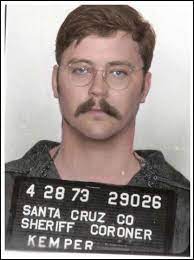
After killing Strandberg and Hallett, Kemper drove east through Nevada and continued to Pueblo, Colorado. He listened to radio reports during the trip and became frustrated when the authorities did not immediately identify him as the killer. From a telephone booth in Pueblo on April 23, 1973, he called the Santa Cruz Police Department and confessed. The officer who initially answered knew Kemper socially and had difficulty believing him. Kemper insisted that investigators search his mother’s home and supplied details that demonstrated his knowledge of the murders.
Colorado authorities arrested Kemper without resistance. He provided an extensive confession after being returned to California, describing the murders, the locations where remains had been abandoned and the methods he had used to approach his victims. Investigators were able to connect his statements with physical evidence and previously unidentified remains. His confession ended the search for the person responsible for the series of disappearances and killings involving young women in the Santa Cruz area.
Trial, Conviction and Imprisonment
Kemper was charged with eight counts of first-degree murder for the killings committed between May 1972 and April 1973. The deaths of his grandparents had already been handled through the juvenile psychiatric system. At his 1973 trial, Kemper entered a plea of not guilty by reason of insanity. Court-appointed psychiatrists examined him, but the prosecution maintained that he understood the nature of his actions, planned the murders and deliberately attempted to avoid detection.
On November 8, 1973, a jury found Kemper legally sane and guilty of eight counts of first-degree murder. Because California’s death penalty was not in effect at the time, he received eight concurrent life sentences. He was eventually transferred to the California Medical Facility in Vacaville, where he has remained incarcerated for decades.
While imprisoned, Kemper participated in programs that recorded books for blind and visually impaired listeners. His institutional behavior was often described as cooperative, but parole officials repeatedly concluded that the calculated nature and extreme severity of his crimes made his release unsafe. He was denied parole again in July 2024, and his next parole hearing was scheduled for 2031.
Legacy of the Case
Edmund Kemper’s crimes became particularly disturbing to investigators because of the contrast between his outward personality and his private behavior. He could speak calmly, demonstrate insight into psychology and maintain friendly relationships while secretly committing carefully planned murders. His knowledge of psychiatric testing and police procedures allowed him to manipulate professionals and avoid suspicion until he chose to confess.
Kemper was later interviewed by criminal-behavior researchers studying patterns among serial offenders. His detailed accounts contributed to the development of investigative ideas concerning victim selection, manipulation, fantasy, escalation and post-crime behavior. However, those interviews also demonstrated how an intelligent offender could shape the story of his own crimes, making it necessary to distinguish verified evidence from his explanations and self-serving claims.
The ten confirmed deaths associated with Kemper began with the murder of his grandparents when he was 15 and ended with the killing of his mother and her friend in April 1973. Between those events, six young women and girls were abducted and murdered after encountering him on California roads. The case remains a grim example of institutional failure, predatory deception and the devastating consequences of releasing a violent offender whose apparent rehabilitation concealed continuing homicidal fantasies.