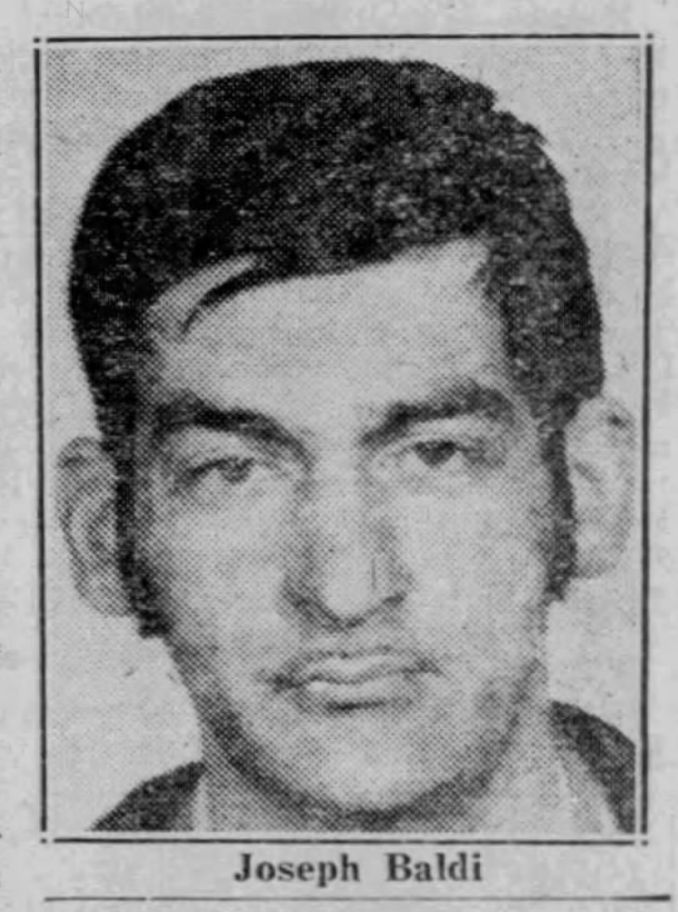
Joseph Baldi: The Queens Creeper
Early Life and Criminal Background
Joseph Baldi was born on January 16, 1941, in Richmond Hill, Queens, New York. He became known as "The Queens Creeper" and "The Monster of Queens" after a series of nighttime attacks on women and girls in Queens during the early 1970s. Baldi's crimes followed a disturbing pattern: he prowled residential neighborhoods late at night or during the early morning hours, entered ground-floor homes or apartments through windows, and attacked women while they were sleeping.
Baldi had a history of burglary and psychiatric hospitalization years before the murders that eventually made him notorious. Beginning in the early 1960s, he spent extended periods at Creedmoor State Hospital in Queens, where he received psychiatric treatment. He also learned carpentry while institutionalized. His later criminal proceedings would repeatedly involve questions about his mental competency, his ability to understand court proceedings, and whether he was legally responsible for his actions.
What made the Baldi case particularly controversial was not only the number of women attacked, but the fact that he was released from psychiatric confinement while criminal charges were still pending against him. Three of the four homicides attributed to him occurred after that release.
The Murder of Areti Koularmanis
Baldi's first identified murder occurred on September 20, 1970, in Jamaica, Queens. Twenty-three-year-old Areti Koularmanis was visiting New York from Canada with her husband and their children. The family was staying with relatives in a ground-floor residence on 88th Avenue.
During the early morning hours, an intruder entered through a window and encountered Koularmanis in the bedroom. She was stabbed in the throat. Despite being severely wounded, Koularmanis was able to reach her husband. She was rushed to Mary Immaculate Hospital but died from her injuries.
The killer escaped, and the murder initially remained unsolved. The circumstances surrounding the intrusion were consistent with Baldi's established habit of entering residences through windows. The killing would not be publicly connected to him until after his arrest nearly two years later.
The 1971 Arrest and Attempted Murder of a Police Officer
During the early morning hours of September 5, 1971, police responded to a report of a prowler in the Woodhaven section of Queens. Officers John Hamberger and Frank Mobileo encountered Baldi walking in the area at approximately 5:00 a.m. When Officer Hamberger asked Baldi for identification, Baldi reached toward his clothing and produced a pistol.
Baldi pointed the weapon toward Hamberger's chest and pulled the trigger. The gun misfired. The officers immediately struggled with Baldi, disarmed him and placed him under arrest. The pistol contained live ammunition and was capable of firing.
Police also discovered identification and automobile documents belonging to a nearby woman, Anne Heeseman. Investigators learned that her handbag had disappeared from inside her residence after someone opened a ground-floor window. The incident strongly reinforced the picture of Baldi as a nighttime burglar who entered occupied homes through windows.
Baldi was charged with attempted murder, burglary, weapons offenses and related crimes. On October 14, 1971, he was found incapable of understanding the criminal proceedings or assisting in his defense. He was transferred through the state psychiatric system, eventually reaching Creedmoor State Hospital.
The Release That Allowed the Murders to Continue
Baldi was formally indicted in December 1971 while still under psychiatric confinement. However, a series of administrative and communication failures prevented the proper authorities from ensuring that he remained in custody. Information concerning the pending Queens charges did not reach the appropriate officials responsible for his confinement.
On January 21, 1972, Baldi was discharged from Creedmoor. The Queens District Attorney and the court handling his criminal case were not properly notified before he was released. He returned to the community despite the unresolved attempted-murder and burglary charges against him.
The consequences were catastrophic. Within approximately two months, another young woman was dead.
The Murder of Camille Perniola
Seventeen-year-old Camille Perniola was killed on March 19, 1972, at her family's home in Jamaica, Queens. She was attacked while sleeping in her bedroom. Her younger brother was reportedly nearby during the night but did not awaken during the attack.
Perniola suffered a fatal stab wound. Her father discovered her after entering the bedroom. As with the Koularmanis murder, investigators were faced with a killer who could quietly approach a residence, gain access through or near a bedroom window, attack his victim and disappear before other members of the household realized what had happened.
The murder intensified concern that a nighttime prowler was targeting women in Queens. Baldi had been free for less than two months.
The Murder of Clara Toriello
On April 13, 1972, approximately three and a half weeks after Perniola's death, 21-year-old Clara Toriello was murdered in her home in the Ozone Park section of Queens. Toriello worked as a secretary and was reportedly engaged to a New York City police officer.
The attacker entered her ground-floor residence while other members of the family were home. Toriello was stabbed four times in the neck, chest and upper-body area. Her clothing and undergarments were disturbed and cut, behavior investigators would associate with the unusual ritualistic elements seen in several attacks attributed to Baldi.
Toriello's family discovered her the following morning. The fact that a killer had been able to enter an occupied home, murder a young woman and escape without awakening the household contributed to growing fear throughout the area.
Escalation in June 1972
The violence continued during June. Court records later described Baldi as admitting involvement in additional attacks on women, including the June 13 stabbing of Elena Farnandez and a June 15 attack on Wilma Jung. Both survived.
Investigators were increasingly dealing with a recognizable pattern. The attacker preferred nighttime or predawn hours, targeted women inside their homes and frequently approached bedrooms through windows. Some surviving victims described sudden knife attacks before the intruder disappeared into the darkness.
Only two days after the June 15 attack, another teenage girl was killed.
The Murder of Debra Jane "Debbie" Januszko
Fifteen-year-old Debra Jane Januszko, frequently identified in accounts of the case as Deborah or "Debbie" Januszko, was killed during the early morning hours of June 17, 1972, in Jamaica, Queens.
Debra had returned home the previous evening and gone to bed after discussing plans to paint her bedroom the next day. At approximately 3:30 a.m., her parents were awakened by screams coming from her room. They rushed inside and found their daughter sitting on her bed with a stab wound to her chest.
Debra was still conscious long enough to tell her parents that she had been stabbed and indicate that the attacker had reached her through the bedroom window. Police later found a metal milk box positioned beneath the window, apparently giving the attacker enough height to reach the opening.
Debra was taken for emergency medical treatment but died from a deep stab wound to her chest. Her death became the homicide that finally led investigators directly to Baldi.
Confirmed Murder Victims
- Areti Koularmanis, 23 — Died September 20, 1970. She was attacked in a ground-floor residence on 88th Avenue in Jamaica, Queens, New York, while visiting relatives with her husband and children. She was stabbed in the throat and later died at Mary Immaculate Hospital.
- Camille Perniola, 17 — Died March 19, 1972. She was stabbed while sleeping in her family's home in Jamaica, Queens, New York.
- Clara Toriello, 21 — Died April 13, 1972. She was murdered inside her ground-floor residence in Ozone Park, Queens, New York. She had been stabbed four times.
- Debra Jane "Debbie" Januszko, 15 — Died June 17, 1972. She was stabbed in the chest through or immediately beside an open bedroom window at her home in Jamaica, Queens, New York. She was able to speak briefly to her parents before dying from the wound.
Other Attacks Attributed to Baldi
Baldi was connected during his interrogations and court proceedings to considerably more violence than the four homicides. Court testimony referenced admissions involving approximately ten assaults on women. Among the attacks discussed during his criminal proceedings were those involving Angela Cortese on January 10, 1970; Sheila Plaks on January 16, 1970; Margie Sailer on February 6, 1971; Marie Fraga on June 3, 1971; Rose Conway on June 9, 1971; Joan Meinick on June 16, 1971; Fusako Watanado on July 26, 1971; Christine Mroz on August 23, 1971; Elena Farnandez on June 13, 1972; and Wilma Jung on June 15, 1972.
The attacks included stabbings, shootings with pellets and other assaults. Because Baldi's statements concerning many of these crimes became the subject of extensive legal arguments and suppression proceedings, they did not result in individual convictions comparable to his conviction for the Januszko murder. Nevertheless, the series demonstrated why investigators believed the four murders were part of a much broader pattern of nighttime attacks against women in Queens.
The Investigation and Arrest
After Januszko's murder, detectives intensified their canvass of the neighborhood. Baldi lived very close to the victim's home and attracted the attention of investigators while they were questioning people in the area.
Detectives Donald Palmer and Michael Walsh encountered Baldi on June 20. Investigators subsequently examined his background and discovered his prior arrests and the unresolved attempted-murder case involving Officer Hamberger.
Shortly after midnight on June 21, detectives returned to speak with Baldi. He agreed to accompany them to the homicide squad. During questioning, detectives placed knives recovered from his residence before him and questioned him about Januszko's murder.
Baldi began behaving in an unusual manner, entering what witnesses described as a trance-like state. Rather than initially providing a conventional narrative confession, he physically acted out portions of the crime. He mimed climbing toward a window and making stabbing movements. Investigators subsequently brought him to the Januszko residence, where he again demonstrated actions corresponding with the attack.
Confessions to Four Murders
Baldi was assigned attorney Sidney Sparrow after his arrest. During additional interrogation sessions on July 7 and July 14, 1972, Baldi made statements concerning the Januszko homicide and three additional murders. Those killings were identified as the deaths of Koularmanis, Perniola and Toriello.
Baldi also described numerous nonfatal attacks. Some of the questioning occurred with his attorney present, and psychiatrists observed portions of the sessions. His bizarre behavior and mental-health history later became central issues in the criminal proceedings.
Baldi was indicted for Januszko's murder on July 8, 1972. Additional indictments concerning the other three murders followed on July 18.
The Murder Charges and an Important Legal Distinction
Baldi is commonly described as a four-victim serial killer, but there is an important distinction between the murders attributed to him and the murders for which he was ultimately convicted.
He was indicted in connection with all four killings and made statements admitting or reenacting them. However, his statements concerning the Koularmanis, Perniola and Toriello murders were later suppressed by the court. The judge concluded that circumstances surrounding the interrogations and an understanding between Baldi's attorney and prosecutors prevented those admissions from being used against him.
A later appellate decision described the arrangement as having effectively freed Baldi from prosecution for the three additional murders. As a result, his definitive murder conviction was for the killing of Debra Januszko, despite police and prosecutors identifying four homicide victims in the series.
Trial for the Attempted Murder of Officer Hamberger
Baldi first went to trial for the September 5, 1971 incident involving Officer John Hamberger. His defense maintained that Baldi suffered from severe mental illness and was not legally responsible for his behavior. Psychiatric evidence became a major part of the proceeding.
The prosecution argued that despite his psychiatric problems, Baldi understood what he was doing when he produced the loaded pistol and attempted to fire it into the officer's chest. The jury rejected the insanity defense and convicted him of attempted murder as well as other offenses connected to the burglary.
Conviction for the Januszko Murder
Baldi was subsequently tried for the murder of Debra Januszko. The case was heard without a jury. Baldi denied killing her and claimed that he could not remember making incriminating statements to investigators.
The court considered extensive psychiatric testimony concerning whether Baldi suffered from a mental disease or defect that prevented him from understanding the nature or wrongfulness of his actions. The judge ultimately rejected the insanity defense and found Baldi legally responsible for Januszko's murder.
On December 19, 1974, Baldi was found guilty of murder. The judgment was entered in January 1975, and he received an indeterminate sentence of 25 years to life for the killing.
Appeals
Baldi's convictions generated years of appellate litigation, much of it centered on the conduct of his defense attorney and the unusual interrogation sessions in which Baldi reenacted crimes. In 1980, an intermediate appellate court reversed his convictions after concluding that he had been denied effective assistance of counsel.
The case then reached the New York Court of Appeals. In 1981, New York's highest court reversed that decision and reinstated Baldi's convictions. The Court of Appeals concluded that, when the defense attorney's overall representation was considered rather than individual tactical decisions in isolation, Baldi had received meaningful legal representation.
Death in Prison
Joseph Baldi remained incarcerated for the remainder of his life. He served his sentence within the New York State prison system, including at Sing Sing Correctional Facility in Ossining.
Baldi died on October 17, 2009, at the age of 68. He never returned to the streets after his 1972 arrest.
Legacy of the Queens Creeper Case
The Joseph Baldi case remains notable for more than the frightening circumstances of the murders themselves. It became an example of how failures between the criminal justice and mental-health systems could have deadly consequences. Baldi had already been arrested for attempting to shoot a police officer, had been formally indicted and had been placed in psychiatric custody. Nevertheless, communication failures resulted in his release on January 21, 1972.
Camille Perniola, Clara Toriello and Debra Januszko were all killed after that release.
The case also produced significant legal history because of the unusual relationship between Baldi's psychiatric condition, his confession reenactments, his attorney's decisions and the suppression of statements concerning three murders. Although only the Januszko homicide produced a surviving murder conviction, law-enforcement investigators considered the four murders solved through Baldi's arrest and admissions.
Between 1970 and 1972, Baldi exploited one of the most ordinary vulnerabilities imaginable: an accessible bedroom window. His victims were attacked in places where they should have been safest, frequently while relatives slept only rooms away. That pattern of silent nighttime intrusion, together with the number of women he attacked and the institutional failures that placed him back on the streets, made Joseph Baldi one of the most notorious serial offenders associated with Queens during the 1970s.