Crime Solvers Central
298 Cases Solved. Advancing justice for missing persons, unsolved homicides, unidentified and unclaimed remains.
⚠️ Warning: Viewer Discretion Advised ⚠️ The following section contains detailed information about serial killers, their crimes, and case details. Some content may be disturbing or graphic.

Description

See any errors? Let us know!
Summary based on 13 sources

Bertha Alice Williams Gifford: The Catawissa Poisoning Case


Early Life and Reputation

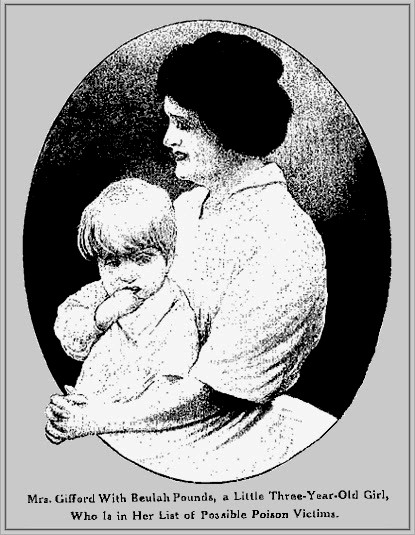
Bertha Alice Williams Gifford was born on October 30, 1871, near Morse Mill, Missouri. She became a farmwife in the rural communities of eastern Missouri and was known locally for an outwardly generous habit that would later become central to one of the state's most disturbing criminal cases: she volunteered to care for sick relatives, neighbors, and children. Gifford was considered a capable cook and an experienced home caregiver. Families trusted her enough to leave vulnerable patients in her care, sometimes for long periods and sometimes overnight. She first married Henry Graham in 1894 and had a daughter, Lila. After Graham's death, she married Eugene "Gene" Gifford in 1907. The couple eventually lived near Catawissa in Franklin County, Missouri. In an era when rural families commonly depended on neighbors rather than hospitals for nursing care, Bertha's willingness to sit with the sick gave her unusual access to people at their most vulnerable.

A Disturbing Pattern Around Her Patients

Over the years, an alarming pattern began to surround people whom Gifford nursed. Patients who were already ill, or in some cases suffering from seemingly minor ailments, developed severe gastrointestinal symptoms. Historical descriptions repeatedly mention stomach pain, cramps, vomiting, diarrhea, weakness, and sudden deterioration. Such symptoms could resemble acute gastritis or other illnesses familiar to doctors of the period, and several deaths were initially accepted as natural. The substance eventually associated with the case was arsenic. Arsenic compounds were much easier to obtain in the early twentieth century than they are today and could be found in pesticides and other household or agricultural products. Gifford reportedly purchased arsenic and maintained that it was needed to control rats around the farm. Investigators, however, became convinced that arsenic was also being administered to people she nursed.

The Schamel Brothers

The deaths of two young brothers in 1925 became especially important. Lloyd Schamel died on August 11, 1925, and his younger brother Elmer Schamel died on September 22, 1925. Bertha had been involved in caring for the boys. Their deaths occurred only weeks apart and were later viewed as part of a cluster of suspicious illnesses and deaths involving the Schamel family and people connected to them. A local physician, Dr. W. H. Hemker, was among those who reportedly became suspicious about the unusual sequence of illnesses. Yet suspicion alone was not enough to prove poisoning. The boys had already been buried, and no murder case could proceed without stronger physical evidence. Their deaths would become much more important three years later, when investigators ordered exhumations.

The Death of Edward Brinley

Another death brought renewed attention to Gifford. Edward Phillip Brinley, a 49-year-old man associated with the Catawissa community, died on May 16, 1927, in Franklin County, Missouri. Accounts of the case describe Brinley becoming seriously ill and coming under Gifford's care. His symptoms resembled those associated with several earlier deaths around her. By this point, community suspicion had become difficult to dismiss. Neighbors had noticed that an extraordinary number of people became desperately ill or died after Gifford took charge of their nursing. Questions were raised about whether illnesses previously described as gastritis or other natural conditions were actually episodes of poisoning. Brinley's death eventually became the central case prosecutors took before a jury.

Investigation and the Discovery of Arsenic

Authorities investigated Gifford during 1928. Investigators examined her access to arsenic and revisited earlier deaths. The bodies of Edward Brinley and brothers Lloyd and Elmer Schamel were exhumed. Post-mortem examinations reported substantial amounts of arsenic in their remains. The findings transformed years of rumor and suspicion into a criminal investigation centered on poisoning. Bertha Gifford was taken into custody on August 25, 1928. Authorities ultimately charged her in connection with the deaths of Brinley and the two Schamel boys. Contemporary accounts also attributed statements to Gifford in which she acknowledged giving arsenic in the principal cases while claiming that she had wanted to relieve suffering. Because surviving newspaper accounts can be sensational and sometimes contradictory, the exact wording and meaning of these alleged admissions should be treated cautiously.

Victims and Suspected Victims

The following people have been identified in historical records and later research as confirmed prosecution cases or suspected victims associated with Gifford. The first three were the deaths at the center of the criminal charges and exhumation evidence. The remaining names were later treated as suspected cases and were not individually proven as murders in court. Where an exact place of death is not firmly established in surviving accounts, the location listed reflects the Catawissa and Franklin County area with which the case was associated.
  • Lloyd George Schamel — Died August 11, 1925, in the Catawissa/Franklin County, Missouri area. He was seven years old. His body was later exhumed, and arsenic was reported in his remains. His death became one of the three cases for which Gifford was charged.
  • Elmer John Schamel — Died September 22, 1925, in the Catawissa/Franklin County, Missouri area. He was five years old and Lloyd's younger brother. His body was also exhumed, with arsenic reported in the remains. Gifford was charged in connection with his death.
  • Edward Phillip Brinley — Died May 16, 1927, in Franklin County, Missouri, at age 49. His remains were exhumed and found to contain arsenic. His death became the case actually presented to a jury at Gifford's trial.
  • Henry A. Graham — Died November 30, 1906, at age 34. Graham was Bertha's first husband. His death was later included among the suspicious deaths associated with her, although she was never prosecuted for it.
  • Emilie Claire Gifford — Died January 24, 1912, at age 55. She was Bertha's mother-in-law and was later identified as a possible victim. The death was associated with the Gifford family in Missouri but was never a charged murder.
  • James Arthur Gifford — Died May 8, 1913, at age 12. He was Bertha's young brother-in-law. His death was subsequently considered suspicious because of the illness surrounding it and Bertha's role as caregiver.
  • Bernard Stuhlfelder — Died February 26, 1915, at approximately one year old, in the Franklin County area. Bernard was one of several members of the Stuhlfelder family whose deaths were later associated with Gifford's nursing.
  • Sherman J. Pounds — Died February 20, 1917, at age 48. His death in the Catawissa-area community was later included among the cases investigators and historians considered suspicious.
  • James L. "Jim" Ogle — Died November 20, 1917, at age 66. Ogle was another Missouri-area death subsequently placed on lists of Gifford's possible victims.
  • Beulah Ardella Pounds — Died April 19, 1918, at age eight. She belonged to the Pounds family, which suffered more than one death later associated with Gifford.
  • Mary Minerva Brown — Died February 6, 1920, at age seven. Historical accounts connected her fatal illness with Bertha's caregiving, although no criminal charge was brought in Mary's death.
  • Margaret Stuhlfelder — Died February 28, 1921, at age two. She was another young member of the Stuhlfelder family whose death was later examined as part of the suspected pattern.
  • Beulah Pounds — Died December 27, 1922, at age three. She was named after her relative Beulah Ardella Pounds, who had died in 1918. Her death was later included among the suspected Gifford cases.
  • Irene Stuhlfelder — Died March 10, 1923, at age seven. She was the third Stuhlfelder child commonly identified among Gifford's suspected victims. Accounts described members of this family developing serious stomach illnesses while Bertha was involved in their care.
  • Leona L. Schamel Slocum — Died in October 1925, at age 37, in the Franklin County area. Most compiled records give October 13, 1925, although some historical retellings give October 12. Because the exact day is inconsistent between surviving accounts, the death is best described as occurring in mid-October 1925.
  • Mary Catherine Stuhlfelder — Died January 10, 1926, at age 73. Her death was later placed among the suspicious deaths connected to Bertha's caregiving.
  • Bertha "Birdie" Unnerstall — Died February 9, 1926, at age 72, in the Pacific/Calvey Township area of Franklin County, Missouri. Her death was another of the older cases later associated with the investigation of Gifford.


The Trial in Union, Missouri

Gifford's case went to court in Union, the county seat of Franklin County. Although she faced charges connected to three deaths, the prosecution proceeded to trial on the death of Edward Brinley. The proceeding lasted three days. Evidence about arsenic, the exhumed remains, Gifford's behavior around sick people, and her mental condition became central to the case. The jury did not return an ordinary murder conviction. Instead, Gifford was found not guilty by reason of insanity. This distinction is important: although she is routinely described in true-crime histories as a serial killer and investigators believed she had poisoned multiple victims, the verdict was not a conventional guilty verdict for murder. She was committed to Missouri State Hospital No. 4 in Farmington rather than sent to prison.

How Many People Did She Kill?

The true number of Gifford's victims remains uncertain. Historical accounts commonly connect approximately seventeen deaths to people who had been in her care, while some later summaries give slightly different totals. Only three deaths produced the arsenic evidence and criminal charges that formed the core of the 1928 case. Many of the earlier deaths had occurred years before investigators seriously considered poisoning, making definitive forensic conclusions difficult or impossible. It is also important to recognize the conditions of the period. Arsenic was widely available for agricultural, household, and even medicinal purposes. Rural medical diagnosis was limited, autopsies were uncommon, and severe gastrointestinal illnesses could have many causes. Those facts do not erase the evidence found in the exhumed Schamel and Brinley remains, but they make it impossible to state with certainty that every person later placed on a list of Gifford's suspected victims was deliberately poisoned by her.

Final Years and Death

After the 1928 verdict, Bertha Gifford remained confined at Missouri State Hospital No. 4 in Farmington. She never returned to her former life in Catawissa. She died at the institution on August 20, 1951, nearly twenty-three years after her arrest. Her case remains notable because the alleged crimes were concealed behind a role normally associated with compassion. Gifford did not stalk strangers or openly threaten the people around her. Instead, suspicion centered on her position as a trusted caregiver who could prepare food, administer medicine, and remain alone with sick patients. The discovery of arsenic in three exhumed bodies gave investigators physical evidence, but the long list of earlier deaths ensured that important questions would remain unanswered. More than a century after the earliest suspected cases, Bertha Gifford is still remembered as one of Missouri's most notorious accused poisoners and as a striking example of how trust, illness, and primitive forensic investigation could allow a possible pattern of murder to remain hidden for years.

Victims

See any mistakes? Let us know!
Confirmed Victims: (3)
  • Lloyd George Schamel Age: (7), Date of Death: 1925-08-11
  • Elmer John Schamel Age: (5), Date of Death: 1925-09-22
  • Edward Phillip Brinley Age: (49), Date of Death: 1927-05-16

  • Suspected Victims:
  • Henry A. Graham Age: (34), Date of Death: 1906-11-30
  • Emilie Claire Gifford Age: (55), Date of Death: 1912-01-24
  • James Arthur Gifford Age: (12), Date of Death: 1913-05-08
  • Bernard Stuhlfelder Age: (1), Date of Death: 1915-02-26
  • Sherman J. Pounds Age: (48), Date of Death: 1917-02-20
  • James L. "Jim" Ogle Age: (66), Date of Death: 1917-11-20
  • Beulah Ardella Pounds Age: (2), Date of Death: 1921-02-28
  • Beulah Pounds Age: (3), Date of Death: 1922-12-27
  • Irene Stuhlfelder Age: (7), Date of Death: 1923-03-10
  • Leona L. Schamel Slocum Age: (37), Date of Death: 1925-10-13
  • Mary Catherine Stuhlfelder Age: (73), Date of Death: 1926-01-10
  • Bertha "Birdie" Unnerstall Age: (72), Date of Death: 1926-02-09