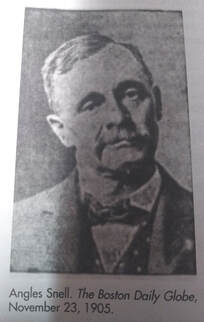
Angles Snell: Suspected Serial Killer of Coastal New England
Background and Criminal History
Angles Snell was a violent repeat offender whose activities in Rhode Island and southeastern Massachusetts eventually led investigators to suspect that he had committed several murders. Born in Tiverton, Rhode Island, during the 1840s, Snell spent much of his adult life around the coastal communities of Tiverton, Little Compton, Westport, Dartmouth, Fall River, and New Bedford. He became familiar to local authorities through a long succession of arrests and convictions involving assault, theft, illegal liquor sales, and other offenses.
Snell reportedly made money by supplying liquor to fishermen and other men living or working near the shoreline. Contemporary accounts portrayed him as someone who sometimes took advantage of intoxicated customers by stealing from them after they had become unable to protect themselves. He was also accused of threatening people who interfered with his personal ambitions. In 1893, Snell was tried for allegedly setting fire to a barn in Dartmouth, Massachusetts, although he was acquitted of that charge.
His personal life was similarly unstable. Snell had reportedly been married and divorced more than once, and witnesses described him as jealous, possessive, and quick to become violent. By the beginning of the twentieth century, authorities in both Massachusetts and Rhode Island regarded him as a dangerous man with an established history of criminal conduct.
The Murder of Peleg Cornell
On or about the night of February 11, 1902, 70-year-old Peleg Cornell was killed inside his home on Adamsville Road in Little Compton, Rhode Island. After Cornell failed to respond to visitors, police entered the residence and discovered his body on the floor. He had suffered fatal injuries consistent with being struck by a blunt object. A knife was reportedly found nearby, but the condition of the house did not suggest an ordinary burglary or a prolonged struggle.
The rooms were said to be generally orderly, there were no obvious signs that a stranger had forced entry, and nothing of significance initially appeared to have been stolen. These circumstances caused investigators to consider the possibility that Cornell had known his attacker and had willingly admitted that person into his home.
Little Compton officials offered a reward for information leading to the arrest and conviction of the person responsible for Cornell's death. Snell was investigated because of his familiarity with the area, his criminal reputation, and reports that he had made incriminating statements. He was never tried for Cornell's murder, however, and the surviving evidence did not produce a separate conviction. Later accounts stated that Snell confessed or claimed responsibility for Cornell's death, but the case was never tested before a jury.
The Murder of Tillinghast Kirby
Tillinghast Kirby, an elderly man approximately 87 years old, was staying near the shoreline at Westport, Massachusetts, in September 1903. On the afternoon of September 9, Kirby prepared to go fishing in a small boat. Snell was nearby and invited Kirby to accompany him, but Kirby declined and said that each man could use his own boat.
Witnesses saw the two men depart at approximately the same time. Snell was later observed in his boat close to Kirby, making him one of the last people known to have seen the elderly fisherman alive. Kirby did not return from the water, and his disappearance led to a search of the shoreline and surrounding waters.
Kirby's body was discovered on Horseneck Beach on September 18, 1903, following a powerful coastal storm. Medical examination revealed a fracture to his skull that appeared to have been caused by a heavy blunt instrument. A rope had also been placed around his neck, with a strap attached to it. Medical witnesses concluded that the blow to Kirby's head had caused his death.
The rope and strap became important evidence. Witnesses testified that Snell regularly carried a similar arrangement in his boat, including a rope, strap, and weight. Prosecutors argued that Snell had struck Kirby, secured a weighted rope around his neck, and placed his body in the water in an attempt to prevent its discovery. The storm apparently disrupted that effort by carrying the body back toward the beach.
Motive and the Plan to Control a Shoreline House
The prosecution presented evidence that Snell was obsessed with obtaining control of a boarding or lodging house near Horseneck Beach that was operated by a man named Burden Head. Snell apparently believed that controlling the property would allow him to sell liquor and establish himself as a powerful figure along that section of the coast.
A longtime acquaintance testified that Snell had previously discussed murdering Burden Head. According to the testimony, Snell proposed taking Head fishing, striking him on the head, tying a rope and stone around his neck, and throwing him overboard so that his body would not rise to the surface. Snell allegedly believed that Head possessed between $1,600 and $2,000 and suggested that the money could be taken after his death.
The proposed method was remarkably similar to the circumstances surrounding Kirby's death. Kirby had suffered a crushing blow to the skull, and a rope with a strap had been secured around his neck before his body was placed in the water. Prosecutors argued that Kirby had become an obstacle to Snell's plan to strengthen his control over the lodging house and surrounding property.
Burden Head was not established as one of Snell's murder victims. The evidence concerned Snell's expressed plan to kill him and was introduced to demonstrate motive, intent, and the similarity between Snell's proposed method and the manner in which Kirby was killed.
Arrest and Murder Trial
Snell was arrested after the discovery of Kirby's body and was indicted for murder in Bristol County on November 6, 1903. His trial took place in Massachusetts, with the prosecution relying heavily on circumstantial evidence. There was no eyewitness who testified to seeing Snell strike Kirby, but the Commonwealth assembled a detailed sequence connecting Snell to the victim's final movements and to the method used to dispose of the body.
The jury heard that Snell and Kirby went onto the water at nearly the same time, that Snell was seen near Kirby shortly before Kirby disappeared, and that Snell carried equipment resembling the rope and strap found on the body. Jurors were also taken to view Horseneck Beach and Gooseberry Neck so they could better understand the geography of the coastline, the boating routes, and the location where Kirby's body was recovered.
Snell's defense contended that Kirby might have died accidentally or committed suicide. The prosecution rejected those explanations, pointing to the skull fracture, the weighted-rope arrangement, Snell's presence near the victim, and his earlier description of an almost identical murder plan.
The jury found Snell guilty of first-degree murder. His attorneys challenged the indictment and objected to portions of the evidence, but the Massachusetts Supreme Judicial Court upheld the legal rulings made during the trial in a decision issued on September 7, 1905.
Sentence and Death in Prison
Following his conviction, Snell was sentenced to death. His execution was scheduled for late 1905, but the sentence was commuted to life imprisonment shortly before it was to be carried out. The decision spared him from execution but ensured that he would remain confined for the remainder of his life.
Snell was imprisoned at Charlestown State Prison in Massachusetts. He died there on March 14, 1910, reportedly after suffering a heart attack. Because he died in custody, authorities never obtained the opportunity to prosecute him for Peleg Cornell's murder or investigate his additional claims through a later trial.
Confirmed and Suspected Victims
- Peleg Cornell, approximately 70 years old — February 11, 1902 — Little Compton, Rhode Island: Cornell was discovered bludgeoned to death inside his Adamsville Road residence. Snell was suspected and was later reported to have admitted responsibility, but he was never prosecuted for the murder.
- Tillinghast Kirby, approximately 87 years old — September 9, 1903 — waters near Horseneck Beach, Westport, Massachusetts: Kirby disappeared while fishing. His body was recovered on Horseneck Beach on September 18 with a fatal skull fracture and a rope secured around his neck. Snell was convicted of first-degree murder for killing him.
- Two unidentified vacationers — date unknown — Westport, Massachusetts area: Snell was reported to have claimed that he killed two people who had been vacationing near Westport. Their identities, exact dates of disappearance, and the locations of their remains were never confirmed.
- Unidentified Portuguese man — date and exact location unknown — southeastern Massachusetts or Rhode Island: Some later accounts state that Snell claimed to have murdered a Portuguese man from a neighboring community. No body was conclusively connected to the statement, and the victim's identity remains unknown.
Questions About the Number of Victims
Only Kirby's murder resulted in a conviction, while Cornell's death remained an attributed or suspected killing. The additional stories involving two vacationers and an unidentified Portuguese man were based on alleged statements and were not supported by identified remains or successful prosecutions. It is therefore difficult to determine whether Snell was responsible for two murders or as many as five.
Historical limitations also complicated the investigations. Police departments in small coastal communities had fewer forensic resources, records were not always shared efficiently across state lines, and medical examiners lacked many of the scientific techniques available to modern investigators. Bodies lost in the ocean could disappear permanently or be recovered so badly decomposed that identification was impossible.
For these reasons, Angles Snell is generally best described as a convicted murderer and suspected serial killer. His conviction for the carefully concealed murder of Tillinghast Kirby, his suspected connection to Peleg Cornell, and his alleged admissions concerning additional victims created the enduring belief that Kirby was not the only person he killed.
Legacy of the Angles Snell Case
The Snell investigation is an early example of a murder case built through a combination of witness testimony, physical similarities, motive, opportunity, and a defendant's prior statements. Prosecutors could not produce a witness to the killing itself, but they demonstrated that Snell had described a specific plan involving a blow to the head, a weighted rope, and disposal of a body at sea. Kirby was then found under circumstances closely matching that plan.
The case also illustrates the danger of treating every allegation as a confirmed murder. Snell's statements about unidentified victims may have been truthful, exaggerated, misunderstood, or falsely attributed to him. Without names, bodies, exact dates, or court proceedings, those cases cannot be placed on the same evidentiary level as the murder of Kirby.
Nevertheless, Snell's criminal history, the violent death of Peleg Cornell, the proven murder of Tillinghast Kirby, and the claims of other killings left behind a disturbing pattern. More than a century later, the full number of people who may have died at his hands remains uncertain.