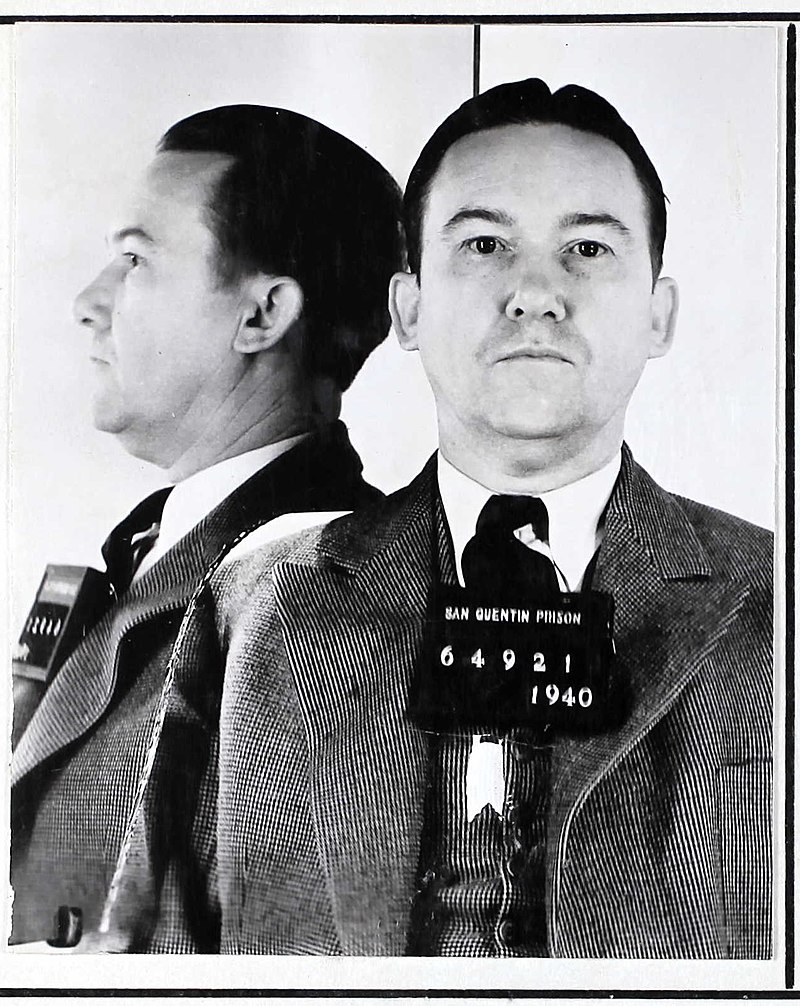
Major Raymond Lisenba: The Rattlesnake Murderer
Overview
Major Raymond Lisenba, better known under the alias Robert Sherwood James, was an American murderer whose pursuit of life-insurance money placed him at the center of one of California’s most sensational criminal cases. Newspapers called him “Rattlesnake James” and the “Rattlesnake Murderer” because he attempted to kill his final wife by forcing venomous snakes to bite her. Although Lisenba was convicted of only one murder, investigators suspected that he had arranged two earlier deaths for similar financial reasons.
Lisenba was born on March 6, 1894, in Hale County, Alabama. He later used several names, including Major Lisby, Raymond Lisenba, Robert S. James and Robert Sherwood James. He worked in a variety of occupations before becoming a barber in Southern California. Beneath his outwardly respectable appearance, however, investigators found a history of unstable marriages, insurance policies and suspicious deaths.
For historical accuracy, Lisenba is best described as a convicted murderer and suspected serial killer. He was legally convicted of murdering Mary Emma Busch. The deaths of his wife Winona Wallace and his nephew Cornelius Wright were investigated as possible insurance killings, but Lisenba was never convicted in either case.
Suspected Pattern of Insurance Killings
The recurring element in the deaths associated with Lisenba was life insurance. He arranged policies on relatives or wives and stood to receive substantial payments when they died. The deaths were made to resemble accidents, usually involving automobiles, cliffs or drowning. After each incident, Lisenba offered an explanation that appeared to remove him from direct responsibility.
Investigators became particularly suspicious because mechanical failure was blamed in more than one automobile crash connected to him. In addition, both Winona Wallace and Mary Emma Busch died by drowning after surviving an earlier injury or attempted method of killing. Insurance investigators examining Busch’s death discovered Lisenba’s marital history and the suspicious circumstances surrounding Wallace’s death, helping authorities recognize a possible pattern.
Known and Suspected Victims
- Winona Wallace — October 1932 — Manitou Springs, Colorado: Wallace was Lisenba’s wife and the insured victim in the first widely reported suspicious death connected to him. On September 21, 1932, she and Lisenba were traveling on the Pikes Peak Highway near Glen Cove when their automobile left the road and plunged down a mountainside. Lisenba claimed that a steering component broke and that he jumped free before the vehicle fell. Wallace survived the crash with head injuries and was taken to a hospital. She was released on October 8 and continued recovering in a tourist cabin in Manitou Springs. Approximately one week later, she was found dead in a partially filled bathtub. The exact day of her death is not consistently established in surviving accounts, but it occurred in October 1932. Lisenba collected approximately $14,000 in insurance benefits. After Mary Busch’s murder was investigated, Wallace’s remains were examined and evidence of serious skull fractures renewed suspicions that she had been deliberately attacked. Lisenba was suspected of striking her before the automobile crash and later drowning her, but he was never tried or convicted for her death.
- Cornelius Wright — 1935 — Near Santa Rosa, California: Wright was Lisenba’s nephew and a young sailor who visited him while on leave. Lisenba had taken out a life-insurance policy on Wright and allowed him to use an automobile. Wright was killed when the vehicle went over a cliff after an alleged steering failure near Santa Rosa. Contemporary accounts identify the death as occurring in 1935, although a reliable exact day and month are not consistently available. The similarity to the earlier crash involving Winona Wallace attracted investigators’ attention. Lisenba received approximately $5,000 from Wright’s insurance policy and reportedly used the money to purchase a Los Angeles-area barber shop. Authorities suspected that the automobile had been deliberately sabotaged, but Lisenba was not prosecuted for Wright’s death.
- Mary Emma Busch James — August 5, 1935 — La Cañada, California: Busch was Lisenba’s final wife and the only victim whose murder resulted in his conviction. She worked as a manicurist at his barber shop. Lisenba arranged substantial life-insurance coverage on her and recruited Charles S. Hope to help carry out a murder disguised as an accident. During the night of August 4 and the early morning of August 5, Busch was restrained on a kitchen table after being deceived into believing she was undergoing an illegal medical procedure. Lisenba forced one of her feet into a container holding rattlesnakes. The snakes bit her, but their venom did not kill her quickly enough. During the early morning of August 5, Lisenba drowned Busch in a bathtub and moved her body to a fish pond in the backyard. He attempted to create the appearance that she had been bitten by a snake and had accidentally fallen into the pond. Her death was initially classified as drowning, but the scheme was later exposed by Hope. Lisenba and Hope were both convicted for their involvement.
The Murder of Mary Emma Busch
Lisenba met Mary Emma Busch in 1935. She worked in his barber shop, and the two married in Orange County, California, on July 19, 1935. Lisenba used the name Robert Sherwood James on the marriage record. According to the prosecution, his plans to profit from her death were already developing around the time of the marriage.
Lisenba approached Charles Hope, a financially troubled customer, and offered him money to obtain rattlesnakes and assist with the killing. Hope acquired two snakes that were kept in a wooden container. Their presence was intended to provide a seemingly natural explanation for Busch’s death and to distance Lisenba from any obvious act of violence.
On August 4, 1935, Busch was led to believe that a secret medical procedure would be performed. Her eyes and mouth were covered, and she was restrained on a table. She was also given a large amount of whiskey, supposedly as an anesthetic. This deception left her helpless and unable to recognize the supposed medical practitioner.
Lisenba placed her foot inside the snake container. The rattlesnakes struck and left visible bites, but Busch remained alive. The plan had depended upon the venom killing her without creating evidence of direct human violence. When that did not happen, Lisenba resorted to drowning her.
In the early hours of August 5, he placed Busch in a bathtub and held her under the water. After she was dead, her body was moved outside and left near or inside the backyard fish pond. Lisenba later arranged for acquaintances to be present when the body was supposedly discovered, strengthening his attempt to portray himself as a shocked husband encountering an accidental death.
The swollen and darkened condition of Busch’s leg appeared to support the story that she had suffered a snakebite before falling into the pond. Authorities initially accepted drowning as the cause of death. Lisenba then attempted to collect the insurance benefits taken out on his wife.
Discovery of the Plot
The murder began to unravel when Charles Hope spoke about his involvement. After authorities questioned him, Hope described how the snakes had been obtained, how Busch had been restrained and how Lisenba had forced her foot into the container. Investigators also found evidence of a snakebite that had been overlooked during the initial examination of Busch’s body.
Insurance investigators examining Lisenba’s claim learned that he had been married several times and that Winona Wallace had also died by drowning after a suspicious automobile crash. They also discovered that his nephew had died in another vehicle allegedly disabled by a steering failure. These similarities transformed Busch’s supposed accident into part of a broader pattern of suspicious deaths followed by insurance payments.
Lisenba was arrested in 1936. Hope became a central witness for the prosecution and explained the murder plot in detail. Authorities reconstructed the scene and demonstrated how Busch’s foot had been exposed to the snakes. The use of live rattlesnakes as courtroom evidence added to the extraordinary publicity surrounding the trial.
Trial and Conviction
Prosecutors argued that Lisenba had married Busch and insured her as part of a calculated plan to obtain money. They presented Hope’s testimony, the physical evidence of the snakebite and information concerning Lisenba’s previous insurance claims. The evidence showed that the rattlesnake attack had been intentional and that Busch was drowned only after the venom failed to kill her.
The defense challenged Hope’s credibility and questioned statements obtained from Lisenba during prolonged police interrogation. Lisenba claimed that investigators had mistreated him, denied him rest and pressured him into making incriminating statements. The controversy surrounding the interrogation later became the basis of an appeal that reached the United States Supreme Court.
Lisenba and Hope were convicted of Mary Emma Busch’s murder. Lisenba received a death sentence, while Hope was sentenced to life imprisonment. Lisenba was also convicted on three counts of incest involving his niece, Lois Wright, with whom he had maintained a sexual relationship that began when she was seventeen.
Supreme Court Appeal
Lisenba’s case reached the United States Supreme Court under the title Lisenba v. California. His attorneys argued that statements used against him had been obtained through coercion and that admitting them at trial violated his constitutional right to due process.
The record described an intense interrogation during which Lisenba was held for an extended period, deprived of sleep and struck by an investigator. The Supreme Court acknowledged serious problems with the conduct of the police but concluded that the confession admitted at trial had not been produced directly by the improper treatment. His conviction and death sentence were therefore allowed to stand.
Execution
Major Raymond Lisenba was executed at San Quentin State Prison on May 1, 1942. He became the last person executed by hanging in California before the state adopted the gas chamber as its principal method of execution.
The execution was reportedly prolonged because the rope was not properly adjusted for his body. Instead of dying immediately from a broken neck, Lisenba remained suspended for more than ten minutes before he was pronounced dead. His final moments added another grim chapter to a case already remembered for its unusual murder method and sensational trial.
Assessment of His Crimes
Lisenba is frequently included in lists of serial killers because three deaths were associated with him and each involved a possible insurance motive. However, only the murder of Mary Emma Busch was proved in court. Winona Wallace and Cornelius Wright should therefore be identified as suspected victims rather than confirmed murder victims.
The Busch case demonstrated Lisenba’s willingness to use deception, accomplices and elaborate staging. The rattlesnake attack was not an impulsive act. It required the purchase and concealment of venomous snakes, the manipulation of the victim, the recruitment of Hope and the creation of a false accident scene. When the original method failed, Lisenba completed the murder by drowning Busch and continued with the insurance scheme.
The earlier deaths displayed notable similarities. Both Wallace and Wright were insured, both were involved in automobile crashes attributed to steering failures and both deaths produced financial benefits for Lisenba. Wallace survived the initial crash but later drowned under circumstances that investigators came to regard as deeply suspicious. These repeated features led authorities and later historians to believe that Busch was probably not his first victim.
Legacy
The name “Rattlesnake James” remains associated with one of the most bizarre insurance-murder plots in American criminal history. The use of rattlesnakes captured public attention, but the essential character of the crime was calculated financial exploitation. Lisenba treated marriage and family relationships as opportunities to obtain insurance policies and, according to investigators, arranged fatal incidents whenever a death could produce a profit.
His case also became significant in American legal history because of the Supreme Court’s examination of police interrogation methods. The decision has remained part of the broader history of constitutional protections governing confessions and due process.
Major Raymond Lisenba died convicted of murdering Mary Emma Busch and suspected of causing the deaths of Winona Wallace and Cornelius Wright. Although the full extent of his crimes was never conclusively established, the combination of insurance policies, staged accidents and repeated deaths left investigators convinced that the rattlesnake murder was the final act in a much longer pattern of lethal deception.