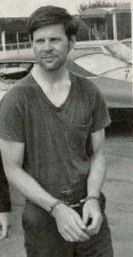
Ronald Gray: The Fort Bragg Serial Killer
Background
Ronald Adrin Gray was a United States Army soldier who became one of the most notorious military criminals in modern American history. While stationed at Fort Bragg, North Carolina, Gray committed a series of murders, rapes, kidnappings, robberies, and violent assaults in the Fayetteville and Fort Bragg area during 1986 and early 1987. Four women were murdered, and another woman survived an attack that prosecutors described as an attempted premeditated murder. Gray's crimes were eventually prosecuted in both North Carolina civilian court and the United States military justice system.
At the time of the crimes, Gray was a young Army specialist serving at Fort Bragg. His victims included civilians as well as female soldiers. The attacks were separated by months in some cases and only days in others. Investigators ultimately connected Gray to the crimes through physical evidence, witness identification, evidence recovered from vehicles and crime scenes, and statements he made during the civilian criminal proceedings.
Victims and Dates
- Linda Jean Coats — April 27, 1986 — Fayetteville, North Carolina. Coats was a Campbell University student and ROTC participant. She was killed at her residence in the Fayetteville area. She had been sexually assaulted and suffered a fatal gunshot wound. Gray later pleaded guilty in North Carolina civilian court to second-degree murder in connection with her death.
- Tammy Cofer Wilson — December 11, 1986 — Fayetteville, North Carolina. Wilson, 18, was abducted from her home in the Bonnie Doone area of Fayetteville. She was sexually assaulted and killed, and her body was discovered in a wooded area nearby. Gray later pleaded guilty to second-degree murder in her case as part of his civilian prosecution.
- Private Laura Lee Vickery-Clay — December 15, 1986 — Fort Bragg, North Carolina. Vickery-Clay, an 18-year-old Army private, disappeared from the Fort Bragg area on December 15. Her body was not recovered until January 1987, when it was discovered in a wooded area on the military installation. Evidence showed that she had been sexually assaulted, beaten, and shot four times. Evidence associated with her automobile and the firearm used in the killing connected Gray to the crime.
- Private Mary Ann Lang Nameth — January 3, 1987 — Fort Bragg, North Carolina. Nameth survived Gray's attack and therefore is not one of his murder victims. Gray attacked her in her barracks, sexually assaulted and robbed her, and repeatedly stabbed her in the neck and side. Her injuries included damage to her trachea and a collapsed or punctured lung. After Gray's arrest received media coverage, Nameth recognized his photograph and identified him as the man who had attacked her.
- Kimberly Ann Ruggles — January 6, 1987 — Fort Bragg, North Carolina. Ruggles, 23, was a civilian taxi driver working in the Fayetteville area. She was dispatched to pick up a passenger named "Ron" on the evening of January 6. Military police discovered her abandoned taxi near a wooded portion of Fort Bragg during the early hours of January 7. Her body was found nearby. She had been sexually assaulted, beaten, and stabbed multiple times. Physical evidence recovered from the taxi, Gray's possession, and the crime scene helped establish his connection to her murder.
The Murder of Linda Jean Coats
The earliest murder attributed to Gray occurred on April 27, 1986. Linda Jean Coats was a college student living in the Fayetteville area while attending Campbell University. She was also involved in ROTC and was preparing for a military career. Coats was found dead at her residence after being sexually assaulted and shot. Her killing initially stood apart from the later crimes, but investigators eventually connected Gray to the case.
Unlike the later murders of Laura Vickery-Clay and Kimberly Ruggles, which were prosecuted by the military, Coats's murder became part of the North Carolina civilian case against Gray. Gray ultimately admitted responsibility in court and pleaded guilty to second-degree murder.
The Murder of Tammy Cofer Wilson
On December 11, 1986, the violence resumed with the abduction and murder of Tammy Cofer Wilson. Wilson was only 18 years old. She was taken from her home in the Fayetteville area, sexually assaulted, and killed. Her body was discovered in nearby woods. The attack demonstrated a willingness by Gray to abduct a victim from a residential setting and move her before killing her.
Wilson's murder occurred only four days before the disappearance of Army Private Laura Lee Vickery-Clay. Like Coats's case, Wilson's murder was handled in the North Carolina civilian proceedings. Gray pleaded guilty to second-degree murder in connection with Wilson's death.
The Murder of Private Laura Lee Vickery-Clay
Private Laura Lee Vickery-Clay disappeared on December 15, 1986. She was an 18-year-old soldier stationed at Fort Bragg. Investigators later established that Gray had encountered her shortly before she vanished. Her automobile became an important part of the investigation, and evidence connected Gray to the vehicle.
Vickery-Clay's body was discovered in a wooded area on Fort Bragg the following month. The medical evidence showed extensive violence. She had been sexually assaulted and had suffered blunt-force injuries across several areas of her body. She had also been shot four times, with gunshot wounds involving her neck, forehead, chest, and the back of her head. Investigators connected the murder weapon and evidence from her automobile to Gray.
Because Vickery-Clay was a soldier and evidence indicated that the crime occurred on the military installation, her murder became one of the central charges in Gray's general court-martial. The military panel eventually convicted him of her premeditated murder.
The Attack on Private Mary Ann Lang Nameth
On January 3, 1987, Gray attacked Private Mary Ann Lang Nameth in her barracks at Fort Bragg. Unlike the four murder victims, Nameth survived. Gray sexually assaulted and robbed her and stabbed her repeatedly in the neck and side. Her wounds were extremely serious, including an injury to her trachea and damage to a lung.
Nameth later saw photographs of Gray after his arrest was reported in newspapers and on television. She recognized him as her attacker and contacted authorities. Her identification became an important part of the military case. Gray was ultimately convicted of attempted premeditated murder as well as offenses connected with the sexual assault and robbery.
The Murder of Kimberly Ann Ruggles
Kimberly Ann Ruggles was a 23-year-old civilian taxi driver. On the evening of January 6, 1987, she received a request to pick up a passenger named "Ron" in Fayetteville. She knew Gray from previous taxi fares and picked him up that evening. Later, communication with her taxi stopped.
During the early morning hours of January 7, military police patrolling Fort Bragg discovered Ruggles's empty taxi near a wooded area. Her body was found a short distance away. She had been sexually assaulted, beaten, and stabbed repeatedly. Investigators found significant evidence tying Gray to the crime. His fingerprints were found inside the taxi, while evidence associated with Ruggles was recovered from Gray's possession. Footprint evidence at the scene also supported the prosecution's case.
The murder of Ruggles was the final killing in the series attributed to Gray. His arrest brought the sequence of murders to an end and allowed investigators to begin connecting the different crimes that had occurred around Fayetteville and Fort Bragg.
Civilian Convictions
Gray faced prosecution in North Carolina for crimes committed against civilian victims. In November 1987, he pleaded guilty to numerous felony charges. They included two counts of second-degree murder for the deaths of Linda Jean Coats and Tammy Cofer Wilson, along with multiple charges involving rape, sexual offenses, kidnapping, armed robbery, burglary, attempted rape, and assault.
The civilian court sentenced Gray to eight life sentences. Several of those sentences were ordered to run consecutively, ensuring that even apart from the military prosecution he faced the possibility of spending the remainder of his life imprisoned.
Military Court-Martial and Death Sentence
Gray was separately prosecuted by the United States Army for the crimes involving Private Laura Lee Vickery-Clay, Kimberly Ann Ruggles, and Private Mary Ann Lang Nameth. His general court-martial took place at Fort Bragg from December 1987 into April 1988. Gray pleaded not guilty to the military charges.
The military panel convicted Gray of the premeditated murders of Vickery-Clay and Ruggles and the attempted premeditated murder of Nameth. He was also convicted of three specifications of rape, two robberies, two forcible sodomy offenses, burglary, and larceny. On April 12, 1988, the court-martial sentenced him to death, dishonorable discharge, forfeiture of his pay, and reduction to the rank of Private E-1.
Appeals and Scheduled Execution
Gray's military convictions generated decades of appellate litigation. Military appellate courts repeatedly reviewed his conviction and death sentence. On July 28, 2008, President George W. Bush approved the military death sentence, a step required before the armed forces can execute a condemned service member. The Army subsequently scheduled Gray's execution for December 10, 2008, at the federal execution facility in Terre Haute, Indiana.
The execution did not occur. On November 26, 2008, a federal court issued a stay while Gray pursued further legal challenges. His case has since remained one of the longest-running capital cases in the modern military justice system.
Legacy of the Case
Ronald Gray's crimes are particularly notable because they crossed the boundary between civilian and military jurisdictions. Some victims were civilians living or working around Fayetteville, while others were soldiers stationed at Fort Bragg. As a result, Gray was prosecuted first through North Carolina's criminal justice system and then through a military general court-martial.
The established sequence of murders ran from April 27, 1986, through January 6, 1987. Four women — Linda Jean Coats, Tammy Cofer Wilson, Laura Lee Vickery-Clay, and Kimberly Ann Ruggles — were killed. Mary Ann Lang Nameth survived an attack for which Gray was convicted of attempted premeditated murder. The combination of victim testimony, forensic evidence, vehicle evidence, witness accounts, and Gray's civilian guilty pleas produced convictions that have remained the foundation of one of the most significant military death-penalty cases of the modern era.