Douglas Franklin Wright: Oregon Serial Killer
Overview
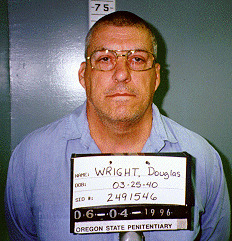
Douglas Franklin Wright was an American serial killer and repeat violent offender whose known crimes stretched across Oregon from 1969 to 1991. He was born on March 25, 1940, in Spirit Lake, Iowa, and was executed by lethal injection at the Oregon State Penitentiary in Salem, Oregon, on September 6, 1996. Wright was convicted of five murders and linked to at least seven known victims. His crimes involved shootings, abductions, and the targeting of vulnerable people, including an elderly woman, a young mother, a child, and homeless men he lured with false promises of paid work.
Early Criminal History
Before Wright became known as a serial killer, he had a long record of violent and predatory behavior. He had been accused of sexual offenses against children and had spent years in and out of prison. His criminal pattern showed repeated manipulation, predation, and violence. He was not a stranger to law enforcement by the time he committed the 1969 murders in Portland, Oregon.
The 1969 Portland Murders
Wright’s first confirmed murders occurred in Portland, Oregon, in early September 1969. The victims were Margaret Rosenberry, age 71, and Gail Snelling, age 27. Snelling was Rosenberry’s daughter in some court records and has also been described in secondary accounts as her granddaughter. Wright knew the family, which made the attack especially disturbing because he used familiarity and trust to gain access to the victims.
According to court records, Wright killed Gail Snelling and Margaret Rosenberry either late on September 1, 1969, or early on September 2, 1969, inside their Portland home. Other later summaries have listed September 4, 1969, but the court record places the killings around September 1 or September 2. Wright shot the women and then abducted Snelling’s five-year-old son, Matt Kaarhus. He took the child away from the home and sexually assaulted him before eventually releasing him alive.
After the double murder and kidnapping, Wright avoided capture for more than a month. He was eventually arrested after shooting a man at a billiards hall in Banks, Oregon. Wright was convicted for the murders of Margaret Rosenberry and Gail Snelling and received a prison sentence of 35 years.
Parole and Return to Violence
Wright was later considered a model prisoner and was paroled in 1982. His release did not end his violence. After leaving prison, he committed armed robberies and continued to prey on others. In 1984, he abducted and killed ten-year-old Luke Aaron Tredway, a Portland boy whose disappearance remained unresolved for years.
The Murder of Luke Aaron Tredway
Luke Aaron Tredway disappeared from Portland, Oregon, on May 23, 1984. He was ten years old and had been walking home from a friend’s house when he vanished. Wright later confessed that he abducted Luke from the street, took him to his apartment, held him for approximately 36 hours, sexually assaulted him, and then killed him on May 25, 1984. Wright said he shot Luke six times and disposed of his body in a remote area near Mount Hood. Luke’s body was not recovered.
The confession came shortly before Wright’s execution in 1996. By then, Luke’s family had spent more than twelve years without knowing what had happened to him. Wright claimed he wanted to give the family answers before he died, though his statement did not undo the uncertainty and pain caused by the crime.
The 1991 Murders of Homeless Men
Wright was released from prison again in June 1991. Within months, he began targeting homeless men in Portland. He placed or offered work opportunities, promising men payment to clear brush at a youth camp. This false offer allowed him to isolate victims and transport them to remote areas in Wasco County and on or near the Warm Springs Indian Reservation.
In October 1991, Wright murdered multiple men by shooting them. The victims included Anthony Arthur Barker, William Clement Marks, William Ray Davis, and Anthony Shawn “Tony” Nelson. Wright’s method was calculated: he offered work, drove the men away from Portland, gave them food or alcohol, and then attacked them in isolated locations where help was unavailable.
The Murder of Anthony Shawn “Tony” Nelson
On October 20, 1991, Anthony Shawn “Tony” Nelson, age 31, accepted Wright’s offer of work along with another homeless man, Randy Scott Henry. Wright drove them away from Portland to a remote area associated with the Warm Springs Indian Reservation. After offering alcohol, Wright shot Nelson in the head. Randy Scott Henry escaped while Wright fired at him and later alerted authorities.
Henry’s survival was critical. His account helped lead police to Wright and connect him to the broader series of killings. Wright later admitted killing Nelson, but because Nelson was Native American and the crime involved reservation jurisdiction, the case carried federal legal complications. Wright was not convicted for Nelson’s murder before his execution.
Arrest, Conviction, and Death Sentence
After Wright’s arrest in 1991, investigators linked him to the murders of Anthony Arthur Barker, William Clement Marks, and William Ray Davis. All three men were homeless and had been lured with the promise of paid work. Wright was tried in Wasco County, Oregon, and convicted of aggravated murder for those three killings. He was sentenced to death on October 11, 1993.
Wright eventually waived his appeals and asked that his execution proceed. He was executed by lethal injection on September 6, 1996. His execution was historically significant because he became the first person executed in Oregon since 1962 and the first person executed in Oregon by lethal injection.
Known Victims
- Margaret Rosenberry — Age 71. Killed in Portland, Oregon, either late September 1, 1969, or early September 2, 1969. She was shot inside her home during Wright’s attack on the household.
- Gail Snelling — Age 27. Killed in Portland, Oregon, either late September 1, 1969, or early September 2, 1969. She was shot inside the same home as Margaret Rosenberry. Wright then abducted Snelling’s five-year-old son, Matt Kaarhus, who survived.
- Luke Aaron Tredway — Age 10. Abducted in Portland, Oregon, on May 23, 1984, while walking home from a friend’s house. Wright later confessed that he killed Luke on May 25, 1984, after holding him for approximately 36 hours. Luke’s body has not been recovered.
- William Clement Marks — Age 23. Killed on October 1, 1991, in Wasco County, Oregon. He was one of the homeless men Wright lured with a false promise of paid work and then shot.
- William Ray Davis — Age 37. Killed on October 1, 1991, in Wasco County, Oregon. He was murdered in the same series of attacks as William Clement Marks and Anthony Arthur Barker.
- Anthony Arthur Barker — Age 27. Killed on October 7, 1991, in Oregon. He was another homeless man Wright lured with a false job offer before shooting him.
- Anthony Shawn “Tony” Nelson — Age 31. Killed on October 20, 1991, in a remote area associated with the Warm Springs Indian Reservation in Oregon. Wright shot Nelson after luring him and another man, Randy Scott Henry, away from Portland with the promise of work. Henry escaped and helped expose Wright’s crimes.
Pattern of Crimes
Wright’s crimes showed a repeated pattern of targeting people he believed he could control. In 1969, he attacked people who knew him and used the opportunity to abduct a child. In 1984, he targeted a child walking alone. In 1991, he targeted homeless men, exploiting their need for income by offering paid labor. Across the cases, Wright used deception, isolation, and firearms. His crimes were not impulsive accidents; they reflected planning, predatory selection, and a willingness to kill witnesses or victims once they were under his control.
Legacy of the Case
Douglas Franklin Wright remains one of Oregon’s most notorious serial killers. His case is remembered not only for the number of victims, but also for the repeated failures of incarceration and parole to prevent further violence. His confession to Luke Tredway’s murder shortly before execution added another confirmed child victim to his known history and gave investigators an explanation for a long-unsolved disappearance. Wright died in 1996, but the harm he caused extended across decades and left multiple families with permanent loss.