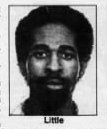
Jerry Lee Little Jr.: The St. Louis Serial Killer
Early Life and Criminal History
Jerry Lee Little Jr. was born in 1956 in Marks, Mississippi. When he was approximately four years old, his family moved to St. Louis, Missouri. His father died not long after the move, leaving Little and his siblings to be raised primarily by their mother. Little struggled in school, frequently missed classes, and ended his formal education after completing the sixth grade.
Little began accumulating a serious criminal record while still a teenager. In 1971, at approximately 15 years old, he was arrested and convicted of rape. He received a five-year juvenile sentence and was paroled in 1974. His release was brief. Within weeks, Little participated in a robbery and gang rape, resulting in another conviction and a 20-year prison sentence.
Little served much of that sentence at the Missouri Eastern Correctional Center. He was paroled in early 1984 and attempted to establish a more conventional life. He married a woman he had met while incarcerated, obtained housing, and found work. However, in 1986, he was arrested in Kansas City for possessing marijuana. Because the arrest violated the conditions of his parole, he was returned to prison. Little was released again in August 1987 and went back to St. Louis, where he worked at a car wash and attended night school.
The Pattern of Violence
Between December 1985 and April 1988, four women connected to Little through religion, housing, charitable work, or school were killed in St. Louis. The victims differed in age and background, but investigators found important similarities among the crimes. Little was familiar with each woman or had an opportunity to approach her without immediately causing alarm. Several victims were sexually assaulted, and strangulation was a recurring method of killing.
The personal connections were especially significant. One victim had served as an assistant prison chaplain at an institution where Little had been incarcerated. Another worked in the same apartment building where Little lived. A third resided in that building, while the final victim had attended night school with him. These connections allowed Little to enter spaces in which a stranger might have been challenged or refused entry.
Confirmed Victims
- Rose Jackson, 60 — December 19, 1985 — St. Louis, Missouri: Rose Jackson was a Baptist church member who had served as an assistant prison chaplain at the institution where Little was incarcerated. Little knew her through that work. She was strangled inside her apartment, and witnesses reportedly saw Little entering or visiting the apartment shortly before the killing. Investigators initially lacked sufficient physical evidence to charge him. Her death was later included among the murders to which Little confessed.
- Patricia Ann Kelly, 50 — September 27, 1987 — St. Louis, Missouri: Patricia Ann Kelly was a Catholic nun involved in charitable programs that assisted elderly and financially struggling residents. She was raped and strangled inside the office of Missouri EnergyCare Inc., a crisis-assistance organization. The office was located in the same apartment building where Little lived with his wife. There were no clear signs of forced entry, suggesting that Kelly may have known her attacker or allowed him into the office. Little was familiar with her and had reportedly been seen at the office shortly before the murder.
- Imogen Jackson, 28 — March 10, 1988 — St. Louis, Missouri: Imogen Jackson lived in the apartment building where Little and his wife resided. She was sexually assaulted and strangled in or near her living quarters. As in the Kelly case, investigators found no obvious indication that a stranger had violently forced his way inside. Little’s residence in the building, his familiarity with its occupants, and his access to its hallways made him a central figure in the investigation.
- Doris Orly Hayes, 48 — April 10, 1988 — St. Louis, Missouri: Doris Orly Hayes became acquainted with Little while attending night school. Her murder was not initially one of the principal cases being used to investigate him. Little disclosed his responsibility for Hayes’s death while being questioned about the other women. His confession allowed authorities to connect her killing to the same offender responsible for the deaths of Rose Jackson, Patricia Kelly, and Imogen Jackson.
The Investigation
By the summer of 1988, St. Louis investigators were examining possible connections between the murders of Patricia Kelly and Imogen Jackson. Both women had ties to the apartment building where Little lived, and both had been sexually assaulted and strangled. Detectives learned that Little knew Kelly and had access to the building where Jackson was killed. His proximity to the victims and crime scenes made him increasingly difficult to dismiss as a coincidence.
Investigators also reconsidered the unsolved murder of Rose Jackson. Although she was not related to Imogen Jackson, she had a separate and direct connection to Little through her prison ministry. Little had been seen entering Rose Jackson’s apartment shortly before she was found strangled. That information had aroused suspicion in 1985, but authorities had not possessed enough evidence to prosecute him at the time.
Police intensified their work in late July and early August 1988. A dedicated group of detectives focused on the connected killings and Little’s movements. On August 4, 1988, he was detained and questioned. During the interrogation, Little confessed to killing Rose Jackson, Patricia Kelly, and Imogen Jackson. He also admitted responsibility for the previously unconnected murder of Doris Hayes.
The Confession and Arrest
Little’s confession was recorded, providing prosecutors with a detailed statement directly linking him to all four deaths. The admission was particularly important because investigators had limited physical evidence tying him conclusively to every crime. His knowledge of the victims, his presence near the scenes, and his recorded statements formed the central foundation of the prosecution.
Little was charged with multiple counts involving murder, rape, robbery, and related offenses. The cases demonstrated how he used familiarity and proximity to gain access to his victims. Rather than selecting women entirely at random, he targeted people whose routines or relationships gave him an opportunity to approach them.
Trial and Convictions
Little’s trial began in September 1990. His defense attorneys challenged the reliability of his confession, arguing that it had been obtained under pressure and should not be trusted. They also attempted to raise questions about his mental condition. Little’s recorded admissions nevertheless remained the most powerful evidence presented against him.
Several relatives and acquaintances testified for the defense, including Little’s wife. The defense maintained that he had falsely confessed and was not responsible for the killings. Prosecutors emphasized the specific knowledge contained in his statements, his relationships with the women, and the repeated pattern of sexual violence and strangulation.
In October 1990, Little was convicted of four murders and the accompanying violent offenses. He received nine life sentences. The punishment ensured that he would remain imprisoned for the rest of his life rather than return to the streets under another parole arrangement.
Appeal and Death in Prison
Little appealed his convictions and sought a new trial. He continued to dispute the use and reliability of his confession, but the courts rejected his arguments. In 1993, the Missouri Court of Appeals upheld his convictions and the denial of post-conviction relief.
Jerry Lee Little Jr. died on February 18, 1994, while imprisoned at the Central Utah Correctional Facility in Centerfield, Utah. He was approximately 37 or 38 years old. His death came less than four years after he received his life sentences.
Legacy of the Case
Little’s crimes exposed the danger posed by a repeat violent offender who repeatedly returned to the community after incarceration. Before the murders were fully uncovered, he had already been convicted of rape, robbery, and gang rape and had spent much of his life in correctional institutions. Each period of freedom provided another opportunity for violence.
The four women he killed were connected not by lifestyle or family relationship but by their contact with Little. Rose Jackson encountered him through prison ministry, Patricia Kelly through the apartment building and charitable work, Imogen Jackson through their shared residence, and Doris Hayes through night school. Little exploited these ordinary connections to place himself close to his victims.
The case was ultimately solved through a combination of persistent police work, recognition of similarities between the murders, and Little’s recorded confession. His convictions brought legal accountability for the deaths of Rose Jackson, Patricia Ann Kelly, Imogen Jackson, and Doris Orly Hayes, four women whose lives ended during a violent series of crimes in St. Louis.