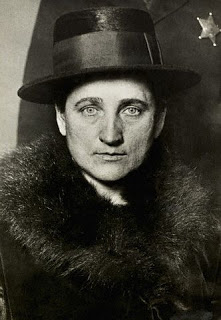
Ottilie “Tillie” Klimek: Chicago’s Arsenic Poisoner
Early Life and Background
Ottilie “Tillie” Klimek, born Otylia Gburek in Poland in the 1870s, became one of Chicago’s most notorious suspected poisoners. Her family immigrated to the United States while she was young and settled among the city’s large Polish community. Klimek later married several times and lived primarily in working-class neighborhoods on Chicago’s Northwest Side.
Klimek developed a disturbing reputation for predicting that people around her would soon die. She spoke of dreams and premonitions in which she supposedly saw funerals, coffins and approaching deaths. Those predictions appeared remarkably accurate because the people she discussed often became violently ill soon afterward. Investigators eventually concluded that her supposed supernatural knowledge concealed a deliberate pattern of arsenic poisoning.
A Pattern of Suspicious Deaths
The pattern surrounding Klimek became noticeable after several husbands, romantic partners, relatives and acquaintances suffered similar illnesses. Victims reportedly experienced severe abdominal pain, vomiting, weakness and prolonged physical deterioration. These symptoms could resemble food poisoning, heart disease or other natural illnesses, allowing arsenic poisoning to go undetected when no autopsy was performed.
Klimek frequently behaved as though she knew exactly when a sick person would die. While her husband Frank Kupczyk was seriously ill, witnesses said she repeatedly told him that he would not live much longer. She reportedly prepared mourning clothing, knitted a funeral hat and obtained a discounted coffin before his death. Instead of appearing frightened by his illness, she allegedly joked with neighbors about how little time he had left.
Victims and Suspected Victims
Klimek was convicted of only one murder, but investigators connected her to numerous suspicious deaths and illnesses. Historical records contain several variations in the spelling of Polish surnames. Exact calendar dates are not consistently preserved, so only verified years or documented dates are included below.
- John or Jozef Mitkiewicz — January 13, 1914 — Chicago, Illinois: Klimek’s first husband died following a short illness. His death was initially attributed to heart trouble. After Klimek’s arrest, his remains were among those examined during the investigation, and arsenic was reportedly discovered.
- John or Joseph Ruszkowski — May 20, 1914 — Chicago, Illinois: Klimek married Ruszkowski shortly after the death of her first husband. He survived the marriage for only a few months before dying after another suspicious illness. Investigators later regarded him as a probable poisoning victim.
- Joseph Grantkowski — 1914 — Chicago, Illinois: Grantkowski was described in contemporary accounts as a former boyfriend or romantic companion who had rejected Klimek. He died under suspicious circumstances during the same year as two of her husbands. Although he was included among her alleged victims, she was never tried for his death.
- Helen Zakrzewski — 1915 — Chicago, Illinois: Helen, a teenage relative, died after Klimek had reportedly helped care for her during an illness. Investigators later examined the deaths of several young members of the Zakrzewski family, although no separate murder charge was filed in Helen’s case.
- Joseph Guszkowski — 1916 — Chicago, Illinois: Guszkowski was identified in some accounts as another husband or romantic partner. His death followed a period of illness and was later included among the suspicious deaths linked to Klimek.
- Rose Chudzinski — 1919 — Chicago, Illinois: Chudzinski was a neighbor or acquaintance who reportedly became ill after attending a social gathering connected to Klimek. Her death was investigated as a possible arsenic poisoning, but Klimek was not convicted in connection with it.
- Frank Kupczyk, also spelled Kupszyk or Kupzsyk — 1921 — 924 North Winchester Avenue, Chicago, Illinois: Kupczyk was the husband whose death led to Klimek’s murder conviction. He endured a prolonged illness as Klimek openly predicted his death and prepared for his funeral. His body was later exhumed, and investigators reported finding a lethal concentration of arsenic. Klimek was convicted of murdering him in March 1923.
Other Deaths Examined by Investigators
Authorities investigated a much wider circle of deaths involving Klimek and her cousin, Nellie Koulik. Among those discussed in contemporary reports were teenage relatives Stanley and Stella Zakrzewski, as well as members of Koulik’s household. Some of these individuals had died before Klimek’s established period of criminal activity, and the evidence connecting Klimek personally to their deaths was incomplete.
Police reportedly reviewed approximately twenty suspicious deaths or illnesses associated with the two women, with as many as fourteen of the individuals already dead. Newspapers sensationally portrayed the investigation as the discovery of a neighborhood poisoning ring. Other women were questioned, and Klimek was described as the central figure or “high priestess” of what reporters called a “Bluebeard clique.” The evidence ultimately did not support convictions for a large organized conspiracy.
Surviving Poisoning Victims
Several people allegedly survived attempts to poison them. Their survival helped expose the pattern because physicians were able to examine them while arsenic remained detectable in their bodies.
- Joseph or Anton Klimek — poisoned in 1922 — 1453 Tell Place, now Thomas Street, Chicago, Illinois: Klimek’s final husband became gravely ill after eating food she prepared. His relatives removed him from the home and obtained medical treatment. Doctors discovered evidence of arsenic poisoning, and he survived after an extended hospitalization.
- Rose Splitt — early 1920s — Chicago, Illinois: Splitt reportedly became extremely ill after eating candy supplied by Klimek following a disagreement. She survived and later gave information concerning Klimek’s behavior.
- Stella Grantowski — early 1920s — Chicago, Illinois: Grantowski, the sister of one of Klimek’s former companions, allegedly became ill after receiving candy from Klimek. She recovered and was treated as another possible attempted-poisoning victim.
- Nick Micko — early 1920s — Chicago, Illinois: Micko, a relative, reportedly suffered arsenic poisoning after eating in Klimek’s home but survived.
- Bessie Kupczyk — early 1920s — Chicago, Illinois: Bessie, a relative of Frank Kupczyk, became seriously ill after eating food associated with Klimek. She recovered and was included among the suspected poisoning survivors.
The Poisoning of Joseph Klimek
The investigation finally began in earnest when Klimek’s last husband, Joseph Klimek, became seriously ill in 1922. His condition resembled the illnesses that had preceded the deaths of her earlier husbands. Members of his family became suspicious and arranged for him to be examined away from his wife. Hospital testing revealed arsenic in his system.
Investigators searched Klimek’s home and examined the deaths surrounding her. They learned that she had access to arsenic-based rat poison and that insurance policies had been placed on the lives of some of her husbands. Her habit of predicting deaths, preparing funeral clothing and discussing coffins before a victim had died became important evidence of premeditation.
Exhumations and Physical Evidence
Authorities ordered the exhumation of former husbands, including Frank Kupczyk. Chemical examinations reportedly revealed arsenic in their remains. Investigators also tested soil from around the graves to address the possibility that the poison had entered the bodies after burial. The findings strengthened the prosecution’s argument that the victims had consumed arsenic while alive.
Arsenic was widely available during the early twentieth century in rat poisons and household products. When administered gradually, it produced symptoms that could be mistaken for digestive disease or contaminated food. Klimek was accused of mixing the substance into meals, candy and other items given to people she wanted to punish or remove.
Arrest and Prosecution
Klimek was arrested in October 1922. Her cousin Nellie Koulik was also arrested after investigators alleged that she had supplied Klimek with rat poison and may have participated in separate poisonings. Klimek reportedly admitted poisoning her surviving husband but attempted to justify her actions by portraying him as abusive or unfaithful. She denied responsibility for the broader series of deaths.
The prosecution concentrated on the murder of Frank Kupczyk because the physical evidence and witness testimony in his case were especially strong. Neighbors described Klimek’s repeated predictions, her comments about Kupczyk’s approaching death and her preparations for his funeral. Medical experts testified about the arsenic discovered during the examination of his remains.
Conviction and Sentence
In March 1923, a Cook County jury found Ottilie Klimek guilty of murdering Frank Kupczyk. Some jurors reportedly considered imposing the death penalty, but the jury ultimately agreed upon a sentence of life imprisonment. At the time, it was considered one of the harshest punishments imposed upon a woman in Cook County.
Nellie Koulik remained imprisoned while awaiting her own trial but was eventually acquitted. Despite the large number of suspicious cases uncovered during the investigation, Klimek was never prosecuted for the other deaths. Her legal status therefore remained that of a woman convicted of one murder but suspected of committing several additional killings.
Death and Legacy
Klimek spent the remainder of her life in the Illinois prison system. She died in custody on November 20, 1936, and was buried at Bohemian National Cemetery in Chicago. She continued to deny responsibility for most of the deaths associated with her.
The exact number of people killed by Klimek remains uncertain. Estimates commonly range from five to seven probable victims, while contemporary investigators examined a much larger collection of deaths and nonfatal illnesses. Her case became infamous because of the combination of domestic poisoning, financial motives and theatrical claims that she could foresee death. The supposed predictions were ultimately understood not as supernatural visions, but as indications that Klimek knew when her victims would die because she had already begun poisoning them.