William Kelly and the Kelly Family Murders
Overview
William Kelly was the patriarch of a frontier family accused of murdering and robbing travelers during the final months of 1887. Kelly, who was approximately 55 years old at the time, operated with his wife, Kate Kelly, their 20-year-old son, Bill or “Billy” Kelly, and their 18-year-old daughter, Kit Kelly. The family became known as the Kelly Gang, the Kelly Friends, or simply the Kelly Family.
The Kellys lived in an isolated area near Oak City in the lawless territory commonly called “No Man’s Land.” The region later became part of the Oklahoma Panhandle, although nineteenth-century newspaper accounts sometimes described the location as being in Kansas. Their property stood near a road traveled by cattlemen, merchants, salesmen and other people crossing the frontier.
The family maintained a small cattle operation and a roadside tavern where travelers could obtain food or shelter. According to contemporary reports, this ordinary appearance concealed a carefully organized robbery and murder operation. Between approximately August and December 1887, at least eleven people reportedly disappeared after traveling through the area around the Kelly residence.
The Kelly Family’s Murder Method
The Kellys allegedly selected victims who appeared to possess money, valuable merchandise, horses or other property. A traveler arriving at the tavern would be welcomed inside and questioned during conversation. William, Bill or Kit might speak with the visitor while Kate prepared a meal. This allowed the family to determine whether the guest carried anything worth stealing.
Accounts of the case claimed that the tavern contained an ingeniously constructed trapdoor. The victim’s chair was positioned over or near the concealed opening. Once the family gave a signal, the trapdoor was released, causing the unsuspecting traveler to fall into the cellar beneath the building.
Some victims may have died from injuries suffered in the fall. Those who survived were reportedly struck with an axe or another heavy weapon. The bodies were then concealed beneath the tavern or buried around the barn and stable. The victims’ money, horses, watches and other possessions were taken by the family.
The method closely resembled the crimes attributed to the Bloody Benders, another frontier family accused of killing travelers in Kansas during the 1870s. The similarities were so striking that some nineteenth-century observers speculated that the Kellys and the Benders were connected or possibly even the same people living under different names. No reliable evidence established that theory.
Discovery of the Bodies
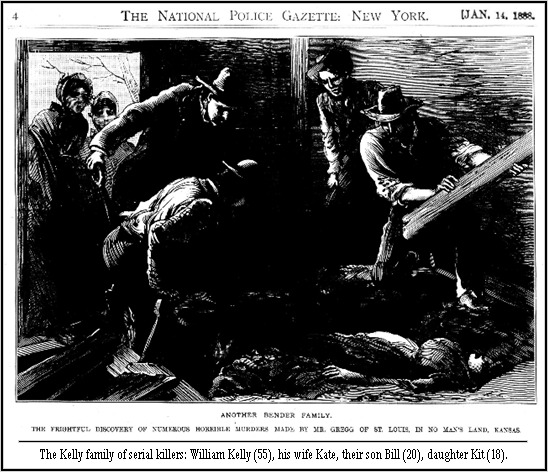
In December 1887, the Kelly family abruptly abandoned its home. A traveler from St. Louis identified in historical reports as S. T. Gregg stopped at the property after noticing that the family had disappeared. When he entered the building, he encountered a powerful odor of decomposition.
Gregg traced the smell to a concealed area beneath the tavern. Three badly decomposed bodies were reportedly found in or near the cellar. He notified people in the surrounding area, and a search party arrived to examine the property.
Searchers began digging near the barn after noticing disturbed or unusually loose soil. They uncovered another body with a fractured skull, apparently caused by an axe or similar instrument. Continued digging revealed additional human remains around the barn, stable and nearby ground.
A total of eleven bodies were reportedly recovered. William Kelly later confessed that the family had killed nine men and two women. Most of the remains were so badly decomposed that they could not be conclusively identified. Only a small number of victims were tentatively recognized through clothing, possessions or information concerning missing travelers.
Searchers also reportedly found an old axe bearing material believed to be blood and human tissue. The weapon was considered evidence that at least some victims had been struck after being dropped through the trapdoor or otherwise overpowered inside the tavern.
Known and Unidentified Victims
Exact dates of death were not recorded for the individual victims. Historical accounts place the murders between August and December 1887. Because the bodies were discovered in advanced stages of decomposition, it was impossible to establish a verified death date for each person.
- J. T. Taylor — A traveling salesman, sometimes described as a wealthy “drummer,” from Chicago, Illinois. Taylor disappeared while traveling through No Man’s Land and was believed to have been killed at the Kelly tavern between August and December 1887. One of the better-dressed bodies was identified as Taylor through clothing or personal effects. William Kelly reportedly possessed Taylor’s gold watch when captured. Taylor’s exact date of death is unknown.
- Jim Coven — A cattleman who reportedly conducted business in the surrounding territory and in Texas. His remains were said to have been identified through clothing after the bodies were discovered at the Kelly property in December 1887. Coven was believed to have been killed sometime between August and December 1887. His exact date of death is unknown.
- Johnson — A Texas merchant whose first name was not preserved in the available historical reports. He was reportedly recognized through clothing or belongings among the bodies recovered from the property. Johnson was believed to have been killed between August and December 1887. His precise date of death and hometown remain unknown.
- Unidentified male victim — One of three decomposed male bodies discovered in the cellar or concealed area beneath the Kelly tavern in December 1887. His exact date of death is unknown.
- Unidentified male victim — Another man found beneath or near the tavern. Decomposition prevented a reliable identification. He was believed to have died during the Kelly family’s crime spree between August and December 1887.
- Unidentified male victim — A man whose body was uncovered near the barn with severe damage to the skull. Investigators believed he had been struck with an axe. His exact date of death is unknown.
- Unidentified male victim — One of several victims buried beneath or beside the stable and barn. No verified name or death date was established.
- Unidentified male victim — A traveler believed to have been robbed and murdered at the Kelly property during the final months of 1887. His remains were too decomposed for identification.
- Unidentified male victim — One of the nine men William Kelly reportedly admitted that the family had killed. His name, hometown and exact date of death remain unknown.
- Unidentified female victim — One of two women reportedly found buried on the Kelly property. Historical accounts did not preserve her identity or the circumstances that brought her to the tavern. She was believed to have been killed between August and December 1887.
- Unidentified female victim — The second woman included among the eleven recovered victims. Her name, age, hometown and exact date of death remain unknown.
The Search for the Kelly Family
After the bodies were uncovered, witnesses reported seeing the Kelly family traveling away from the region with several horses and an apparently unusual amount of money. A posse of approximately twenty armed men was organized to pursue them.
The posse followed the family south through the frontier, reportedly tracing them toward Palo Duro Creek and Wheeler, Texas. A prolonged horseback chase followed. During the pursuit, Kate Kelly’s horse stumbled or fell. Kate was thrown to the ground and reportedly suffered a fatal broken neck.
Bill and Kit Kelly were captured approximately half an hour later. The posse did not take them before a court. Instead, the siblings were placed beneath a tree and prepared for immediate execution. According to later accounts, Kit considered confessing, but Bill told her not to cooperate. Both were lynched and left hanging from the tree.
William Kelly’s Capture and Confession
William Kelly initially escaped from the posse. His horse, however, had reportedly been fitted with shoes only on its front hooves, producing a distinctive trail that allowed the pursuers to continue tracking him. After several hours, the posse approached closely enough to fire shots and order him to surrender.
Kelly dismounted and was surrounded. He first denied participating in any murders, claiming that the family had left because it had heard about violence and disappearances in the area. The posse rejected his explanation.
Historical reports state that the vigilantes placed a rope around Kelly’s neck and briefly hanged him before lowering him to the ground. Faced with another hanging, he reportedly confessed that every member of the family had participated in the killings.
Kelly admitted that the family had murdered nine men and two women. He also disclosed the location of stolen money and property. A gold watch identified as belonging to J. T. Taylor was reportedly found among Kelly’s possessions, providing a direct connection between him and one of the missing travelers.
William Kelly’s Death
After obtaining the confession, the posse stripped Kelly of his valuables and hanged him from a tree. William, Bill and Kit Kelly are generally reported to have died on January 4, 1888, in South Texas. Kate Kelly died during the same pursuit after being thrown from her horse.
None of the Kelly family members received a formal trial. No court examined the physical evidence, tested the confession or determined the individual responsibility of each family member. The posse acted as a vigilante force in a region where organized law enforcement and clearly established legal jurisdiction were extremely limited.
Questions About the Historical Record
The Kelly Family murders were reported in numerous newspapers during the closing days of 1887 and the opening weeks of 1888. However, the surviving accounts contain contradictions. Some reports gave different descriptions of the discovery, the location of the property, the number of bodies initially found and the deaths of the Kelly family members.
Some newspapers claimed that Kate and Kit were shot, while others stated that Kate died in a riding accident and Kit was hanged with her brother. Reports also disagreed about how many bodies were positively identified. One account recognized only J. T. Taylor, while later retellings named Jim Coven and a Texas merchant named Johnson.
Because the alleged offenders were killed without trial, no complete prosecution file was created. Much of the story rests on newspaper reports, frontier testimony and later retellings. The precise details of the trapdoor mechanism, the order of the killings and the roles played by individual family members cannot be independently confirmed.
Legacy
William Kelly became remembered as the leader of one of the American frontier’s most disturbing alleged family murder operations. By presenting themselves as tavern keepers, the Kellys could observe travelers, identify those carrying valuables and attack them in a location far from immediate assistance.
The discovery of eleven bodies transformed the family’s isolated property into the scene of a major frontier atrocity. The three partially identified victims represented only a fraction of the people believed to have died there. Eight others entered history without confirmed names, hometowns or exact dates of death.
The case also illustrates the uncertainty surrounding crimes committed in remote nineteenth-century territories. The Kellys were never questioned under lawful conditions, the bodies were not examined with modern forensic methods, and the alleged killers were executed before their statements could be tested in court.
Despite those limitations, the central account remained consistent: eleven people, including nine men and two women, were found dead at the Kelly property after months of disappearances. William Kelly confessed to the family’s involvement and was found carrying property linked to J. T. Taylor. His death at the hands of the posse ended the Kelly family’s crime spree but left the identities and personal histories of most of their victims permanently unknown.