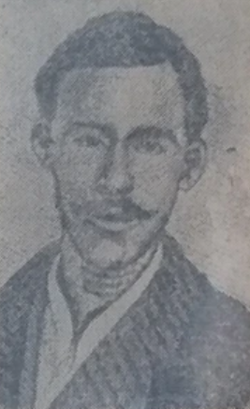
Syd Jones: The Condemned Killer Who Confessed to Thirteen Murders
Early Life and Military Background
Syd Jones was an American murderer whose background remains largely unknown. His date of birth, childhood and family history were never reliably documented. He was believed to have come from Alabama and reportedly served as a soldier in the United States Army’s 10th Cavalry Regiment. The regiment, composed primarily of Black enlisted soldiers, was stationed at several western military posts during the period in which Jones claimed to have begun killing.
Jones eventually became known as a self-confessed serial killer, but most of the information about his alleged crimes came from a note discovered on the day of his execution. In that statement, he claimed responsibility for thirteen murders committed in Alabama, Nebraska, California, Kentucky, New Mexico and Wyoming. Some of the killings corresponded with actual violent incidents, while others were never independently verified. Because many of his claims were made only hours before his death, investigators had little opportunity to question him or determine how much of the confession was true.
The Alleged Nebraska Killings
Several of the murders Jones described were connected to Crawford, Nebraska, near Fort Robinson. Jones claimed that he killed Thomas Thompson, Charles Bennett and a deputy sheriff he identified as W. S. Moseley. Later inquiries raised serious questions about the names and circumstances contained in his confession.
Authorities in Crawford reportedly stated that no deputy named W. S. Moseley had been killed in the incident Jones appeared to be describing. The lawman who died was believed to have been Art Moss, who had temporarily been placed in charge of law enforcement duties while the town marshal was away. Moss was killed during a confrontation involving soldiers from the 10th Cavalry.
The disturbance began after soldiers reportedly became involved in disorderly behavior near Crawford. When Moss attempted to restore order, gunfire erupted and he was killed. Another man, Phil Murphy, was later shot after approaching an alley guarded by soldiers who believed he might be attempting to reach a detained trooper. Jones may have participated in the violence, but the precise extent of his involvement was never conclusively established. The discrepancies suggest that he may have confused names, exaggerated his role or combined several deaths into his personal confession.
Murders in California and the American West
Jones claimed that he committed several murders while traveling or serving in the western United States. He named Shay White, Thomas Shay and Sam Lee as victims in Monterey, California. Sam Lee was described in historical accounts as a Chinese man. No exact death dates for these three victims have been reliably established, and surviving summaries provide little information about the circumstances in which they died.
Jones also claimed that he killed Pattie Quiergo, described as a Mexican woman, at Fort Wingate in New Mexico. Another alleged victim was John Little John, described as a Native American man killed in or near Sheridan, Wyoming. As with the California victims, Jones did not provide dates in his final confession, and the available historical record does not conclusively confirm his responsibility.
His account suggested a pattern of sudden and apparently unrelated violence rather than killings directed at one particular type of victim. The alleged crimes occurred across widely separated locations, making it difficult for authorities in 1915 to compare records or determine whether Jones had actually been present at every location he named.
The Alabama Prison and Mining-Camp Killings
The most clearly dated killings attributed to Jones occurred in Alabama. He claimed to have killed an unnamed convict at the Banner Mines in 1907 and another unnamed convict there in 1911. Banner Mines was associated with Alabama’s convict-leasing system, under which prisoners were forced to perform dangerous labor in mines and other industrial operations. Conditions were harsh, violence was common and deaths were not always thoroughly investigated.
Jones was eventually serving a life sentence for murder when he killed another prisoner, generally identified as Cleave Waters. Waters was killed at the Banner Mines on May 22, 1911. This murder became the crime for which Jones received a death sentence.
Historical descriptions sometimes state that Jones was executed for a murder committed in the Jefferson County jail yard, while other accounts identify Waters as a fellow convict killed at Banner Mines. The surviving record is inconsistent, but it is clear that Jones committed a murder while already imprisoned and that this killing led to his execution.
Other Victims Named in the Confession
Jones claimed responsibility for killing Bessie Humphrey in Huntsville, Alabama. He also confessed to murdering an unidentified railroad brakeman in Bardwell, Kentucky. The brakeman was said to have worked for the Mobile and Ohio Railroad. Jones did not provide the man’s name or the date of the killing.
The lack of dates and supporting details made these claims nearly impossible to verify after Jones was executed. Records from the period were incomplete, and communication between law-enforcement agencies in different states was slow. In addition, transient workers, prisoners and members of marginalized communities could disappear or die without extensive newspaper coverage or official investigation.
Known and Alleged Victims
- Unnamed convict — 1907 — Banner Mines, Alabama: Jones claimed that he killed a fellow prisoner at the mining operation. The victim’s name and exact date of death have not been established.
- Unnamed convict — 1911 — Banner Mines, Alabama: Jones confessed to killing another prisoner during 1911. No more precise date or verified identity is available.
- Cleave Waters — May 22, 1911 — Banner Mines, Alabama: Waters was a fellow convict whose murder was attributed to Jones. This killing resulted in Jones receiving a death sentence.
- Thomas Thompson — Date unknown — Crawford, Nebraska: Named by Jones in his final confession, although the circumstances and Jones’s responsibility remain uncertain.
- Charles Bennett — Date unknown — Crawford, Nebraska: Jones listed Bennett as another Nebraska victim. No verified death date was included in the surviving confession.
- W. S. Moseley or Art Moss — Date unknown — Crawford, Nebraska: Jones claimed to have killed a deputy named W. S. Moseley. Crawford authorities reportedly stated that the slain officer was actually Art Moss, creating uncertainty about Jones’s account.
- Shay White — Date unknown — Monterey, California: One of three people Jones claimed to have killed in Monterey. The date and circumstances remain unverified.
- Thomas Shay — Date unknown — Monterey, California: Named in Jones’s confession, with no reliable date of death available.
- Sam Lee — Date unknown — Monterey, California: Described as a Chinese man killed by Jones. No confirmed date or detailed account of the crime survives.
- Unidentified railroad brakeman — Date unknown — Bardwell, Kentucky: Jones claimed to have killed a Mobile and Ohio Railroad employee but did not provide the victim’s name.
- Bessie Humphrey — Date unknown — Huntsville, Alabama: Named by Jones as one of his victims. The claim was not conclusively verified.
- Pattie Quiergo — Date unknown — Fort Wingate, New Mexico: Described as a Mexican woman whom Jones claimed to have killed. Her exact date of death is unavailable.
- John Little John — Date unknown — Sheridan, Wyoming: Described as a Native American man killed by Jones. No verified date or detailed case record has been established.
The Attempted Murder of Richard Moore
Jones’s confession also referred to an unsuccessful attack on Richard Moore on September 12, 1912. Jones expressed regret that Moore survived, reportedly because another death would have brought his claimed number of victims to an even total. The statement demonstrated a chilling lack of remorse and suggested that Jones regarded the people he killed as numbers rather than human beings.
Little is known about Moore, the location of the attack or the injuries he may have suffered. Jones’s reference remains one of the few precisely dated incidents in the confession, but it is unclear whether authorities ever investigated the attempted murder after the note was discovered.
Death Sentence and Final Confession
Jones was condemned after murdering a fellow prisoner while already serving a life sentence. On June 25, 1915, he was executed by hanging in Birmingham, Alabama. He was one of several condemned prisoners executed in Alabama that day.
Before being taken to the gallows, Jones left a written note in his cell. In it, he confessed to thirteen murders and named victims from six states. The confession transformed him from a convicted prison murderer into a suspected multistate serial killer. Because the note was found at the end of his life, authorities could not interrogate him about inconsistencies, locations, motives or possible additional victims.
Questions About the Confession
Jones’s claim of thirteen murders has often been repeated as fact, but the true number of his victims remains uncertain. Cleave Waters’s death and Jones’s involvement in serious prison violence are comparatively well documented. Some of the Nebraska violence also appears to have been based on actual events, although Jones gave at least one incorrect name.
Other alleged murders have little independent documentation. Jones may have been truthful, but he may also have exaggerated, misremembered events or claimed deaths committed by other people. His military service and travels could have placed him near several of the locations he named, yet proximity alone does not prove responsibility.
The confession nevertheless contained enough specific names and places to suggest that Jones possessed knowledge of real people and incidents. Whether that knowledge came from personal participation, observation, rumor or newspaper reports could never be fully determined.
Legacy
Syd Jones remains one of the more obscure alleged serial killers of the early twentieth century. His case illustrates the difficulty of investigating crimes committed across state lines before centralized records, fingerprint databases and modern communication systems existed. It also demonstrates why a confession, especially one made immediately before execution, cannot automatically be accepted as complete proof.
Jones was unquestionably a convicted murderer who killed again while imprisoned. His claim that he murdered thirteen people may have been accurate, partially accurate or deliberately inflated. The inconsistent names, missing dates and incomplete records prevent a definitive accounting of his crimes. What survives is the disturbing story of a condemned man who used his final hours to announce that the murder for which he was executed represented only a small part of his violent history.