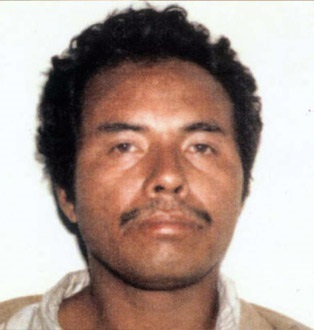
Angel Maturino Resendiz: The Railroad Killer
Overview
Angel Maturino Resendiz was a Mexican serial killer whose ability to travel secretly aboard freight trains allowed him to move across the United States without leaving the usual trail of tickets, vehicle records, credit-card charges, or hotel registrations. Known as the “Railroad Killer,” he attacked people in Texas, Florida, Kentucky, California, Georgia, and Illinois. Many of the victims lived near railroad tracks, rail yards, or freight routes that provided him with both transportation and an escape route.
Resendiz used numerous names, including Rafael Resendez-Ramirez, the identity under which he was initially sought by federal authorities. His birth name has been reported as Angel Leoncio Reyes Recendis or a similar variation. He repeatedly entered the United States without authorization, was arrested and deported several times, and accumulated convictions for burglary, vehicle theft, assault, immigration violations, and the use of false identities.
His confirmed and suspected crimes stretched from the 1980s through June 1999. Resendiz generally selected residences close to railroad lines, entered through unlocked doors or windows, and attacked occupants with objects found at the scene. His victims varied greatly in age and background. They included students, elderly people, a physician, a minister and his wife, a teacher, and travelers who encountered him aboard a freight train.
Known, Confessed, and Suspected Victims
- Unidentified woman — 1986, Bexar County, Texas: Resendiz later claimed that he shot an unidentified woman several times and left her body at an abandoned farmhouse. Human remains discovered on March 23, 1986, have been associated with his confession, although the woman’s identity and exact date of death remain uncertain.
- Unidentified man — 1986, between San Antonio and Uvalde, Texas: Resendiz claimed that he killed a man described as the unidentified woman’s boyfriend and disposed of the body near a creek. No remains were conclusively located, and the account depended primarily on Resendiz’s later statements.
- Michael White — July 19, 1991, San Antonio, Texas: White, 22, was found beaten to death with a brick in the yard of an abandoned house. Resendiz confessed years later and reportedly supplied investigators with details and a map of the location. Authorities eventually concluded that his account corresponded with the crime.
- Jesse Howell — March 23, 1997, near Belleview in Marion County, Florida: Howell, 19, was traveling with his fiancée, Wendy Von Huben. The couple encountered Resendiz while riding in a freight car. Howell was beaten to death with a heavy railroad air-brake coupling, and his body was left beside railroad tracks.
- Wendy Von Huben — March 23, 1997, Sumter County, Florida: Von Huben, 16, disappeared after Howell was killed. Resendiz later admitted assaulting and strangling her before burying her in a shallow grave. In 2000, he directed investigators to the area where her remains were recovered.
- Roberto Castro — July 5, 1997, Colton, California: Castro, 54, was a transient found beaten to death in or near a railroad yard. Resendiz was identified as a leading suspect, although the case was not the basis of a completed murder prosecution against him.
- Christopher Maier — August 29, 1997, Lexington, Kentucky: Maier, 21, was walking beside railroad tracks with University of Kentucky student Holly Dunn when Resendiz confronted them. Maier was killed with a large rock. Dunn was sexually assaulted, severely beaten, and left for dead, but she survived and later became an important witness.
- Leafie Mason — October 4, 1998, Hughes Springs, Texas: Mason, 87, was attacked inside her home, which stood close to railroad tracks. Resendiz entered through a window and beat her to death with an antique iron from the residence. Evidence ultimately connected him to the killing.
- Fannie Whitney Byers — December 10, 1998, Carl, Georgia: Byers, 81, was beaten to death inside her home near a railroad line. A heavy metal object, commonly described as a tire rim or wheel component, was used in the attack. Other people were initially accused, but Resendiz later claimed responsibility. The murder remained one of the cases attributed to him through confession rather than a separate conviction.
- Claudia Benton — December 17, 1998, West University Place, Texas: Benton, 39, was a physician and pediatric neurologist. Resendiz entered her home near railroad tracks, sexually assaulted her, stabbed her, and beat her with a bronze statuette. He stole property and escaped in her Jeep. His fingerprints were discovered in the vehicle, providing investigators with crucial evidence. This was the murder for which he was convicted and sentenced to death.
- Norman J. “Skip” Sirnic — May 2, 1999, Weimar, Texas: Sirnic, 46, was the minister of the United Church of Christ in Weimar. He and his wife lived in a parsonage near a railroad line. Resendiz entered the home and killed Sirnic with a sledgehammer while the couple was in bed.
- Karen Sirnic — May 2, 1999, Weimar, Texas: Karen Sirnic, 47, was killed beside her husband with the same sledgehammer. Evidence indicated that she was also sexually assaulted. Resendiz stole the couple’s red Mazda, which was later recovered in San Antonio.
- Noemi Dominguez — June 4, 1999, Houston, Texas: Dominguez, 26, was a schoolteacher living close to railroad tracks. Resendiz entered her residence, sexually assaulted her, and killed her with a pickax. He then stole her automobile and used it to travel away from Houston.
- Josephine Konvicka — June 4, 1999, Dubina in Fayette County, Texas: Konvicka, 73, was killed in her rural home only hours after Dominguez. Reséndiz used a pickax during the attack and left the weapon at the scene. Fingerprint and other evidence connected him to the residence.
- George Morber Sr. — June 15, 1999, Gorham, Illinois: Morber, reported as 79 or 80 years old in different accounts, was killed in his home about 100 yards from a railroad line. He was shot with a shotgun during the attack.
- Carolyn Frederick — June 15, 1999, Gorham, Illinois: Frederick, Morber’s adult daughter, was also attacked inside the home. Resendiz sexually assaulted her and fatally beat her with the shotgun, striking her so violently that the weapon broke. The Illinois double homicide became one of the final known attacks of his 1999 crime series.
Pattern of the Crimes
Resendiz’s use of the railroad system was central to his ability to avoid detection. He climbed aboard freight trains and traveled without documents, reservations, or predictable schedules. After arriving in a town, he could walk along the tracks, identify isolated houses, and disappear aboard another train after an attack. Because the murders occurred in widely separated jurisdictions, local investigators initially had little reason to believe that the cases were connected.
The attacks did not follow a single victim profile. Some victims were elderly and living alone, while others were couples or younger people encountered near train tracks. Resendiz frequently used a weapon available at the scene, including rocks, bricks, irons, statues, sledgehammers, railroad equipment, firearms, and household tools. This reduced the need for him to carry an identifiable murder weapon from one location to another.
Robbery was often part of the crimes. Resendiz stole cash, jewelry, identification cards, vehicles, and personal belongings. Some stolen items were reportedly taken to relatives in Mexico. Investigators also determined that he sometimes remained inside victims’ homes after the murders, eating food or examining their possessions before leaving.
Identification and the Nationwide Manhunt
Investigators gradually connected the murders through fingerprints, DNA, stolen vehicles, railroad geography, and similarities in the attacks. Claudia Benton’s stolen Jeep was especially important. When it was found in San Antonio, fingerprints recovered from the steering column were traced to Resendiz’s immigration and criminal records.
The investigation was complicated by his many aliases and conflicting personal information. Government agencies had records under different names, and he had crossed the United States–Mexico border repeatedly. In one of the most heavily criticized events of the case, Border Patrol agents detained him near El Paso on June 1, 1999, but returned him to Mexico before authorities recognized that he was wanted in connection with the railroad murders. He reentered the United States and committed additional killings days later.
On June 21, 1999, the FBI placed him on its Ten Most Wanted Fugitives list. His photographs and aliases were distributed nationwide as law-enforcement agencies watched freight yards, railroad routes, homeless shelters, and border crossings. The publicity also reached members of his family.
Surrender and Confessions
Resendiz’s sister, Manuela, helped authorities arrange his surrender. She was reportedly afraid that he would kill again or be killed by police or bounty hunters. Texas Ranger Drew Carter negotiated with the family and met Resendiz at the international bridge between Ciudad Juarez, Mexico, and El Paso, Texas.
Resendiz surrendered on July 13, 1999. He was taken into custody without a violent confrontation and transferred to Houston to face charges. Over time, he admitted responsibility for several murders and provided information about additional victims. Some confessions were supported by physical evidence, while other claims could not be independently verified. His changing accounts made it difficult to determine the exact number of people he killed.
Trial for the Murder of Claudia Benton
Texas prosecutors selected the Claudia Benton case because the physical evidence against Resendiz was particularly strong. His fingerprints had been found in Benton’s stolen vehicle, and additional forensic evidence connected him to the murder.
During the 2000 trial, the defense argued that Resendiz suffered from severe mental illness and believed that he was carrying out a divine mission against people or places he considered evil. A defense psychiatrist described him as paranoid and delusional. Prosecutors maintained that he understood that his actions were wrong and that his behavior showed careful planning, concealment, robbery, and escape.
The jury rejected the insanity defense and convicted him of capital murder. On May 22, 2000, he was sentenced to death. The conviction covered Benton’s murder, although evidence and confessions linked him to numerous other killings.
Execution
Resendiz remained on Texas death row while his attorneys pursued appeals and questioned his mental competency. Courts ultimately permitted the execution to proceed. He was executed by lethal injection at the Huntsville Unit in Huntsville, Texas, on June 27, 2006.
In his final statement, Reséndiz asked the victims’ relatives for forgiveness and acknowledged that he deserved his punishment. Family members of several victims attended the execution. He was pronounced dead at 8:05 p.m.
Legacy of the Case
The exact number of Resendiz’s victims remains uncertain. He was conclusively convicted of Claudia Benton’s murder, confessed to several additional killings, and was linked through forensic or circumstantial evidence to others. Authorities have investigated him in connection with still more unsolved deaths near railroads, but not every suspected case could be proven.
The investigation exposed serious problems in communication among immigration authorities, local police departments, state investigators, and federal agencies. Resendiz had been detained, deported, and released under different identities even while evidence was beginning to identify him as a serial murderer. His ability to move through freight corridors demonstrated how a highly mobile offender could exploit jurisdictional boundaries and fragmented record systems.
Beyond the name given to the killer, the case is remembered for the lives he destroyed. His victims were individuals whose ordinary homes, workplaces, relationships, and journeys were suddenly invaded by violence. Holly Dunn’s survival provided investigators and the public with a firsthand account of one of the attacks, while the victims’ families continued to speak about the lasting consequences of the crimes long after Resendiz was captured and executed.