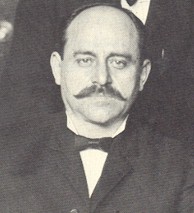
Johann Otto Hoch: The “Bluebeard” Poisoner
Overview
Johann Otto Hoch was a German-born bigamist, swindler and suspected serial killer who operated in the United States during the late nineteenth and early twentieth centuries. Born John Schmidt in Germany, he used many false names, including Jacob Huff, Henry Bartels, Albert Buschberg, Martin Dotz, Dr. James and Johann Otto Hoch. His true birth year is disputed, with historical accounts generally placing it between 1855 and 1862.
Hoch became known as the “Chicago Bluebeard” and the “Bluebeard Murderer” because he repeatedly courted, married and robbed women. Many of his targets were widows or unmarried women who had homes, savings, insurance policies or valuable property. He often presented himself as a respectable businessman, doctor, pharmacist or wealthy gentleman. After gaining a woman’s trust, he persuaded her to marry him and give him control of her money. Some women were abandoned after being robbed. Others became suddenly and violently ill, often with symptoms associated with arsenic poisoning.
His Method of Finding Victims
Hoch frequently searched newspaper marriage advertisements and “lonely hearts” columns for women seeking companionship. He was especially interested in German-speaking widows because he could approach them through their churches and immigrant communities. He proposed marriage very quickly, sometimes only days after meeting a woman. His confident manner, musical ability and claims of financial success helped him appear respectable.
After a marriage, Hoch commonly asked his wife for money to purchase furniture, open a store or invest in a business. He also encouraged some women to name him as the beneficiary of an insurance policy. When he had obtained what he wanted, he either disappeared or allegedly began giving the woman small doses of poison. Investigators later believed that arsenic was his preferred weapon.
The Death of Caroline Miller Hoch
One of the earliest well-documented suspicious deaths connected to Hoch occurred in Wheeling, West Virginia. In early 1895, he arrived there under the name Jacob Huff and opened a saloon in a German neighborhood. He soon began courting several financially comfortable widows.
Caroline Miller Hoch was a widow who owned a house, had approximately $900 in savings and carried a life-insurance policy worth about $2,500. Despite warnings from the Reverend Herman C. A. Haass, she married Hoch on April 18, 1895. Before long, the previously healthy woman became seriously ill.
On June 14, Reverend Haass visited Caroline’s sickroom and reportedly saw Hoch give her a white powder. Caroline appeared frightened and reluctant to take it. Her condition included severe vomiting, swelling and a painfully distended abdomen. She died early the following morning, June 15, 1895, in Wheeling.
After her death, Hoch obtained her money, sold her property and collected the insurance payment. He then staged his own apparent suicide by leaving clothing, a watch and a note near the Ohio River. No body was found. Investigators later concluded that he had crossed the river and escaped. He subsequently began using Caroline’s surname, Hoch, as one of his principal identities.
Other Suspicious Marriages and Deaths
During the following years, Hoch moved between cities and states while continually changing his name. Historical investigations linked him to women in Illinois, Wisconsin, Ohio, Indiana, Missouri, New York, New Jersey, Pennsylvania, California and West Virginia. Newspapers also claimed that he may have operated in Europe.
In August 1895, Hoch reportedly married Maria Steimbucher in Chicago. She died approximately four months later after declaring that she believed she had been poisoned. Hoch then sold property associated with her for about $4,000. A precise calendar date for her death has not been reliably established.
In Milwaukee in 1893, a man using the name “Dr. James,” believed to have been Hoch, reportedly married Lena Schmitz. She later died, and he was then said to have married her sister Clara, who also died. Contemporary reports did not provide dependable full dates for either death.
In Cincinnati, Hoch married Clara Bartel in November 1896. She reportedly died approximately three months later. In 1902, he married Mary Becker of St. Louis, who was reported dead in 1903. In June 1904, he married a woman identified as Lena Hoch in Milwaukee. She reportedly died about three weeks later, leaving him approximately $1,500. Complete and independently confirmed death dates for these women have not survived in the available historical record.
The Disappearance of Mary and Nettie Schultz
After being released from custody in 1900, Hoch traveled to Argos, Indiana, using the name Albert Buschberg. He introduced himself to the recently widowed Mary Schultz as a wealthy Chicago druggist. He married her and gained access to money connected with her late husband’s insurance policy.
Hoch persuaded Mary and her fifteen-year-old daughter, Nettie Schultz, to travel with him to Chicago. Both mother and daughter then disappeared, along with their savings. Their bodies were never conclusively identified, and no verified dates of death exist. Investigators nevertheless regarded their disappearance as one of the most disturbing incidents connected to Hoch.
The Murder of Marie Walcker
The crime that finally resulted in Hoch’s conviction began in Chicago late in 1904. Marie Walcker, whose surname was also written as Walker in some records, operated a small candy store. Hoch courted her while using the name Joseph Hoch. They married on December 10, 1904.
Marie sold her business and gave Hoch her savings, reportedly totaling several hundred dollars. On December 20, only ten days after the wedding, she became seriously ill. Her symptoms continued for several weeks while Hoch remained in control of her household and treatment.
Marie Walcker died on January 12, 1905, at 6034 Union Avenue in Chicago, Illinois. Her death was initially treated as natural. However, Hoch’s behavior immediately afterward created suspicion. On the night Marie died, he began courting her widowed sister, Emilie Fischer. He married Emilie on January 15, only three days after Marie’s death, and obtained approximately $750 from her. He then disappeared.
Emilie reported him to the police. Marie’s body was exhumed, and chemical testing detected arsenic. Unlike many earlier bodies associated with Hoch, Marie’s remains had been treated with an embalming fluid that did not contain arsenic. This allowed investigators to argue that the poison had entered her body before death rather than during embalming.
Victims and Suspected Victims
- Caroline Miller Hoch — Died June 15, 1895, in Wheeling, West Virginia. She became violently ill after marrying Hoch, who was then using the name Jacob Huff. Hoch obtained her savings, property and life-insurance money. Her death was strongly suspected to have resulted from poisoning, although he was not convicted in the case.
- Maria Steimbucher — Died around December 1895 in Chicago, Illinois, approximately four months after marrying Hoch on August 5, 1895. She reportedly stated before her death that she had been poisoned. The exact date of her death remains uncertain.
- Clara Bartel — Reportedly died around February 1897 in Cincinnati, Ohio, about three months after marrying Hoch in November 1896. Her exact date of death has not been reliably confirmed.
- Wilhelmina Hoch — Reported to have died in 1898 in Buffalo, New York. Surviving accounts do not provide a dependable full date or conclusive proof that Hoch caused her death.
- Unnamed wife of “Martin Dotz” — Reportedly died in June 1898 in Chicago, Illinois. Hoch was known to use Martin Dotz as an alias, but the woman’s identity and exact death date remain unclear.
- Mary Becker — Reportedly died in 1903 after marrying Hoch in St. Louis, Missouri, on April 8, 1902. A precise and independently verified date of death is unavailable.
- Mary Schultz — Disappeared in 1900 after traveling from Argos, Indiana, to Chicago with Hoch. She was accompanied by her daughter Nettie. Neither a body nor a verified date of death was established.
- Nettie Schultz — The fifteen-year-old daughter of Mary Schultz. She disappeared with her mother in 1900 after accompanying Hoch to Chicago. Her fate and date of death remain unknown.
- Lena Hoch — Reportedly died around July 1904 in Milwaukee, Wisconsin, approximately three weeks after marrying Hoch in June. She allegedly left him about $1,500. Her exact death date is uncertain.
- Marie Walcker Hoch — Died January 12, 1905, at 6034 Union Avenue in Chicago, Illinois. Arsenic was found in her remains. This was the only murder for which Hoch was tried, convicted and executed.
Arrest and Evidence
After leaving Emilie Fischer, Hoch traveled to New York City and rented a room from Catherine Kimmerle. Using the name Henry Bartels, he reportedly proposed marriage to her shortly after arriving. On January 30, 1905, Kimmerle recognized his photograph in a newspaper and contacted the authorities.
Police arrested Hoch and found several suspicious objects among his belongings. These reportedly included wedding rings with identifying inscriptions removed, a revolver and a fountain pen containing arsenic. Hoch claimed that he had intended to use the poison to kill himself, but investigators believed it was connected to his method of poisoning women.
As news of his arrest spread, women from several cities identified him as a former husband, fiancé or swindler. Police attempted to reconstruct years of marriages, disappearances and unexplained deaths. The large number of aliases, incomplete records and frequent movement between states made it impossible to determine the exact number of victims.
Trial and Execution
Hoch was tried in Chicago for the murder of Marie Walcker. Prosecutors presented evidence of arsenic poisoning, his rapid marriage to Marie’s sister and his repeated pattern of marrying women for financial gain. The jury found him guilty on May 19, 1905. He was formally sentenced to death on June 23, 1905.
His attorneys filed appeals and delayed the execution several times, but the courts refused to overturn his conviction. Johann Otto Hoch was hanged in Chicago on February 23, 1906. He continued to claim innocence shortly before his death.
Uncertain Number of Victims
Hoch was convicted of only one murder, but police and newspaper writers suspected him of killing many more women. Estimates have ranged from approximately fifteen to fifty victims. Such numbers should be treated cautiously because many accusations came from sensational newspaper reports, incomplete investigations and incidents involving women who were robbed or deserted but not necessarily murdered.
Arsenic was difficult to detect in bodies from this period because many embalming fluids contained the same substance. In the Caroline Hoch investigation, her body was exhumed, but the organs needed for testing had been removed. In other cases, bodies were never found, records were missing or Hoch’s aliases prevented investigators from confirming that the same man had been involved.
Legacy
Johann Otto Hoch remains one of the most notorious marriage swindlers and suspected poisoners in American criminal history. His crimes exposed the dangers faced by financially independent widows who used early matrimonial advertisements to seek companionship. He exploited loneliness, trust and the limited ability of police departments in different states to exchange information.
His case also demonstrated the importance of forensic toxicology. The arsenic discovered in Marie Walcker’s body provided the physical evidence that earlier investigations had lacked. Although the full number of women he killed will probably never be known, the verified murder of Marie Walcker and the suspicious death of Caroline Miller Hoch reveal a calculated pattern of courtship, financial exploitation, poisoning and escape.