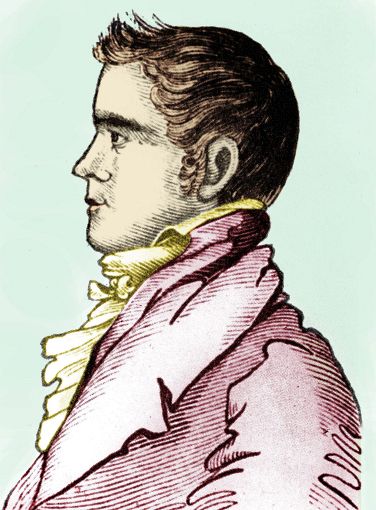
Samuel Green: The “Terror of New England”
Samuel Green was an early nineteenth-century American murderer, robber, burglar, counterfeiter, and habitual escapee whose crimes became notorious throughout New England. Born in Meredith, New Hampshire, in 1796, Green spent much of his short adult life moving between New Hampshire, Vermont, Massachusetts, Maine, New York, and parts of Canada. Later accounts have frequently described him as one of the earliest American serial killers and as an early example of a widely hunted “public enemy.” However, because his crimes occurred more than two centuries ago, many stories about his supposed victims survive only in later histories rather than complete court records. The murder that can be established most firmly is the killing of fellow prisoner Billy Williams in Massachusetts in 1821.
Early Criminal Life
Accounts of Green's youth describe a pattern of theft, destructive behavior, cruelty to animals, and retaliation against people who disciplined him. As a young man he drifted increasingly toward burglary and robbery. He eventually became associated with another criminal, William Ash. The pair were said to travel through New England stealing property, breaking into buildings, robbing travelers, and repeatedly escaping attempts to imprison them. Green was regarded as the more violent of the two.
Green also became involved in counterfeiting and apparently learned skills useful for burglary, including lock picking and the duplication of keys. His mobility made him particularly difficult for early nineteenth-century authorities to contain. Police organizations were local, communication between jurisdictions was slow, and there was no modern system for exchanging fingerprints, photographs, or centralized criminal records. A wanted man could therefore cross a state boundary and make identification considerably more difficult.
Murders Attributed to Green
Historical accounts attribute several killings to Green during his travels, although most of the supposed victims were never identified by name in surviving accounts. One commonly repeated story concerns a jewelry salesman encountered by Green and William Ash in Bath, New Hampshire. According to the story, the salesman allowed the men to examine his merchandise. Green and Ash later ambushed him while he was traveling, knocked him down, robbed him, and decided that he could not be allowed to identify them. Green was said to have killed the unconscious man with a club. The victim's name and exact date of death have not been reliably preserved, so an exact date should not be presented as established fact.
Another killing traditionally attributed to Green occurred near Middlebury, Vermont. Later biographies describe the victim as a wealthy French traveler whom Green robbed and shot. Again, surviving summaries do not provide a reliably verified name or exact date of death. Green was also accused in later accounts of killing men who pursued him following a robbery in Montreal. The number and identities of those alleged victims are uncertain. These stories contributed heavily to Green's later reputation as a serial killer, but they should be separated from the murder for which a surviving Massachusetts court decision clearly establishes his conviction.
Known and Attributed Victims
- Billy Williams — A fellow prisoner at the Massachusetts State Prison in Charlestown, Massachusetts. Green attacked Williams on November 8, 1821. Historical accounts state that Williams survived for approximately one week before dying from his injuries in mid-November 1821. The surviving sources checked for this account do not establish a sufficiently reliable exact calendar date for his death, so a more precise date is not given.
- Unnamed jewelry salesman — Reportedly robbed and killed near Bath, New Hampshire. Accounts describe Green killing the salesman after an ambush so that he could not identify the robbers. The victim's name and exact date of death are not securely documented in the available historical summaries.
- Unnamed French traveler — Reportedly robbed and shot to death near Middlebury, Vermont. The victim is described in later histories as wealthy and French, but his name and exact date of death have not been reliably established.
- Unidentified pursuers in Montreal — Later accounts claim that Green shot and killed several men while escaping from authorities after a robbery in Montreal, Lower Canada. Reliable names, an exact number of fatalities, and verified dates of death are not available, so these deaths remain attributed rather than firmly documented victims.
The Murder of Billy Williams
The killing of Billy Williams ultimately ended Green's criminal career. By this point Green had been arrested in Danvers, Massachusetts, following a burglary and was serving a prison sentence. His repeated attempts to escape made him a serious disciplinary problem. According to later accounts, prison officials eventually placed him in restrictive shackles or weighted restraints designed to make another escape more difficult.
Green believed that Billy Williams, another prisoner, had informed officials about one of his escape plans. He reportedly developed an intense desire for revenge. One account states that Green first attempted to poison Williams's food, but Williams did not eat it. On the morning of November 8, 1821, Green encountered Williams in a prison work area and attacked him with an iron bar. Williams suffered catastrophic injuries during the assault. He remained alive for approximately another week before dying.
This murder is considerably better documented than the other killings attributed to Green. The Massachusetts Supreme Judicial Court's record in Commonwealth v. Green states that Samuel Green and fellow convict Howard Trask were indicted for the murder of Billy Williams. Green was convicted of murder. Trask was found not guilty by reason of insanity. Green later sought a new trial, arguing in part that testimony against him had come from a witness whose previous criminal conviction should have affected his ability to testify. The legal effort did not ultimately save Green from execution.
Capture, Trial, and Execution
Green's conviction for Williams's murder finally produced the punishment that his previous arrests and escapes had repeatedly allowed him to avoid. The case proceeded through the Massachusetts courts during late 1821 and early 1822. His challenge following conviction became significant enough to appear in the published decisions of the Massachusetts Supreme Judicial Court, providing unusually strong documentation for this final chapter of his life.
Samuel Green was executed by hanging in Massachusetts on April 25, 1822. He was approximately twenty-six years old. Accounts of his execution portray him as defiant until the end and claim that he suggested he had written a confession explaining his crimes. No complete confession capable of definitively identifying every alleged murder victim has survived in a form that resolves the uncertainties surrounding his supposed killing spree.
Historical Reputation
Green is frequently called the “Terror of New England” and has sometimes been described as America's first serial killer. That description requires caution. Modern definitions of serial murder were developed long after Green's lifetime, and the evidence supporting many of the killings attributed to him is considerably weaker than the documentation surrounding Billy Williams's murder. Stories about Green were repeated in nineteenth-century crime literature and later collections of serial-killer history, allowing details that were difficult to verify to become part of his legend.
What can be stated with confidence is that Green was a violent career criminal who operated across numerous jurisdictions, repeatedly committed property crimes, escaped custody, and was convicted of murdering Billy Williams. Contemporary legal records confirm Williams as his murder victim and confirm Green's prosecution. Other killings in New Hampshire, Vermont, and Canada remain associated with him in historical accounts but lack the victim names and exact death dates necessary to describe them with the same certainty. This distinction is important when discussing Samuel Green: his reputation was enormous, but the surviving evidence is much clearer about his final murder than about the full number of people he may have killed.