The Freeway Phantom: Washington, D.C.'s Unsolved Serial Killer
The Freeway Phantom is the name given to an unidentified killer responsible for the murders of six Black girls and young women in the Washington, D.C., area between 1971 and 1972. The victims ranged in age from 10 to 18. They disappeared while carrying out ordinary activities such as walking to a store, going to work, returning from school, or traveling home by bus. Their bodies were later discovered beside major roads in Washington or neighboring Prince George's County, Maryland. The similarities among the crimes eventually convinced investigators that they were dealing with a serial murderer.
The case became particularly disturbing because the killer appeared able to abduct victims from populated neighborhoods without attracting attention. Several victims were found without their shoes, strangulation was a recurring feature, and investigators later discovered matching green synthetic fibers on the clothing of five of the six victims. In the fifth murder, a handwritten message apparently dictated by the killer was found with the victim and signed "Free-way Phantom," giving police the name by which the murderer would become permanently known.
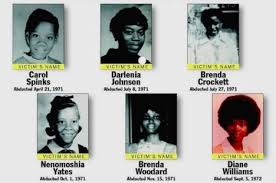
The Victims
Exact medical times of death were not established in every case. In several instances, historical police records establish the disappearance and recovery dates more clearly than the precise day on which the victim died. Where the exact death date remains uncertain, that uncertainty is noted rather than treating the recovery date as an unquestioned date of death.
- Carol Denise Spinks, 13: Carol disappeared on April 25, 1971, after walking from her home in Southeast Washington to a 7-Eleven on Wheeler Road, just across the Maryland line. She bought groceries but vanished on the return trip. Her body was discovered on May 1, 1971, on a grassy embankment beside the northbound lanes of Interstate 295, approximately 1,500 feet south of Suitland Parkway and near St. Elizabeths Hospital. She had been sexually assaulted and strangled, and her shoes were missing. The medical findings indicated that she had been dead for only part of the six days she was missing, suggesting that she may have been held alive for several days. Her exact date of death was therefore in late April 1971 rather than firmly established as May 1.
- Darlenia Denise Johnson, 16: Darlenia disappeared on July 8, 1971, after leaving her home in the Congress Heights area to travel to her summer job at a recreation center in Oxon Hill, Maryland. She never arrived. Her body was recovered on July 19, 1971, beside Interstate 295, only about 15 feet from the location where Carol Spinks had been found. Decomposition was advanced enough that the medical examiner could not establish an exact date or definitive cause of death, although investigators reported evidence consistent with strangulation. Her shoes were also missing. The exact day of Darlenia's death remains uncertain.
- Brenda Faye Crockett, 10: Brenda disappeared on the evening of July 27, 1971, after her mother sent her to a nearby Safeway from the family's Northwest Washington neighborhood. Later that night, Brenda telephoned home. She said that a man had picked her up and that she believed she was in Virginia. Police later suspected she had been forced to give misleading information during the calls. Her body was discovered at approximately 5:50 a.m. on July 28 beside U.S. Route 50 in Prince George's County, near the Baltimore-Washington Parkway. She had been sexually assaulted and strangled with a scarf. Her shoes were missing. Because she was alive during the telephone calls on July 27 and was found early the next morning, her death occurred sometime between late July 27 and the early hours of July 28, 1971.
- Nenomoshia "Neno" Yates, 12: Nenomoshia disappeared on October 1, 1971, after going to a Safeway near Benning Road to buy household items for her family. She was last known to have completed her shopping but never reached home. Her body was discovered only a few hours later beside Pennsylvania Avenue in Prince George's County, Maryland, just beyond the District line. She had been sexually assaulted and strangled, and her shoes were missing. Because the disappearance and recovery occurred within the same short period, her death is established as October 1, 1971.
- Brenda Denise Woodard, 18: Brenda disappeared during the night of November 15, 1971. She had attended night classes at Cardozo High School and afterward ate with a friend at Ben's Chili Bowl on U Street. She later traveled by bus toward her home and was last known to have gotten off in Northeast Washington to make a connection. About six hours later, during the early morning of November 16, a police officer discovered her body in a grassy area near an access ramp connecting the Baltimore-Washington Parkway and Route 202 in Prince George's County. Brenda had been strangled and stabbed. Unlike the previous victims, she was found with her footwear. A handwritten message was discovered in her coat pocket. Investigators concluded that the handwriting was Brenda's but believed the words had been dictated by her killer. The message challenged police to catch the murderer and was signed "Free-way Phantom." Her death occurred during the overnight period between November 15 and November 16, with some records listing November 15 as the date of death.
- Diane Denise Williams, 17: Diane disappeared during the night of September 5, 1972, after visiting her boyfriend. She had earlier cooked dinner for her family and was later seen boarding a bus to return home. She never arrived. At approximately 6:30 a.m. on September 6, a motorist discovered her body on the shoulder of Route 295 just north of the Maryland-District of Columbia line in Prince George's County. She had been strangled. Maryland State Police records list September 5, 1972, as her date of death. Diane was the sixth and final victim officially associated with the Freeway Phantom series.
A Pattern Emerges
The murders developed a recognizable pattern. Most of the victims were young girls who vanished close to home while performing normal errands or traveling familiar routes. Several were taken from busy areas where an abduction should theoretically have been difficult to conceal. Their bodies were then deposited in locations accessible by automobile, frequently beside major highways connecting Washington with Prince George's County.
Strangulation connected the murders particularly strongly. Carol Spinks, Brenda Crockett, Nenomoshia Yates, Brenda Woodard, and Diane Williams were clearly documented as having been strangled. Darlenia Johnson's remains were too decomposed for a definitive cause of death, although investigators found indications suggesting strangulation. At least several of the victims had also been sexually assaulted.
Another important connection came from microscopic evidence. Investigators eventually determined that the same type of green synthetic fiber appeared on the clothing of five victims. Detectives believed the fibers could have come from carpeting, a rug, upholstery, or another surface inside a place where the victims had been held or transported. Unfortunately, much of the original physical evidence from the cases was later lost or destroyed, severely limiting the usefulness of modern forensic testing.
The Free-way Phantom Note
The murder of Brenda Woodard provided investigators with their most unusual piece of evidence. Inside her coat was a handwritten note containing hostile statements about women and a challenge suggesting that the writer would acknowledge the other killings when police caught him. It ended with the name "Free-way Phantom."
Police compared the handwriting with Brenda's schoolwork and concluded that she herself had written the note. Investigators therefore developed the theory that the killer had dictated the message to her before murdering her. If correct, the incident meant that Brenda had spent enough time in the killer's presence to be forced or persuaded to write several sentences. The unusual vocabulary used in the message, particularly the word "tantamount," later became an important clue when detectives investigated possible suspects.
Suspects and Investigation
The Freeway Phantom murders produced an enormous investigation involving D.C. police, Prince George's County authorities, Maryland investigators, and the FBI. Detectives examined large numbers of possible suspects and looked for connections to schools, recreation centers, neighborhoods, prisons, and known sexual offenders. Despite the scale of the investigation, no person was ever charged with the six murders.
One theory focused on men associated with a group of offenders sometimes called the Green Vega Rapists, who were responsible for numerous sexual attacks in the Washington area during roughly the same period. An imprisoned member reportedly claimed that members of the group had participated in the Phantom murders, but he later withdrew his account. Investigators ultimately concluded that the evidence was insufficient to attribute the six killings to that group.
Another major suspect was Robert Elwood Askins, a convicted kidnapper and sexual offender who came under scrutiny during the late 1970s. Investigators considered his criminal history, his familiarity with Washington, and reports that he frequently used the unusual word "tantamount," which had appeared in the Woodard note. Police obtained a warrant, searched his property, and investigated him extensively. No physical evidence tied Askins to the murders, however, and he was never charged as the Freeway Phantom.
An Unsolved Case
More than half a century after the first murder, the identity of the Freeway Phantom remains unknown. The Metropolitan Police Department continues to identify Carol Spinks, Darlenia Johnson, Brenda Crockett, Nenomoshia Yates, Brenda Woodard, and Diane Williams as the six victims in the case. No arrest has produced a proven explanation for the entire series.
The case also remains significant because of the victims themselves. Six young Black girls and women disappeared from the nation's capital during ordinary moments of everyday life, and their families were left without a conviction or definitive answer. The surviving records describe a murderer who repeatedly operated around Washington's streets and highways, apparently moving victims by vehicle and abandoning them in accessible roadside locations. Despite massive investigative efforts, numerous suspects, and decades of renewed examination, the Freeway Phantom has never been conclusively identified.