The Dayton Strangler: Dayton's Unidentified "Jack the Strangler"
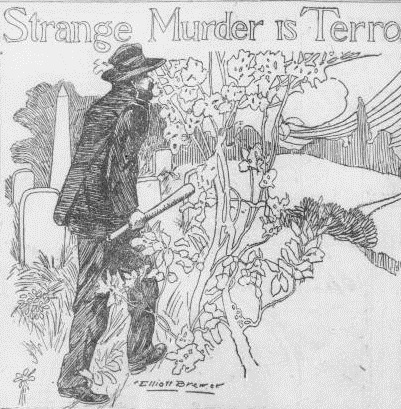
The Dayton Strangler was the name given to an unidentified killer believed responsible for a series of murders in Dayton, Ohio, during the first decade of the twentieth century. Newspapers also referred to the unknown offender as "Jack the Strangler," the "Strangler of Death Lane," and, in some sensational accounts of the period, the "Man-Gorilla of Death Lane." The exact number of victims remains disputed, but a core group of five female victims and one male victim is commonly associated with the case.
The murders occurred during an era when Dayton was rapidly expanding as an industrial city. Streetcars carried thousands of workers between residential neighborhoods and factories, while many streets on the outskirts of the city remained poorly illuminated. Several of the crimes occurred near streetcar routes, railroad lines, isolated fields, parks, or the National Soldiers' Home. Investigators repeatedly arrested suspects, obtained questionable confessions, and pursued competing theories, but no person was ever conclusively established as the killer responsible for the entire series.
The Murder of Ada Lantz
The earliest killing later associated with the Dayton Strangler occurred on the evening of October 13, 1900. Ada Lantz was only 11 years old. Her parents were holding a birthday gathering at their home on Leroy Street in Dayton, and numerous adults and children were present. While the adults were occupied with the celebration, Ada went outside and disappeared.
When her absence was noticed, relatives and guests searched the neighborhood with lanterns. Attention eventually turned to the privy behind the Lantz residence. Ada's body was discovered inside the vault beneath it. Contemporary accounts and later cemetery records place her death on October 13, 1900. She had been assaulted, struck in the face, and strangled before her body was concealed.
Several people came under suspicion. An 18-year-old named Harrison Blessing was arrested approximately a year later and was reported to have confessed, but authorities did not have sufficient evidence to establish his guilt and he was released. Ada's murder remained unsolved. Because it occurred six years before the next major Dayton killing, some researchers treat her as a possible rather than certain victim of the later serial murderer. The similarities in the assault and strangulation, however, caused her case to become closely associated with the Dayton Strangler series.
The Murder of Dona Gilman
On November 20, 1906, Dona Gilman, approximately 20 years old, left her job in the bindery department of the National Cash Register Company and traveled toward her West Dayton home by streetcar. She was last seen at about 5:40 that evening. She never arrived home.
Gilman's body was discovered on November 22 in weeds near Groveland and Grandview avenues, not far from her family's residence. Investigators concluded that she had been strangled and assaulted. Evidence surrounding the condition and position of her body caused investigators to question whether she had actually been killed where she was found or whether her body had been moved after death.
The Gilman investigation became extraordinarily confused. Numerous suspects were questioned. One of the most memorable was David Curtis, a 27-year-old newspaper seller sometimes called "Baby Dave." Curtis confessed and provided a story in which he claimed to have followed Gilman from a streetcar and strangled her. His reliability immediately became an issue because he was known for making fantastic claims and had previously confessed to a crime he had not committed. Curtis later said he had been pressured into confessing, and the case against him collapsed.
Suspicion even fell on members of Gilman's own family. Her mother, brother, and sisters became entangled in the investigation after officials advanced theories that the killing had occurred closer to home. Those accusations ultimately failed to produce a conviction. Dona Gilman's murder remained unsolved and later became one of the central crimes attributed to the Dayton Strangler.
The Attack on Anna Markowitz and Abe Cohan
On the night of August 4, 1907, Anna Markowitz was walking near the National Soldiers' Home with her sister Bertha and Anna's companion, Abraham "Abe" Cohan, who was also reported in contemporary newspapers under the surname Gordon. The group entered a relatively isolated area near what became known as McCabe Park.
According to Bertha's account, a man suddenly attacked Cohan from behind with a club, blackjack, or similar weapon. When Cohan turned toward him, the attacker shot him in the abdomen. The assailant then moved toward the two sisters. Bertha escaped and ran for help, leaving Anna behind.
A search party returned and found the severely wounded Cohan. A trail through the vegetation led searchers to Anna's body. She had fought with her attacker, had been sexually assaulted, and had been strangled. More reliable local historical research identifies Anna as 18 years old, although some contemporary newspaper reports incorrectly gave her age as 24.
Cohan was taken to a hospital but remained in extremely serious condition and was unable to provide investigators with a reliable account of his attacker. He died from the gunshot wounds on August 6, 1907. The killing of a male companion distinguished this attack from the other crimes: the gun appears to have been used to eliminate Cohan before the assailant concentrated on Anna.
The Conviction of Layton Hines
The Markowitz-Cohan murders produced the most consequential arrest of the entire investigation. Layton Hines, also identified in some records as Layton Marion, was arrested in October 1907. Officials announced that Hines had confessed. He was prosecuted for Anna Markowitz's murder and convicted of first-degree murder, with the jury recommending mercy rather than execution.
The reliability of Hines's confession was disputed. Hines recanted and claimed that officials had frightened or pressured him into admitting responsibility. Even at the time, some investigators and members of the public questioned whether he was capable of committing the crime as described. The most damaging development for the prosecution's theory came later: women continued to be attacked and murdered in Dayton while Hines was imprisoned.
For that reason, the Hines conviction did not end public belief in the Dayton Strangler. Instead, the murders of 1909 strengthened the argument that the person responsible for the series remained free.
The Murder of Mary Forschner
Mary Forschner was 15 years old when she left her North Dayton home shortly after 6 p.m. on January 23, 1909. She was carrying money and a bankbook and was expected to make a family deposit at the Dayton Savings and Trust Company. She did not return.
Mary's family initially hoped she had gone elsewhere, but concern increased as the evening passed. Her stepfather, Robert Geppert, joined neighbors in searching the area. Searchers noticed disturbed ground and followed a muddy trail onto the nearby Grafton C. Kennedy estate. Inside a small barn or shed, they found Mary's body.
Mary had been sexually assaulted and strangled. Her death certificate records January 23, 1909, and lists strangulation by the hand as the cause. This is significant because some later summaries incorrectly date her murder to January 24. Contemporary circumstances and the surviving death record establish that she disappeared and died on January 23.
The coroner reportedly observed unusually extensive finger impressions around Mary's neck and concluded that her killer possessed very large hands. Reports also emerged of a suspicious man in the neighborhood. A woman identified as Mrs. Scheff reportedly encountered a man who followed her after she left a streetcar, while another resident reported seeing a suspicious stranger near the area of Mary's murder.
Once again, suspects were detained and released. Charles Snyder, a boarder at the Geppert home, was questioned after claims were made about his appearance after the murder, but investigators did not establish a case against him. Other men were also examined without any conclusive result.
The Death of Elizabeth "Lizzie" Fulhart
Elizabeth "Lizzie" Fulhart was an 18-year-old woman from Vandalia who regularly traveled into Dayton. Historical research based on contemporary reporting indicates that she disappeared on January 29, 1909, only days after Mary Forschner was killed.
On February 5, 1909, Charles Weaver and his father were working at a vacant property at 124 North Jefferson Street in Dayton. When they attempted to use an old cistern, they discovered a human body inside. The remains were identified as Elizabeth Fulhart.
Her body had been concealed in the cistern and was associated with a piece of burlap or gunny sack. The coroner believed she had been dead for approximately a week. Therefore, her precise date of death cannot responsibly be stated as a single confirmed day. The evidence places her death at approximately January 29 or January 30, 1909. Later accounts giving February 7 or February 8 as her death date confuse the chronology of her disappearance and the discovery of her body.
Unlike the Forschner case, decomposition prevented doctors from establishing exactly how Fulhart had died. Investigators considered strangulation, poisoning, drugging, and other possibilities. No obvious fatal wound was identified. Despite the uncertainty surrounding the medical cause of death, newspapers of the period immediately discussed Fulhart alongside the other unsolved Dayton murders.
The location was particularly important to later investigators. The cistern was behind property associated with B'nai Yeshurun, the congregation now known as Temple Israel. That connection would eventually lead to one of the most persistent modern theories about the Dayton Strangler's identity.
Victims Commonly Attributed to the Dayton Strangler
- Ada Lantz — Age 11. Died October 13, 1900. Murdered at or near her family's Leroy Street residence in Dayton, Ohio. She was assaulted and strangled, and her body was concealed in the vault beneath the family's outdoor privy.
- Dona Gilman — Approximately age 20. Died November 20, 1906. Last seen traveling home from work in Dayton. Her body was discovered on November 22 in a field or thicket near Groveland and Grandview avenues in West Dayton. She had been assaulted and strangled.
- Anna Markowitz — Age 18. Died August 4, 1907. Attacked in the McCabe Park/National Soldiers' Home area of Dayton while walking with her sister Bertha and Abe Cohan. She was sexually assaulted and strangled.
- Abraham "Abe" Cohan — Died August 6, 1907. Attacked with Anna Markowitz on August 4 near the National Soldiers' Home. He was struck and shot in the abdomen while apparently attempting to resist the attacker and died in a Dayton hospital two days later.
- Mary Forschner — Age 15. Died January 23, 1909. Disappeared while leaving her North Dayton home to make a bank deposit. Her body was discovered on the Grafton C. Kennedy estate near her Keowee Street neighborhood. She had been sexually assaulted and strangled by hand.
- Elizabeth "Lizzie" Fulhart — Age 18. Disappeared January 29, 1909 and was probably killed January 29 or January 30. Her body was discovered February 5, 1909 in a cistern at a vacant property on North Jefferson Street in Dayton. Decomposition prevented the coroner from determining a definite cause of death.
A City Gripped by Fear
By early 1909, Dayton's unsolved murders had developed into a national story. Newspapers compared the unknown killer to London's Jack the Ripper. Reports emphasized the repeated strangulation of young women, the sexual nature of several attacks, and the failure of police to stop the crimes despite repeated arrests.
The murders also exposed the limitations of criminal investigation in the early twentieth century. Modern DNA testing did not exist. Fingerprinting was only beginning to enter routine American police work, and blood typing had little practical investigative value. Investigators relied heavily on eyewitnesses, physical descriptions, informants, confessions, and circumstantial evidence. False or unreliable confessions repeatedly complicated the Dayton cases.
There was also no modern concept of criminal profiling or an established investigative system for linking sexually motivated murders. Although journalists increasingly suspected that one offender was responsible for several crimes, authorities often investigated each killing largely as an individual event.
The Hick White Theory
One of the strongest modern theories identifies a man commonly known as Hick White as a possible Dayton Strangler. White worked as a janitor at B'nai Yeshurun, the synagogue connected to the property near which Elizabeth Fulhart's body was discovered.
White became especially significant after an attack on February 2, 1910. A 25-year-old Springfield woman named Bessie Stickford was reportedly lured to the synagogue with the promise of employment. She was assaulted and raped at knifepoint but survived and identified White. He was convicted and imprisoned for that crime.
Researcher and former University of Dayton criminal justice instructor Brian Forschner, a relative of victim Mary Forschner, later argued that White was responsible for the Dayton murders. Forschner noted White's documented predatory behavior, his connection to the location where Fulhart's body was hidden, and the apparent end of the Dayton murder series after White's incarceration.
The theory is compelling to some researchers, but it has never been proven in court or established through physical evidence. Hick White should therefore be described as a modern suspect rather than as the confirmed Dayton Strangler.
Other Suspects and Failed Leads
The investigation produced an extraordinary number of suspects. Harrison Blessing was investigated in connection with Ada Lantz. David Curtis confessed to killing Dona Gilman but was cleared. Members of the Gilman and Markowitz families were at various times suspected and released. Layton Hines was convicted in the Markowitz case despite serious questions about his confession. Other men, including James Rogers, Jeremiah Cronin, Elmer Carr, and several transient or local suspects, were investigated without producing a convincing solution to the complete series.
Elmer Carr attracted particular attention in 1909 after accusations connected him with the murders of Mary Forschner and Elizabeth Fulhart. The allegations were based largely on statements made by another person, and subsequent statements weakened the accusations. Carr was never established as the serial killer.
Possible Connection to the Cumminsville Killer
Another theory proposes that the Dayton Strangler may have been the same unidentified predator responsible for a series of murders and attacks in Cincinnati's Cumminsville neighborhood in 1904. The Cumminsville killer preyed upon women in poorly illuminated areas near railroad and streetcar routes and used methods that included bludgeoning, strangulation, and sexual assault.
Researchers have pointed to geographical and behavioral similarities between the Cincinnati and Dayton crimes. Both series occurred near transportation corridors, both involved women attacked while traveling alone, and both featured an offender capable of disappearing quickly after the crime. There is also a notable gap between the Cincinnati murders of 1904 and Dona Gilman's killing in Dayton in 1906.
No surviving physical evidence establishes that the Cumminsville killer and Dayton Strangler were the same person. The connection remains an investigative theory rather than a solved historical fact.
An Unsolved Identity
The Dayton Strangler remains unidentified. The case is especially complicated because "Dayton Strangler" was a newspaper-created label applied retrospectively to murders that may or may not all have been committed by one person. Some researchers accept five murdered girls and young women as the central series, with Abe Cohan killed during the attack on Anna Markowitz. Others include additional Ohio murders or attempt to connect the Dayton crimes to the earlier Cincinnati series.
What is clear is that Dayton experienced a disturbing succession of unsolved attacks on young women between 1900 and 1909. Ada Lantz, Dona Gilman, Anna Markowitz, Mary Forschner, and Elizabeth Fulhart became associated through similarities in their deaths, while Abe Cohan died because he was present during one of the attacks. The continued murders after Layton Hines was imprisoned left enduring doubts about his conviction and reinforced the belief that a serial predator had remained at large.
More than a century later, researchers continue examining contemporary newspapers, cemetery records, death certificates, trial records, and geographical patterns in an effort to determine whether Hick White, another known suspect, or an unidentified offender was responsible. Without surviving forensic evidence capable of conclusively connecting a suspect to the victims, the true identity of the Dayton Strangler remains one of Ohio's enduring historical murder mysteries.