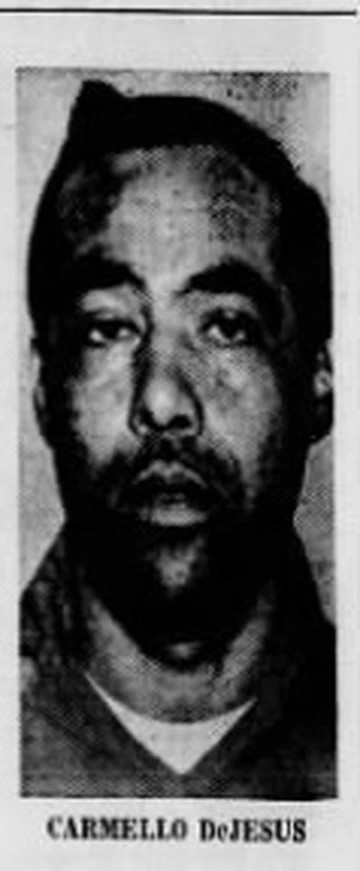
Carmello DeJesus: The Itinerant Killer
Overview
Carmello DeJesus was an itinerant gambler and career criminal whose life on the margins of society was punctuated by bursts of extreme violence. Between 1971 and 1973, he murdered at least three women in two different states, each killing sparked by a sudden, furious argument. His crimes were not connected by investigators until he brought the cases to a dramatic and unexpected close himself. A fugitive for two years, DeJesus was finally cornered by the law after his third known murder. Rather than face capture, he took his own life in a desolate field in upstate New York. He left behind a handwritten confession tucked inside a Bible, admitting to the three killings and claiming a fourth, unidentified victim. His suicide note provided answers that had eluded police across multiple jurisdictions but also created an enduring mystery that remains unsolved.
Early Life and Criminal Background
Born in Puerto Rico in 1934, very little is publicly known about the childhood or upbringing of Carmello DeJesus. At some point, he relocated to the mainland United States, where he embarked on a life of transience and crime. He was known to law enforcement under several aliases, including Antonio Angel DeJesus and Jimenez DeJesus. His official FBI rap sheet began in 1960 and grew steadily over the next decade, documenting a man who lived outside the law.
His criminal record spanned both New Jersey and Florida, reflecting his itinerant lifestyle. He accumulated convictions for a range of offenses including burglary, gambling, assault, and possession of stolen property. DeJesus was not just a petty criminal; he was also a defiant one, having successfully escaped from prison on two separate occasions prior to his murder spree. This history painted a portrait of a man with a profound disregard for authority and a proven ability to disappear when necessary. He was described by those who knew him as a gambler with a volatile temper, a trait that would ultimately define his deadly path.
The First Murder: Octavia Ford
The string of killings began on September 17, 1971, in the city of Bridgeton, New Jersey. The victim was 42-year-old Octavia Ford, a woman with whom DeJesus was acquainted, and some reports suggested they were in a relationship. On that day, DeJesus broke into her home on South Avenue. When Ford confronted him, the encounter escalated violently. DeJesus produced a gun and shot her once in the chest. Her body was discovered later by neighbors on the back porch of her house.
Immediately after the murder, DeJesus fled. He drove his car to a spot near Woodstown, about 15 miles away, where he abandoned it and stole another vehicle to continue his escape. The crime scene and his known association with the victim quickly made him the primary suspect. On October 28, 1971, a Cumberland County grand jury returned a five-count indictment against him in absentia. The charges included murder, atrocious assault and battery, breaking and entering with intent to kill, larceny of a firearm, and threatening the life of another individual, William Gould, on the same day.
The indictment officially triggered a multi-state manhunt. A federal warrant for unlawful flight to avoid prosecution was issued, bringing the FBI into the search. DeJesus, however, had vanished, beginning a two-year period as a fugitive. Some later sources would mistakenly refer to the victim as Octavia Lloyd, but contemporary court and news records confirm her name as Octavia Ford.
On the Run and a Second Murder: Sandra Lee Postell
For the next sixteen months, Carmello DeJesus successfully evaded capture. The FBI chased leads across the country and beyond. Sightings were reported in Pennsylvania, New York, and Florida, with some tips even suggesting he had fled to Mexico or back to his native Puerto Rico. Despite the widespread search, he remained a ghost.
At some point during this period, he settled for a time in the small hamlet of Egypt, within the town of Perinton, New York, a suburb of Rochester. There, he lived an unassuming life, finding work as a sweeper at the Comstock Canning Company. He kept a low profile, and there is no indication he committed any violent acts during 1972.
His murderous rage resurfaced at the beginning of 1973. By then, he had made his way to Delray Beach, Florida. On January 5, 1973, DeJesus was at a motel where he knew a 30-year-old woman named Sandra Lee Postell, who also went by the name Sandy Lee Barbery. An argument erupted between them; the specific cause was never determined. In a fit of anger, DeJesus attacked Postell with a knife, slitting her throat. Just as he had done in New Jersey, he immediately fled the scene, leaving local police with a homicide but no suspect in custody. The murder remained unsolved, with no apparent connection to the fugitive wanted for a killing in Bridgeton, New Jersey.
The Final Murder: Milagro Ines Tena
After the murder of Sandra Postell, DeJesus once again disappeared. Eight months later, in the late summer of 1973, he was living in Camden, New Jersey. There, he became involved with Milagro Ines Tena, a 40-year-old single mother. She lived in an apartment on North 25th Street with her 23-year-old son.
On Saturday, September 1, 1973, Tena’s son was away for the Labor Day weekend, leaving her alone in the apartment with DeJesus. Another argument broke out, and it quickly turned deadly. As Tena tried to flee the apartment, DeJesus shot her once through the heart. The single bullet entered her upper right chest and exited through her back, killing her instantly.
Her body was not discovered until two days later, on Monday, September 3, when her daughter came to visit the apartment and found the horrific scene. Camden police were called, and their investigation rapidly identified DeJesus as the prime suspect. He was known to have been with Tena, and he had disappeared immediately after the estimated time of her death. A warrant for his arrest was issued on September 4, and his name was once again circulated to law enforcement agencies. This time, however, the net was closing faster than he knew. Some sources would later refer to this victim as Milagros Inez Pena, but contemporary reports confirmed her name as Milagro Ines Tena.
The Victims
- Octavia Ford, 42 — September 17, 1971, in Bridgeton, New Jersey. A woman who knew DeJesus, she was shot and killed inside her home after confronting him during a break-in.
- Sandra Lee Postell, 30 — January 5, 1973, in Delray Beach, Florida. Also known as Sandy Lee Barbery, she was killed in a motel after an argument with DeJesus, who slit her throat.
- Milagro Ines Tena, 40 — September 1, 1973, in Camden, New Jersey. A single mother of two, she was shot to death in her apartment by DeJesus during a heated altercation while her son was away.
Investigation and Suicide
The murder of Milagro Tena set off an intense, localized manhunt. Camden police, certain that DeJesus was their man, focused their efforts on the surrounding area. Unbeknownst to them, DeJesus had already fled the state, heading north to a place where he had previously found anonymity: Perinton, New York.
On Saturday, September 8, 1973, just one week after he killed Tena, two teenage boys were walking through a field off Route 31F near the Wayne County line, just outside the town of Perinton. There, they stumbled upon the body of a man. Near the body lay a .32-caliber revolver, a half-empty bottle of whiskey, and a Spanish-language Bible.
Monroe County Sheriff's deputies responded to the scene. The man had a single gunshot wound to the chest. An autopsy later confirmed the cause of death was suicide; the bullet had pierced his lung. Fingerprints were taken and sent to the FBI, who quickly made a positive identification: the deceased was 39-year-old Carmello DeJesus, the fugitive wanted for murder in two states.
The most crucial piece of evidence was found tucked between the pages of the Bible. It was a two-page suicide note, written in Spanish and addressed to his mother and siblings in Puerto Rico. In the letter, DeJesus expressed a chilling finality. "I have killed four persons and I don't want to kill anyone else," he wrote. "That's why I want to end my life."
He then proceeded to confess to the murders that had baffled police. He admitted to killing Octavia Ford in Bridgeton on September 17, 1971; Sandra Lee Postell in Delray Beach on January 5, 1973; and Milagro Ines Tena in Camden on September 1, 1973. The details he provided matched the specifics of the unsolved cases, allowing authorities in New Jersey and Florida to officially close their investigations. His confession, born of a desire to end his own life, had solved three homicides.
Aftermath and the Unidentified Fourth Victim
The suicide of Carmello DeJesus brought an end to his violent spree and provided justice, of a sort, to the families of his known victims. However, his final words left law enforcement with one last, nagging question. He had confessed to killing four people but had only named three.
The note offered no name, no date, no location, and no details whatsoever about this fourth murder. Investigators were left with a ghost victim and a vast field of possibilities. Police departments in New York, New Jersey, and Florida immediately began reviewing their unsolved murder files, hoping to find a case that might fit DeJesus's timeline and methods.
Speculation arose that the fourth murder might have occurred in Puerto Rico, given his origins and the fact that an FBI warrant had been issued for him from San Juan. However, authorities later clarified that this warrant was related to his flight after the Bridgeton murder, not a separate crime on the island. Another lead pointed to a 1968 murder in Miami, Florida, for which DeJesus had once been a suspect. Charges in that case had been dropped for reasons that remain unclear. Investigators re-examined the file after his suicide, but no definitive link could be established.
Despite the efforts of multiple agencies, the identity of the fourth person Carmello DeJesus claimed to have killed has never been discovered. The confession that closed three cases simultaneously opened a new one—a cold case with no known victim, no crime scene, and a killer who took all the answers with him to the grave.