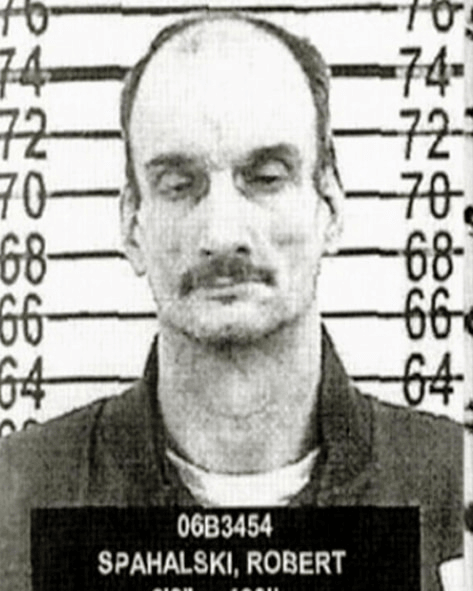
Robert Bruce Spahalski: The Rochester Serial Killer Who Confessed
Background
Robert Bruce Spahalski is an American serial killer convicted of murdering four people in the Rochester, New York, area between December 1990 and November 2005. His crimes remained separated by time, geography and circumstance until November 8, 2005, when he unexpectedly entered Rochester police headquarters and confessed. What began as an admission to a recent killing soon expanded into a series of statements about three older homicides, including cases that investigators had been unable to solve for approximately fourteen or fifteen years.
Spahalski was born on December 12, 1954, in Elmira, New York. He had an identical twin brother, Stephen Spahalski, who was separately convicted of killing a man in 1971. Robert accumulated his own lengthy criminal history beginning in adolescence, including arrests and prison terms for offenses involving vehicles, arson, burglary and other crimes. By adulthood, he was living a transient and unstable life marked by cocaine use, street activity and repeated contact with the criminal justice system.
Unlike serial killers who hunted complete strangers according to a rigid pattern, Spahalski generally killed people he knew. His victims included acquaintances, a girlfriend and individuals with whom he had personal or sexual relationships. Cocaine use was present in his descriptions of several killings, but prosecutors emphasized that drug intoxication did not excuse the deliberate acts of violence. His known methods included strangulation, blunt-force assault and beating a victim with a hammer.
Confirmed Victims
- Moraine Armstrong, 24 — December 31, 1990 — 509 Lake Avenue, Rochester, New York: Armstrong was strangled inside her Lake Avenue apartment. Spahalski later admitted that he had shared cocaine with her and became angry during an argument involving money and sex. He described choking her until she died. Her death remained unresolved for nearly fifteen years before his confession supplied details that investigators said were consistent with the evidence.
- Adrian Berger, 35 — July 21, 1991 — 85 Emerson Street, Rochester, New York: Berger was Spahalski’s girlfriend. She was found dead in her Emerson Street apartment after being strangled. Spahalski was questioned shortly after the killing because of his relationship with her, but he was not charged at that time. In 2005, he admitted killing Berger and gave investigators information about the crime that helped connect him conclusively to her death.
- Charles Grande, 40 — October 1991 — Webster, New York: Grande, a landscaping business owner, was beaten to death with a hammer. His body was discovered in Webster, a suburb east of Rochester. Court records consistently identify the homicide as occurring in October 1991, although secondary accounts differ over the precise day. Spahalski was found driving Grande’s vehicle and carrying Grande’s identification soon after the killing, making him an early suspect. Authorities lacked sufficient evidence to prosecute him for murder until he confessed in 2005.
- Vivian Irizarry, 54 — on or about November 4, 2005 — Spencer Street, Rochester, New York: Irizarry was an acquaintance who frequently visited the apartment building where Spahalski lived. She was beaten in the head and strangled with cord or twine. Spahalski dragged her body into a basement room and left it there. Her remains were recovered on November 8, 2005, after Spahalski entered police headquarters and told officers where to find her.
The Murder of Moraine Armstrong
The first murder for which Spahalski was ultimately convicted occurred on December 31, 1990. Moraine Armstrong was killed in her apartment at 509 Lake Avenue in Rochester. Investigators began examining the scene that day and conducted neighborhood interviews on January 1, 1991. Spahalski lived nearby and was questioned during the early investigation, but he denied knowing Armstrong.
Years later, Spahalski told detectives that he and Armstrong had used cocaine together. According to his confession, an argument followed when Armstrong demanded money for sex after he had shared drugs with her. He responded by strangling her. His admission contained information that investigators believed matched evidence from the original scene and circumstances that had not been widely released to the public.
Armstrong’s case had remained an unsolved Rochester homicide for almost fifteen years. There was no arrest immediately after her death, and the investigation eventually grew cold. Spahalski’s confession transformed the case by connecting a nearby man questioned during the original investigation to the killing through his own detailed account.
The Killing of Adrian Berger
On July 21, 1991, Adrian Berger was killed inside her apartment at 85 Emerson Street in Rochester. Berger was Spahalski’s girlfriend, placing him within the immediate circle of people detectives needed to interview. Investigators located him the following day at an address on Lake Avenue and asked him to accompany them to the Public Safety Building for questioning.
Despite the early suspicion surrounding him, investigators did not possess enough evidence to charge Spahalski with Berger’s murder in 1991. The case remained open while he continued moving through Rochester’s street environment and criminal justice system. When he confessed in 2005, he acknowledged strangling Berger and supplied details that supported the prosecution’s conclusion that he had killed her.
Berger’s murder demonstrated how Spahalski’s personal relationships placed his victims in danger. She was not selected randomly from a distant location. She knew him, had an intimate relationship with him and was killed in her own residence. That closeness initially drew police attention to Spahalski, but it took his eventual confession to resolve the case.
The Murder of Charles Grande
Charles Grande was killed in Webster in October 1991, only a few months after Berger’s death. Grande suffered a fatal beating with a hammer. The nature of the attack differed from the strangulations of Armstrong and Berger, but Spahalski’s involvement became apparent to investigators almost immediately because he was discovered using Grande’s property.
Police stopped Spahalski while he was driving Grande’s vehicle and presenting Grande’s driver’s license as though it belonged to him. Once Grande’s body was discovered, detectives considered Spahalski a strong suspect. He was prosecuted for criminal impersonation, but he was acquitted after questions arose about whether he matched the description associated with the vehicle incident. The evidence then available was insufficient to convict him of Grande’s murder.
Investigators never completely abandoned their suspicions. The Grande homicide remained an open cold case, and detectives reviewed the file again in October 2005, only weeks before Spahalski appeared at police headquarters. During his November interrogation, investigators confronted him about Grande. Spahalski admitted killing him and provided a written statement describing the hammer attack.
Prosecutors also argued that Grande was robbed during the homicide. This resulted in both an intentional murder charge and a felony-murder charge connected to the robbery. Grande’s killing therefore produced two of the five second-degree murder counts on which Spahalski was ultimately convicted.
The Murder of Vivian Irizarry
Vivian Irizarry’s murder ended the long gap between Spahalski’s earlier known killings and his final homicide. Irizarry was acquainted with Spahalski and his longtime companion, Christine Gonzalez. On Friday, November 4, 2005, Irizarry’s son reportedly dropped her off at the Spencer Street apartment building where Spahalski lived.
Inside the residence, Spahalski attacked Irizarry with a blunt object, striking her in the head several times. He then wrapped a piece of cord or twine around her neck and strangled her. In his later account, he claimed that cocaine intoxication caused him to believe that Irizarry had become a demon. He attempted to portray the strangulation as an act intended to end her suffering after the beating, but the prosecution treated the entire assault as a deliberate homicide.
After killing Irizarry, Spahalski dragged her body into the basement. Blood and drag marks remained visible along the floor. Her body was left in a rear room, nude except for one sock, with the ligature still around her neck. The cool temperature in the basement slowed decomposition during the several days before police recovered her remains.
On the morning of November 8, 2005, Spahalski walked into Rochester police headquarters and asked to speak with a homicide detective. He announced that he had killed a woman and told officers where Irizarry’s body could be found. Police and firefighters entered the basement and confirmed his account. His surrender immediately changed the investigation from a missing-person concern into a homicide case supported by a confession and a recoverable crime scene.
The Expanding Confession
Once detectives began questioning Spahalski about Irizarry, they recognized an opportunity to revisit older Rochester-area homicides. Investigators first turned to the Grande case because Spahalski had been a major suspect in 1991. He admitted beating Grande to death with a hammer and described circumstances that corresponded with the cold-case evidence.
The interrogation then expanded to the deaths of Armstrong and Berger. Spahalski admitted strangling both women. Detectives compared his statements with old reports, witness accounts, property records and physical evidence. Authorities concluded that his descriptions contained details that either matched the known facts or had not been publicly disclosed.
Spahalski blamed cocaine for much of his violent behavior and described periods of paranoia, anger and distorted thinking. His accounts, however, also revealed purposeful actions after the killings. He concealed Irizarry’s body, used Grande’s vehicle and identification, denied knowing Armstrong when police initially questioned him and avoided responsibility for the earlier homicides for more than a decade.
Investigation and Trial
Spahalski attempted to prevent prosecutors from using portions of his confession by arguing that investigators should not have questioned him about the older homicides without an attorney. His defense pointed to legal representation he had received during unrelated cases in 1991 and to an attorney’s earlier instructions that police not question him about homicides.
The court rejected the attempt to suppress the statements. Spahalski had voluntarily entered police headquarters in 2005, initiated contact with law enforcement and agreed to speak with detectives after being advised of his rights. The court concluded that his old legal representation on unrelated charges did not permanently prevent investigators from questioning him when he voluntarily waived his rights years later.
At trial, prosecutors presented Spahalski’s confessions alongside corroborating evidence from each homicide. They described how his statements matched locations, methods, relationships and investigative details. The defense argued that Spahalski was mentally disturbed, heavily affected by drugs and unreliable. Jurors nevertheless found that the confessions were credible and supported by independent evidence.
In November 2006, the jury deliberated for less than three hours before finding Spahalski guilty. He was convicted of four counts of intentional second-degree murder, one for each victim, and an additional count of felony murder for killing Charles Grande during a robbery. The five convictions arose from four separate homicides.
Sentencing
On December 12, 2006, Robert Bruce Spahalski was sentenced in Monroe County. The court imposed consecutive prison terms totaling one hundred years to life. The sentence ensured that he would remain incarcerated for the rest of his natural life, with no realistic possibility of release.
During sentencing, the court considered the length of the killing period, the violence used against the victims and Spahalski’s years of deception. Three families had waited approximately fifteen years for definitive answers, while Irizarry’s family was forced to confront the fact that her killer had hidden her body only days before surrendering.
Spahalski later appealed his convictions, raising challenges involving his interrogation, legal representation and trial proceedings. In June 2017, the New York Appellate Division unanimously affirmed the judgment. A later request for permission to bring the case before New York’s highest court was denied, leaving the convictions and sentence intact.
Possible Connections to Other Crimes
Following Spahalski’s confession, Rochester investigators examined whether he might have been responsible for additional unsolved killings. He had lived in neighborhoods where numerous vulnerable people were murdered, and some victims were found near buildings or areas associated with him. Police compared old cases with his movements, relationships and known methods.
No additional homicide convictions resulted from those reviews. The four named victims remain the killings legally attributed to Spahalski through jury verdicts. Claims that he killed more people have not been established in court and should be distinguished from the four confirmed murders.
Legacy of the Case
Robert Bruce Spahalski’s case is unusual because the decisive break did not begin with forensic technology, a witness identification or a routine arrest. It began when the killer voluntarily entered a police station. His surrender solved the recent murder of Vivian Irizarry and gave detectives the information needed to close three cases dating to 1990 and 1991.
The crimes also demonstrated the difficulties investigators face when victims live within unstable or marginalized social environments. Drug activity, street relationships and the passage of time complicated the investigations. In several instances, police suspected Spahalski but could not transform those suspicions into charges until his admissions were tested against preserved evidence.
Spahalski murdered Moraine Armstrong, Adrian Berger, Charles Grande and Vivian Irizarry over a period approaching fifteen years. Although he attempted to blame cocaine, anger and hallucinations, the jury held him responsible for a series of calculated and lethal attacks. His one-hundred-years-to-life sentence permanently removed him from the community and brought legal resolution to four families whose relatives had been strangled or beaten to death.