The I-70 Killer: An Unsolved Interstate Murder Spree
Overview
The I-70 Killer is the name given to an unidentified gunman who murdered six people during a brief but frightening crime spree in the American Midwest in 1992. The nickname came from the locations of the crimes, many of which were in shopping centers located near Interstate 70. The confirmed killings occurred in Indiana, Kansas, and Missouri between April 8 and May 7, 1992.
The killer generally targeted employees of small specialty stores during quiet business hours. Most of the victims were young women with dark hair who were working alone. He entered the businesses as though he were an ordinary customer, produced a small-caliber firearm, and forced or followed the victim toward a private area of the store. The victims were shot at close range, usually in the back of the head. The attacks were quick, and the killer often escaped before anyone realized that a crime had occurred.
Confirmed Victims
- Robin Fuldauer — April 8, 1992 — Indianapolis, Indiana: Fuldauer, age 26, was the manager of a Payless ShoeSource store on Pendleton Pike. She was working alone when the killer entered during the early afternoon. She was found in a rear storage area at approximately 3:00 p.m. Investigators determined that she had been shot at close range. Less than $100 was reportedly taken from the business.
- Patricia Smith — April 11, 1992 — Wichita, Kansas: Smith, age 23, was working at La Bride d'Elegance, a bridal store on East Kellogg Drive. She and store owner Patricia Magers remained after the normal closing time because a customer was expected to collect a cummerbund. The gunman entered the store and took both women into a back room, where they were killed.
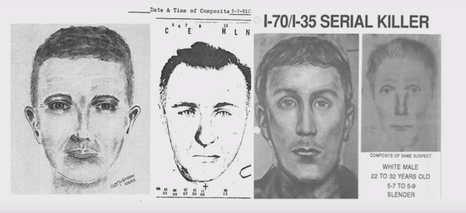
- Patricia Magers — April 11, 1992 — Wichita, Kansas: Magers, age 32, owned La Bride d'Elegance. She was killed alongside Patricia Smith. The customer who was actually expected at the store arrived shortly afterward and encountered a slender man carrying what appeared to be a compact, military-style firearm. The stranger ordered the customer toward the back of the store, but the customer refused and left. His description later helped investigators create a composite image of the suspect.
- Michael “Mick” McCown — April 27, 1992 — Terre Haute, Indiana: McCown, age 40, was working at Sylvia's Ceramics, a store owned by his mother. He was found during the late afternoon after apparently being attacked while stocking merchandise. His wallet and a small amount of store money were missing. McCown was the only confirmed male victim. Investigators have suggested that the killer may have selected the business because its name implied that a woman operated it and may have mistaken McCown, who had long hair, for a female employee when approaching him from behind.
- Nancy Kitzmiller — May 3, 1992 — St. Charles, Missouri: Kitzmiller, age 24, was working at Boot Village in Bogey Hills Plaza at 2079 Zumbehl Road. She had agreed to work even though she had originally been scheduled to have the day off. Customers discovered her in a back room at approximately 2:30 p.m. Cash was missing from the store. A witness had seen Kitzmiller speaking with a male customer shortly before her death, providing police with another description of the suspected killer.
- Sarah Blessing — May 7, 1992 — Raytown, Missouri: Blessing, age 37, was working in a gift shop called Store of Many Colors. A neighboring business owner saw a man enter her store, heard a sound resembling a gunshot, and then watched the man leave. When the neighbor checked the store, Blessing was found fatally wounded. Other witnesses reported seeing the suspect moving away from the shopping area in the direction of Interstate 70.
Pattern of the Crimes
The six confirmed murders occurred at five crime scenes over a period of only twenty-nine days. Ballistics evidence connected the attacks to the same .22-caliber firearm and a particular type of ammunition. The small stores were generally quiet, offered limited visibility from neighboring businesses, and were positioned close enough to major roads to allow the killer to leave the area rapidly.
Robbery did not appear to be the primary motive. Although money was taken from several locations, the amounts were usually small. There was no evidence that the victims had been sexually assaulted, and investigators found no personal connection between them. The offender appeared to value speed, control, and isolation rather than financial gain. His actions suggested that he selected vulnerable workplaces rather than specific individuals.
Description of the Suspect
Witnesses described the suspected killer in 1992 as a thin white man, possibly in his twenties or thirties, approximately five feet seven inches to five feet nine inches tall. He reportedly had sandy blond or reddish hair and unusually heavy or drooping eyelids. Witness descriptions varied slightly, but several people recalled a narrow build and an ordinary appearance that allowed him to enter stores without immediately causing alarm.
The firearm was described by one witness as resembling a miniature machine gun or an Uzi. Investigators considered several compact .22-caliber semiautomatic weapons that could have matched the description. The gun's unusual appearance became an important part of the investigation, although the weapon has never been recovered.
Possible Texas Attacks
Authorities have examined whether the same offender later committed similar attacks in Texas. These cases involved employees of small specialty businesses near major highways, but they have not been conclusively connected to the six Midwestern murders. Different firearms may have been used, and investigators in different jurisdictions have expressed varying opinions about the possible link.
- Mary Ann Glasscock — September 25, 1993 — Fort Worth, Texas: Glasscock, age 51, was killed while working at the Emporium Antiques store. The setting and rapid nature of the attack resembled the I-70 crimes.
- Amy Vess — November 1, 1993 — Arlington, Texas: Vess, age 22, was killed inside a dance-apparel business. She was working in a small retail location near a major roadway when she was shot.
- Vicki Webb — January 15, 1994 — Houston, Texas: Webb, age 35, survived an attack at the Alternatives gift shop. She spoke briefly with the gunman before being shot from behind. The bullet struck a vertebra and did not enter her skull. The attacker attempted to fire again, but the weapon malfunctioned. Believing Webb was dead, he fled. Her survival gave investigators a rare account from a person who had directly encountered a possible offender.
The Investigation
The connection between the Midwestern murders became clear after detectives compared the methods, ammunition, victim characteristics, and store locations. Police departments in several states exchanged evidence and witness statements. Composite drawings were distributed nationally, and the case was featured in newspapers and television crime programs.
Investigators examined numerous tips and possible suspects. Some convicted criminals were considered because of their appearance, travel history, or involvement in other murders, but no one was conclusively connected to the I-70 crimes. Several individuals were eliminated after investigators compared physical descriptions, timelines, weapons, and methods.
One of the greatest difficulties was the lack of a known vehicle. Witnesses saw the suspect walking away from some locations, but no one reliably observed him entering or leaving a particular car. He may have parked away from the businesses, used side streets, or walked to another location before driving away. This prevented investigators from developing a license plate number or dependable vehicle description.
An Unresolved Case
The I-70 Killer has never been publicly identified or arrested. The confirmed murders remain among the most troubling unsolved serial cases in the Midwest. Age-progressed versions of the suspect's composite image have been released to show how he might appear decades after the crimes.
The case remains notable for the offender's ability to cross jurisdictional boundaries and disappear after attacks committed in public commercial areas. The short duration of the confirmed spree has led to many theories. The killer may have died, been imprisoned for another offense, moved to another region, or changed his method of committing crimes. It is also possible that additional attacks were never recognized as part of the same series.
For the victims' families and the communities of Indianapolis, Wichita, Terre Haute, St. Charles, and Raytown, the passage of time has not provided a final answer. The six confirmed victims were ordinary people carrying out everyday work when they were selected by a stranger. Their murders remain under investigation, and law-enforcement agencies continue to seek information capable of identifying the person responsible.