The Cumminsville Killer: The Unsolved Murders of Cincinnati's "Murder Zone"
A Killer Without a Name
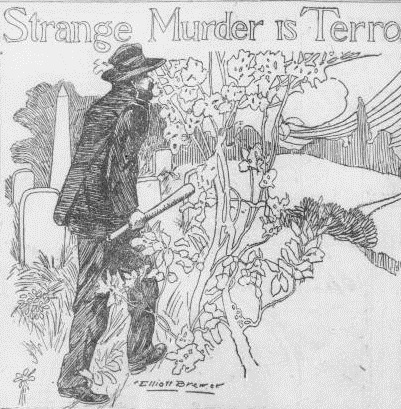
The Cumminsville Killer is the name given to an unidentified assailant believed to have been responsible for a series of violent deaths in and around the Cumminsville section of Cincinnati, Ohio, during the early twentieth century. The crimes have also been associated with such names as the Cumminsville Ripper, the Slouch Hat Man and Cincinnati's Jack the Ripper. Five women eventually became associated with what newspapers called the city's "Murder Zone," an isolated landscape of railroad tracks, industrial property, vacant lots, poorly illuminated roads and stretches of land surrounding Mill Creek. The murders occurred between 1904 and 1910, but no individual was ever convicted of committing them.
Although the five deaths have traditionally been grouped together as the work of a serial killer, investigators never proved that one person committed all of them. The similarities were nevertheless frightening. Several victims were found near railroad or streetcar routes, some had suffered severe injuries to the head, and witnesses repeatedly reported suspicious men in the neighborhood. After the 1904 killings, stories of a short or heavily built stranger wearing a slouch hat became part of Cincinnati's public image of the murderer. Whether that description represented the actual killer, several different men, or a mixture of genuine sightings and public fear has never been established.
Mary McDonald and the Beginning of the Mystery
Mary McDonald, 32, was the first woman later associated with the Cumminsville series. She had originally come from Saginaw, Michigan, and was living in Cincinnati. During the night of April 30, 1904, she had been visiting acquaintances and was last traced through the Cumminsville area. Around dawn on May 1, a railroad switching crew discovered her critically injured near the Big Four Railroad tracks close to the East Cumminsville station.
McDonald had suffered a serious injury to the back of her head, and one of her legs had been severed in connection with the railroad tracks. She was still alive when discovered and was taken to a hospital, where she was able to identify herself before dying on May 1, 1904. Money she reportedly had been carrying was missing. Investigators considered several possibilities, including robbery, personal jealousy and the possibility that she had been struck by a train. Contemporary reporting, however, increasingly treated the circumstances as suspicious. No satisfactory explanation for her death was established.
Lulu Mueller and Lovers' Lane
Only months later, another woman's death intensified the fear surrounding Cumminsville. Lulu Mueller, whose name also appears in later accounts as Louise Mueller, was found in an isolated section of Fergus Street commonly described as a lovers' lane. Contemporary Cincinnati research places the discovery early on October 1, 1904. The exact hour of her death was never firmly established, meaning she was probably killed late on September 30 or during the early hours of October 1.
Mueller had suffered devastating injuries to her head and face, including a fractured skull. A shallow excavation near the body created speculation that someone might have intended to conceal her remains. Witnesses supplied police with different accounts of her movements shortly before her death. One account described a frightened woman being pursued by a man in the vicinity, while investigators also examined several men who had been acquainted with Mueller. Theodore Salmon and William Wilson were among men questioned and arrested during the investigation, but the case against them did not hold and no one was convicted.
The murder scene itself complicated the investigation. Large crowds came to the area after news of the discovery spread, potentially destroying footprints and other physical evidence. With forensic science still primitive by modern standards, detectives were heavily dependent on witness testimony, interrogation and observations made at the scene. Mueller's murder remained unsolved.
The Murder of Alma Steinigewig
The third and perhaps most influential of the 1904 cases involved 18-year-old Alma Steinigewig, whose surname appeared in numerous variations in newspapers and who was sometimes called Alma Steinway. She worked as a telephone operator at the Park telephone exchange near Hamilton and Knowlton avenues. On the evening of November 2, 1904, she finished work at about 9 p.m. and began her trip home using Cincinnati's streetcar system.
Steinigewig rode a Clark Street car toward Winton Road and Spring Grove Avenue and was issued a transfer for the next portion of her journey. A conductor remembered her leaving the car. Contemporary investigators also became interested in a stout or rough-looking man reported to have traveled in the area. Steinigewig never reached home.
Her body was discovered on the morning of November 3 in a vacant area near Mill Creek and the railroad and streetcar corridors. Evidence suggested she had been struck in the head with a blunt object and then moved from the point of the initial attack. Her streetcar transfer remained in her hand, a detail that reinforced the belief that she had been attacked only a short time after leaving public transportation on November 2.
The killing produced an immediate public outcry. Residents began to believe the deaths of McDonald, Mueller and Steinigewig could be connected. The telephone company offered a substantial reward for information leading to the capture of Steinigewig's murderer. Police, private investigators and streetcar employees pursued numerous leads, but none resulted in the identification of a killer.
The Slouch Hat Man and the 1904 Attacks
The fear was increased by reports from women who survived threatening encounters around Cumminsville. Dorothy Hannaford reported being grabbed by a man while waiting for transportation in the area on the same general night that Steinigewig disappeared. Other women described being followed, seized or attacked around railroad crossings, Spring Grove Cemetery and neighboring streets during the weeks surrounding the murders.
Among the names appearing in historical accounts of these encounters are Miss Clausing, Mrs. Unkaback, Mrs. Hagerdorn, the Weimer sisters, Mamie Roddie, Mrs. Philip Gerbig and Josephine Hewitt. In several incidents, women escaped by fighting back, screaming, reaching populated areas or receiving unexpected assistance. Hewitt was reported to have fought off a man and produced a revolver when confronted in November 1904.
Witness descriptions were inconsistent, but the image that became most famous was that of a stocky or heavily built stranger wearing a dark slouch hat. Newspapers transformed the mysterious figure into the symbol of the Cumminsville terror. Police never established that all of the surviving women's encounters were connected to one another or to the murders.
Five Years of Silence
After the intense violence and panic of 1904, the suspected killer appeared to vanish. Years passed without another murder universally associated with the Cumminsville series. The absence generated theories that the offender had died, moved away, been imprisoned for an unrelated crime or simply stopped killing. Because Cumminsville was closely connected to railroad and streetcar transportation, later researchers have also wondered whether the offender could have traveled to another Ohio city.
One theory eventually connected the Cincinnati crimes with the unsolved murders attributed to the Dayton Strangler, who operated approximately fifty miles north in Dayton during the same general era. Similarities between attacks on women and the accessibility of railroad transportation have kept the theory alive, but no historical evidence has proved that the Cumminsville and Dayton crimes were committed by the same person.
Anna Lloyd: Murder on New Year's Eve
The Cumminsville mystery returned dramatically on December 31, 1909. Anna Lloyd worked as a secretary for the Wiborg-Hanna Lumber Company near the railroad tracks and Hopple Street. Contemporary Cincinnati reporting described her as an established employee and active member of her community. She left the company's office late that afternoon and began walking away from the industrial property.
Lloyd was attacked before she could safely complete her journey. Her body was discovered on New Year's Day, January 1, 1910, in a gully near the railroad tracks and only a relatively short distance from the lumber company's property. Evidence showed that she had suffered massive head injuries and a cut throat. She also appeared to have fought vigorously against her attacker.
Because Lloyd was last alive on the afternoon of December 31 and contemporary reports placed the attack that evening, her death occurred on December 31, 1909, although the discovery of her body on January 1 has sometimes produced confusion in later accounts. Investigators pursued multiple suspects, including Henry Cook and James Fields. Cook attracted particular attention during the investigation, but the evidence was insufficient to establish that he murdered Lloyd. Other men were questioned or detained as detectives followed a succession of leads.
The killing created enormous public pressure. Cincinnati officials offered a reward for the capture and conviction of the murderer, while Lloyd's employer also contributed reward money. Police examined employees, witnesses and men reported near the scene. Despite the resources devoted to the case, no prosecution followed.
Mary Hackney and the Fifth Murder
The final death traditionally attributed to the Cumminsville Killer occurred on October 25, 1910. Mary Hackney, 26, lived with her husband, Harley Hackney, in the Canal Ridge section near the Dane Street footbridge. The neighborhood was close to the industrial and railroad landscape already associated with the earlier mysteries.
Hackney was seen alive on the morning of October 25. Her husband and Charles Eckert, a young man boarding at the house, were away at work. When the men returned that evening, Hackney was found murdered inside the residence. Her head had been severely injured and her throat had been cut. An axe associated with the crime was recovered, and investigators reportedly found a bloody fingerprint or thumb mark, but forensic methods available in 1910 did not produce an identification capable of solving the murder.
Police examined several people. Harley Hackney and Charles Eckert were questioned, as was Herman Schwering, a local milk driver. Authorities also investigated Richard Finley, who lived nearby. Despite the arrests, questioning and coroner's proceedings, investigators could not develop sufficient evidence against any suspect. The murder remained unsolved.
Victims Traditionally Attributed to the Cumminsville Killer
- Mary McDonald, 32 — Died May 1, 1904, after being found critically injured near the Big Four Railroad tracks by the East Cumminsville station in Cincinnati. The attack appears to have occurred during the night of April 30-May 1.
- Lulu "Louise" Mueller — Killed approximately September 30-October 1, 1904. Her body was discovered early October 1 in the secluded Fergus Street "Lovers' Lane" area of Cumminsville. The precise time of death could not be established from surviving contemporary accounts.
- Alma Steinigewig, 18 — Killed on the night of November 2, 1904, after leaving her job at the Park telephone exchange. Her body was discovered November 3 near Winton Road, Spring Grove Avenue and Mill Creek in Cincinnati.
- Anna Lloyd — Killed December 31, 1909, near the Wiborg-Hanna Lumber Company and railroad tracks around Hopple Street. Her body was discovered on January 1, 1910.
- Mary Hackney, 26 — Killed October 25, 1910, inside her Canal Ridge residence near the Dane Street footbridge in Cumminsville. Her body was discovered that evening.
A Difficult Investigation
The Cumminsville cases were investigated decades before DNA testing, computerized fingerprint databases, modern crime-scene preservation and sophisticated forensic pathology. Investigators had fingerprints in at least one case, footprints or possible tracks in others, physical objects and extensive witness testimony, but they lacked the technology that could potentially connect those clues to a particular person today.
The investigations were also damaged by the enormous public interest surrounding the crimes. Curious crowds gathered around scenes, newspapers competed for dramatic stories, and police were forced to sort legitimate information from rumors, mistaken sightings and apparent hoaxes. A letter writer using the initials "S.D.M." claimed knowledge of the Lloyd murder, but the communication was eventually treated as a hoax rather than a breakthrough.
Were All Five Murders Really Connected?
Modern examination of the case raises an important question: whether the Cumminsville Killer was actually responsible for five deaths. The 1904 murders of McDonald, Mueller and Steinigewig occurred relatively close together and were followed by reports of additional assaults on women. Anna Lloyd's murder occurred more than five years later, while Mary Hackney was killed inside her own home rather than outdoors near a streetcar or railroad route.
Those differences have led some researchers to argue that Lloyd and Hackney may have been killed by separate offenders. Contemporary Cincinnati newspapers, however, eventually grouped all five deaths into the same frightening narrative, and the district became widely known as the "Murder Zone." Without a confession, conviction or surviving forensic evidence establishing a common offender, the precise number of victims attributable to one killer remains uncertain.
The 1913 Streetcar Conductor Theory
One of the stranger developments came several years after Anna Lloyd's death. In 1913, private detectives investigating unrelated unrest involving Cincinnati streetcar employees reportedly developed a theory that a former streetcar conductor could have been responsible for Lloyd's murder. The man was said to have been confined to an institution by that time. No criminal case establishing his guilt resulted, and there was never proof that he was responsible for the other Cumminsville murders.
The theory nevertheless attracted interest because public transportation appeared repeatedly in the earlier cases. Steinigewig had been traveling by streetcar immediately before her death, and several threatening encounters involving women occurred near trolley stops or routes. The connection remains circumstantial rather than proof of the killer's occupation or identity.
The Enduring Mystery
The Cumminsville murders remain among Cincinnati's most disturbing historical mysteries because there was never a definitive ending. No identified murderer went on trial, no confession conclusively solved the crimes and no later forensic discovery established the identity of the person—or persons—responsible. The "Slouch Hat Man" became a legend, but the actual human being behind the murders disappeared into history.
More than a century later, the strongest conclusion is also the most cautious one. Five women were killed under mysterious and violent circumstances in the Cumminsville area between 1904 and 1910, and contemporary Cincinnati residents and newspapers increasingly believed the deaths were connected. Police investigated numerous suspects but never proved that any of them was the murderer. Whether the Cumminsville Killer was one serial offender responsible for all five deaths, a killer responsible primarily for the 1904 attacks, or a name imposed on several unrelated crimes remains unresolved.
A Legacy of Fear and Unanswered Questions
The murders changed everyday life in Cumminsville. Women demanded greater police protection and better street lighting, while residents complained that dark streets, vacant industrial land and isolated transportation routes created an environment in which an attacker could disappear almost immediately. The killings became part of a larger civic debate about public safety in a rapidly developing industrial city.
Eventually Cincinnati expanded, transportation patterns changed and much of the old landscape disappeared. Cumminsville itself was transformed, with much of the former neighborhood now incorporated into what is known as Northside while South Cumminsville retains the historic name. The physical "Murder Zone" of 1904 is therefore difficult to recognize today, but the unresolved deaths of Mary McDonald, Lulu Mueller, Alma Steinigewig, Anna Lloyd and Mary Hackney remain part of the city's history. Their cases illustrate both the limitations of early twentieth-century criminal investigation and the danger of assuming that a sensational historical theory has been proven simply because it survived for generations.