Lyda Southard: The Suspected Serial Poisoner Known as "Flypaper Lyda"
Lyda Southard, better known during much of her early life as Lyda Trueblood, became one of the most notorious women in Idaho criminal history after a remarkable succession of deaths occurred among her husbands and immediate family between 1915 and 1920. She was suspected of poisoning four husbands, her brother-in-law, and her young daughter with arsenic, apparently with financial gain through life insurance as a major motive. Although six deaths were eventually associated with her, Southard was criminally tried and convicted for only one: the murder of her fourth husband, Edward F. Meyer.
Historical records most commonly identify her as Anna Elizabeth "Lyda" Trueblood or Lyda Anna Mae Trueblood. She was born on October 16, 1892, in Keytesville, Missouri, and later moved with her family to Idaho. The middle name "Catherine," sometimes attached to her name in modern references, is not the name most consistently found in the historical material concerning the case.
Marriage to Robert Dooley and the First Suspicious Deaths
In 1912, when she was about 19 years old, Lyda married Robert C. Dooley. They settled on a ranch near Twin Falls, Idaho, where Robert's brother, Edward "Ed" Dooley, also lived. Lyda and Robert had a daughter, Lorraine, who was born in October 1913.
The Dooley household was devastated by a series of deaths during 1915. Ed Dooley became suddenly ill in August and died from what physicians believed at the time was ptomaine poisoning, an older term commonly associated with food poisoning. There initially appeared to be nothing criminal about the death. Lyda and Robert benefited from a life insurance policy associated with Ed, however, a circumstance that later became significant to investigators.
Approximately two months later, Robert Dooley became seriously ill. His symptoms were attributed to typhoid fever, and he died in Twin Falls in October 1915. Some historical accounts give October 1 and others October 12 as the exact date of his death, so October 1915 is the most reliable way to state the date without presenting a disputed day as certain. Lyda received additional insurance money following Robert's death.
The tragedy continued in November 1915 when little Lorraine Dooley died. Her death was also originally attributed to disease, with historical Idaho records describing the diagnosis as typhoid. Other retellings say Lyda claimed her daughter had become ill after drinking contaminated well water. Whatever explanation was accepted at the time, no murder investigation immediately followed. By the end of 1915, Ed Dooley, Robert Dooley, and Lorraine were all dead, leaving Lyda as the surviving member of the household.
William G. McHaffie
Lyda later married William G. McHaffie, whose surname is also written as McHaffle in a number of accounts. The marriage took place in the period following Robert Dooley's death, and the couple eventually moved to Hardin, Montana.
McHaffie became suddenly ill and died in October 1918. His death was attributed to influenza, with some historical accounts also mentioning diphtheria. The precise day in October is inconsistent in surviving accounts, although October 1918 is well established. His death occurred during the period of the devastating 1918 influenza pandemic, making the original diagnosis appear entirely plausible at the time.
McHaffie had also been insured. A later Idaho historical account states that a $5,000 policy had lapsed, preventing Lyda from collecting it. Investigators would eventually view the existence of insurance policies surrounding several of the deceased men as part of a larger pattern rather than a series of unrelated coincidences.
Harlan C. Lewis
By March 1919, Lyda had married again. Her third husband was Harlan C. Lewis, an automobile salesman associated with Billings, Montana. Their marriage was extraordinarily short. Within approximately four months Lewis became gravely ill with severe gastrointestinal symptoms.
Harlan C. Lewis died in Billings on July 6, 1919. His death was attributed in contemporary records to gastrointestinal illness, with accounts variously describing gastroenteritis, influenza, or food-related illness. Once again, there was nothing immediately obvious to demonstrate homicide.
Lewis carried life insurance naming Lyda as beneficiary, and she received insurance proceeds following his death. By this point, three men closely connected to Lyda had died after sudden illnesses, in addition to her daughter and brother-in-law. Nevertheless, each death had occurred under circumstances that could individually be explained as a natural illness common to the period.
Edward F. Meyer and the Death That Exposed the Pattern
Lyda returned to Idaho and became involved with Edward F. Meyer, a ranch foreman in the Twin Falls area. Using the name Anna May McHaffie, she married Meyer in Pocatello on August 10, 1920.
The marriage lasted less than a month before Meyer became seriously ill. His condition resembled the gastrointestinal illnesses associated with several of Lyda's previous husbands. He was hospitalized but deteriorated and died on September 7, 1920, in the Twin Falls area. He was only about 35 years old.
Meyer's initial medical findings were consistent with typhoid, providing Lyda with yet another apparently natural explanation for the death of a husband. There were, however, circumstances that began to trouble people around him. A worker at the ranch reportedly became sick during approximately the same period but recovered. Lyda also left the area quickly after Meyer's funeral rather than remaining in Twin Falls.
Meyer had substantial life insurance coverage. Historical accounts differ somewhat concerning the amount, but Idaho historical records describe a policy worth approximately $12,000. Unlike some of the earlier policies, Lyda did not successfully collect the money before leaving the area.
The Arsenic Investigation
Meyer's death finally caused authorities to reconsider the remarkable number of deaths surrounding Lyda. Investigators began tracing her marital history and discovered that Edward Meyer was not the first husband who had died shortly after marrying her. Robert Dooley, William McHaffie, and Harlan Lewis were already dead, as were Robert's brother Ed and Lyda's daughter Lorraine.
Investigators and chemists focused on arsenic. At the beginning of the twentieth century, certain types of flypaper contained arsenic, and prosecutors eventually alleged that Lyda obtained poison from such products and secretly introduced it into food or drink. This theory gave rise to one of her most enduring nicknames: "Flypaper Lyda." She was also called the "Black Widow" and "Lady Bluebeard."
Deputy Virgil Ormsby became an important figure in the investigation. His inquiries into Lyda's past reportedly uncovered evidence that she had purchased unusually large amounts of arsenic-containing flypaper while living in Montana. Historical accounts also describe flypaper being discovered at a former residence associated with Lyda and McHaffie.
Authorities obtained permission to exhume bodies connected with the case. Edward Meyer's remains were subjected to chemical testing, and investigators reported finding an amount of arsenic capable of causing death. Examinations of other exhumed remains also produced evidence that prosecutors believed supported arsenic poisoning. The degree of certainty varied from body to body because of decomposition, burial conditions, and the limitations of forensic science at the time.
Victims and Suspected Victims
Southard was convicted only of Edward Meyer's murder. The other five deaths were investigated or presented as evidence of a pattern, but she was never convicted of killing those individuals. Because several historical sources disagree on particular days of death, the list below uses month and year where an exact day cannot be established consistently.
- Edward "Ed" Dooley — Southard's brother-in-law. He died in August 1915 in Twin Falls, Idaho. His death was initially attributed to ptomaine or food poisoning. Investigators later considered him a suspected arsenic-poisoning victim.
- Robert C. Dooley — Southard's first husband. He died in October 1915 in Twin Falls, Idaho. His death certificate attributed his illness to typhoid fever. Historical sources conflict between October 1 and October 12 for the exact day, so the month and year are the most defensible date.
- Lorraine Dooley — Southard's young daughter with Robert Dooley. She died in November 1915 in the Twin Falls, Idaho, area. Her death was initially attributed to illness, with historical Idaho records describing typhoid. Investigators later included her among Southard's suspected poisoning victims.
- William G. McHaffie — Southard's second husband. He died in October 1918 in Hardin, Montana. Influenza, and in some accounts diphtheria, was given as the original explanation. Sources disagree on the precise day of death.
- Harlan C. Lewis — Southard's third husband. He died on July 6, 1919 in Billings, Montana. His fatal illness was originally diagnosed as gastrointestinal disease or a similar natural illness. His death was later investigated as a suspected arsenic poisoning.
- Edward F. Meyer — Southard's fourth husband and the only victim whose murder resulted in her conviction. He died on September 7, 1920 in the Twin Falls, Idaho, area. Chemical testing following the investigation found a lethal amount of arsenic in his remains.
Insurance as the Suspected Motive
Life insurance became central to the prosecution's theory. Investigators discovered that policies existed on Southard's husbands and that she was positioned to benefit financially from their deaths. Contemporary and later historical accounts differ about some exact policy values, but thousands of dollars were paid following several deaths—a considerable amount of money during the 1910s.
The prosecution argued that the repeating pattern was too striking to be accidental: marriage, insurance, sudden gastrointestinal illness, death, and the widow's financial benefit. When combined with chemical evidence of arsenic, prosecutors believed the earlier deaths helped demonstrate that Meyer's poisoning was part of an established pattern.
Flight, Hawaii, and Arrest
After Meyer's death, Lyda left Idaho. Her movements took her through other western states, and she eventually married for a fifth time. Her new husband was Paul Vincent Southard, a U.S. Navy petty officer. Through that marriage she acquired the surname by which the criminal case is most commonly remembered.
Paul Southard survived. The couple eventually went to Hawaii while he was stationed in the islands. Meanwhile, Idaho investigators continued building their case and searching for Lyda.
Authorities located her in Honolulu in May 1921. She was arrested and returned to Idaho to face prosecution. Despite the sensational accusations concerning as many as six deaths, prosecutors centered their formal case on Edward Meyer because his death supplied their strongest combination of jurisdiction, forensic evidence, and circumstantial evidence.
The 1921 Murder Trial
Southard's trial in Twin Falls attracted nationwide attention. Prosecutors accused her of deliberately poisoning Edward Meyer with arsenic. Evidence concerning Robert Dooley, Ed Dooley, William McHaffie, Harlan Lewis, and Southard's daughter was introduced to establish what the state characterized as a recurring pattern.
The defense emphasized that the case was largely circumstantial. Several of the deceased had originally been diagnosed with legitimate diseases, and arsenic was a substance encountered in a variety of products during that era. Southard denied being a murderer.
The trial became a contest between the original medical diagnoses and the later chemical evidence. Idaho State Chemist E. F. Rhodenbaugh testified about arsenic detected in Meyer's remains, while prosecutors argued that the quantity was sufficient to account for his death.
After lengthy testimony and approximately a day of jury deliberations, the jury reached its decision. On November 4, 1921, Lyda Southard was found guilty of second-degree murder in the death of Edward F. Meyer. She was not convicted of murdering four husbands, despite the way the case was sometimes described in later popular accounts. Legally, Meyer remained the single murder for which she was convicted.
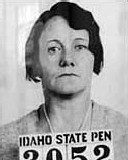
On November 7, 1921, the court sentenced Southard to a term of ten years to life in the Idaho State Penitentiary in Boise.
Escape and Recapture
Southard remained an unusual and highly publicized prisoner. On May 4, 1931, after approximately a decade behind bars, she escaped from the Idaho State Penitentiary. She made her way over the prison wall and disappeared, beginning a fugitive period that lasted more than a year.
While hiding in Colorado, she used another identity and became a housekeeper for a widower named Harry Whitlock. She eventually married him in March 1932. Whitlock survived the relationship and became involved in the circumstances that helped authorities locate her.
Southard was recaptured in the summer of 1932 and returned to Idaho to continue serving her sentence. Her escape added another dramatic episode to a criminal history that had already made her nationally famous.
Release and Later Years
After returning to prison, Southard remained incarcerated for several more years. She was conditionally released in October 1941 after serving a combined period approaching twenty years. Idaho historical records state that she ultimately received a full pardon in April 1943.
Southard lived for more than a decade after leaving the penitentiary. She used other names during her later life, including Anna Shaw, and largely disappeared from the intense publicity that had surrounded her during the 1920s and 1930s.
Lyda Southard died on February 5, 1958, in Salt Lake City, Utah, at the age of 65. Her death was attributed to a heart attack. She was buried at Sunset Memorial Park in Twin Falls, Idaho.
Legacy of the "Lady Bluebeard" Case
Southard remains one of the most famous criminal defendants in Idaho history and is frequently described as one of America's earliest documented female serial killers. That description requires an important qualification: authorities suspected her of six poisonings, but the courts established criminal responsibility only for the murder of Edward Meyer.
The case attracted extraordinary attention because the individual deaths had originally seemed ordinary. Food poisoning, typhoid fever, influenza, diphtheria, and gastrointestinal disease were all credible causes of death during an era when infectious illness was widespread and forensic toxicology was still developing. It was only after the same woman repeatedly lost husbands under similar circumstances that investigators began examining the deaths collectively.
Once arsenic was detected and investigators reconstructed Southard's marriages, insurance policies, purchases, and movements, events once regarded as unrelated illnesses appeared to prosecutors as evidence of a deliberate pattern. The resulting prosecution transformed Lyda Southard from a repeatedly bereaved widow into the woman newspapers called "Lady Bluebeard," "The Black Widow," and, most memorably, "Flypaper Lyda."