Regis Deon Thomas: The Compton Cop Killer
Overview
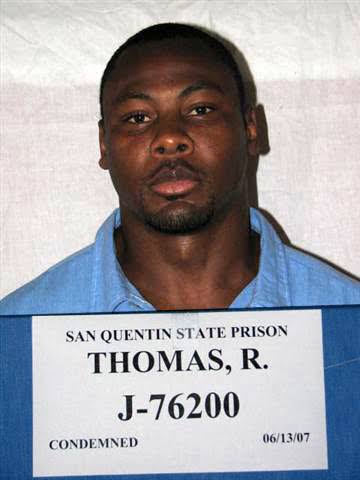
Regis Deon Thomas is a convicted murderer and member of the Bounty Hunter Bloods street gang, sentenced to death for a crime spree in the early 1990s that included the murders of three people in Los Angeles County. His most notorious crimes were the execution-style slayings of two Compton police officers, Kevin Michael Burrell and James Wayne MacDonald, during a traffic stop in February 1993. The murders of the two officers, the first in the Compton Police Department's history, sparked a massive manhunt that culminated in Thomas's unusual surrender to a television reporter. A year prior to the police killings, Thomas had murdered another man, Carlos Adkins. Convicted of all three homicides, he currently resides on death row at San Quentin State Prison.
Early Life and Background
Regis Deon Thomas was born on June 16, 1970, in Los Angeles, California. He was the oldest of four children and grew up in South-Central Los Angeles, where he became involved with the Bounty Hunter Bloods, a notorious street gang based in the Watts neighborhood. His early adulthood was marked by a criminal conviction for perjury in 1990. For a time, Thomas worked as a security guard at a liquor store, but he lost his job when the building was burned down during the 1992 Los Angeles riots, leaving him unemployed for a year.
The Murder of Carlos Adkins
On the night of January 31, 1992, more than a year before the police killings, Regis Thomas was involved in a fatal confrontation in an apartment in the Nickerson Gardens housing project in Los Angeles. The incident began with a verbal altercation outside between Thomas and a man named Bertrand Dickson. Thomas, apparently angered by a misunderstanding, followed Dickson into an apartment where Carlos Adkins was present.
Witnesses testified that Thomas, armed with a gun, argued with the men inside. As Thomas started to leave, Adkins made a remark, "You don't know who I am either." Enraged, Thomas turned back, placed the gun between Adkins' eyes, and threatened him. A struggle over the weapon ensued, during which two shots were fired, killing Adkins.
Thomas was arrested for Adkins' murder and spent four months in jail. However, the case against him collapsed when a key witness, Andre Chappelle, was murdered in March 1992, and another witness, Bertrand Dickson, recanted his identification after being threatened by Thomas in a courthouse holding cell. The charges were dismissed, and Thomas was released.
The Murders of Officers Burrell and MacDonald
On the rainy night of February 22, 1993, at approximately 11 p.m., Compton Police Officer Kevin Michael Burrell, 29, and Reserve Officer James Wayne MacDonald, 24, were on patrol. They initiated a traffic stop on a red 1992 Chevrolet pickup truck driven by Regis Thomas at the intersection of Rosecrans and Dwight Avenues in Compton.
The officers never had a chance to radio the stop to dispatch. As they approached the truck, Thomas exited his vehicle and opened fire with a 9mm handgun. According to witness statements and trial testimony, a struggle ensued where the officers tried to restrain Thomas. However, Thomas managed to arm himself and shoot both men.
After Officers Burrell and MacDonald were wounded and on the ground, Thomas shot them multiple times in the head, execution-style. Both officers were wearing bulletproof vests, but they were overwhelmed by the barrage of bullets and the final, fatal headshots. Their service weapons were found still secured in their holsters. Thomas then got back into his truck and fled the scene.
The Victims
- Carlos Adkins — January 31, 1992, Los Angeles. He was shot and killed during an argument in an apartment. Little public information is available about his life.
- Kevin Michael Burrell, 29 — February 22, 1993, Compton. A five-year veteran of the Compton Police Department, he was a Compton native known as a "gentle giant" who at 6-foot-7 was a former college basketball standout. He grew up wanting to be a police officer and was remembered for his commitment to the community, often talking with and mentoring young people. He was the father of a young son.
- James Wayne MacDonald, 24 — February 22, 1993, Compton. A dedicated volunteer reserve officer for 18 months, he was known to friends as "Jimmy Mac." The night he was killed was his last shift; he was preparing to move to San Jose to begin training as a full-time officer there. He was remembered as a compassionate person who had wanted to be a police officer since high school.
Investigation and Capture
The brutal murders of the two officers, the first in the department's 65-year history, triggered a massive and intense manhunt involving multiple law enforcement agencies. The entire 125-officer Compton Police Department was mobilized, with officers canceling vacations and working around the clock. The investigation was difficult, as there were initially no positive identifications of the shooter.
The manhunt did, however, lead to arrests in several other violent crimes, ultimately solving three other murders and two attempted murders committed by different individuals.
The break in the case came from a man named Calvin Cooksey. Cooksey testified that a couple of days after the murders, Thomas confessed to him, stating, "Yeah, I did it… They slipped," meaning the officers had failed to take proper precautions. Thomas described the murders in detail to Cooksey, who later helped Thomas dispose of the murder weapon. Facing his own legal troubles, Cooksey eventually went to the police with the information.
As the investigation zeroed in on him, Thomas became aware that he was the primary suspect. On April 6, 1993, after a series of pre-dawn raids by police, Thomas arranged to surrender. In a highly unusual move, he turned himself in to KTLA television reporter Warren Wilson in the parking lot of the Nickerson Gardens housing project. He was then taken into custody and booked for the murders of the officers.
Trial and Sentence
On April 8, 1993, the Los Angeles County District Attorney charged Regis Deon Thomas with three counts of murder for the deaths of Carlos Adkins, Kevin Burrell, and James MacDonald. The Adkins case was revived based on new evidence, including the link between the gun used to kill the officers and the one used to kill Adkins.
The trial was emotionally charged. The prosecution's case for the officers' murders relied heavily on the testimony of Calvin Cooksey, who recounted Thomas's detailed confession. For the Adkins murder, the key witness Bertrand Dickson, who had previously recanted, testified against Thomas, stating he had been threatened into silence.
On May 17, 1995, a jury convicted Thomas of two counts of first-degree murder for the deaths of Officers Burrell and MacDonald, finding true the special circumstances of multiple murder and the murder of peace officers engaged in their duties. He was also convicted of second-degree murder for the killing of Carlos Adkins.
During the penalty phase, the officers' families pleaded for the death penalty, while Thomas's family begged for his life. Thomas himself offered condolences to the families but maintained his innocence, stating, "I'm not Superman. I couldn't take out two people -- not two highly trained, armed police officers."
On August 15, 1995, Superior Court Judge Edward A. Ferns followed the jury's recommendation and sentenced Regis Deon Thomas to death. He was also given a sentence of 15 years to life for the second-degree murder of Adkins after an initial sentencing error was corrected on appeal.
Aftermath and Legacy
The murders of Officers Kevin Burrell and James MacDonald left a profound and lasting scar on the Compton Police Department and the wider community. It was a stark reminder of the dangers of gang violence and the risks faced by law enforcement. The department, which was later disbanded in 2000 with law enforcement services contracted to the Los Angeles County Sheriff's Department, never saw another line-of-duty death.
Regis Deon Thomas was sent to California's death row at San Quentin State Prison, where he remains. His case has gone through numerous appeals, which is standard for death penalty cases in California. His convictions and death sentence have been upheld. The case stands as a grim chapter in the history of Los Angeles crime and a painful memory for the families of his three victims.