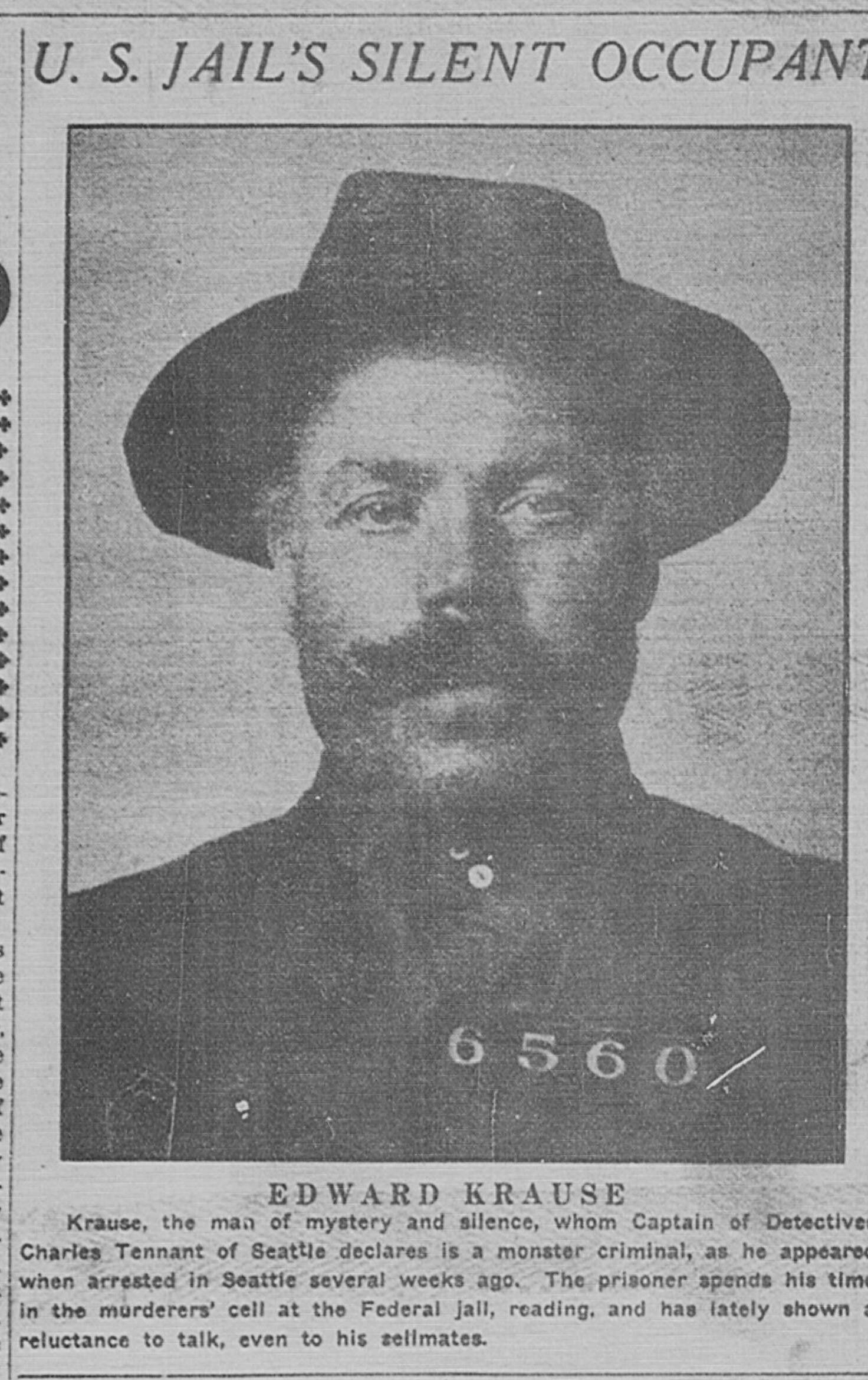
Edward Krause: Alaska’s First Known Serial Killer
Early Life and Criminal Background
Edward Krause, whose birth name was reportedly Edward Slompke, was a German-born murderer, fraudster and fugitive who operated in Southeast Alaska during the early twentieth century. He was born around 1870 and immigrated to the United States before joining the United States Army. Krause was stationed at Wrangell, Alaska, with the 12th Infantry in the late 1890s.
When his military unit received orders to leave Alaska, Krause deserted. He reportedly stole military payroll funds, forged documents and began using false identities. He eventually established himself in Petersburg, Alaska, where he presented the appearance of a respectable resident. In 1912, he even ran unsuccessfully for a seat in the Alaska Territorial Legislature as a Socialist Party candidate.
Behind this public identity, investigators believed Krause led a loosely organized group of thieves involved in fraud, property theft and murder. His victims were generally single men who had money, boats, real estate or other valuable possessions but few close relatives who might immediately report them missing.
Method of Operation
Krause appears to have selected victims whose disappearances could be explained by the transient nature of life in territorial Alaska. Prospectors, fishermen, laborers and sailors frequently moved between isolated communities, mining camps and coastal settlements. A man could vanish without producing the immediate alarm that would accompany a disappearance in a more established community.
After a victim disappeared, Krause allegedly took control of the man’s identification papers, bank records, deeds, mail and personal property. He forged signatures, assumed identities and conducted financial transactions in the missing person’s name. These crimes allowed him to profit from his victims while also creating false explanations for their absence.
No body conclusively attributed to Krause was ever recovered. Consequently, exact dates of death could not be established for most of the men connected to him. The available dates generally represent when a victim was last seen or disappeared and was presumed murdered.
Known and Suspected Victims
- Kumajiro Yamamoto — January 1913, Petersburg area, Alaska: Yamamoto was last seen alive in Krause’s company during January 1913. After Yamamoto disappeared, Krause gained access to his financial and identification documents. Investigators discovered that Krause used Yamamoto’s identity to reach bank accounts in Seattle and to obtain a mortgage involving property in Victoria, British Columbia. Yamamoto’s remains were never found, so his precise date and location of death remain unknown.
- Ole Moe — approximately 1913, near Petersburg, Alaska: Moe was reportedly last seen boarding a boat with Krause in the Petersburg area. When Krause was later arrested, he was traveling under Moe’s name and carrying deeds and other property belonging to him. Krause claimed that Moe had returned to Europe and voluntarily left his Alaska possessions behind. Investigators considered this explanation implausible. Moe was never located, and his exact date of death is unknown.
- James O. Plunkett — September or October 1915, waters near Juneau, Alaska: Plunkett was a charter-boat operator who owned a cruising launch named the Lou. He disappeared after being associated with Krause, and both Plunkett and his vessel vanished. Prosecutors later argued that Krause killed Plunkett and took control of property connected to him. Although Plunkett’s body was never recovered, this became the murder case in which Krause was convicted. Contemporary accounts differ regarding the precise day of Plunkett’s disappearance, but it occurred during the fall of 1915.
- William “Billie” Christie, also identified in some accounts as James Christie — September 1915, Douglas Island near Juneau, Alaska: Christie worked for the Treadwell mining operation and had recently married Celia Gesekus, a woman Krause had reportedly pursued. Krause appeared at the mine pretending to be a United States marshal named Miller. He carried a fraudulent subpoena or summons and claimed Christie was required to accompany him. Christie left the mine with Krause and was never seen again. His body was not recovered, and an exact date of death could not be verified.
Investigators connected Krause to the unexplained disappearances of at least eight men, while some historical accounts place the possible number of victims at nine or ten. Most of those men were never publicly identified with sufficient documentation to establish reliable names and disappearance dates. Authorities believed the known cases represented only part of Krause’s criminal activity.
The Disappearance of William Christie
Christie’s disappearance was the mistake that brought greater scrutiny to Krause. Unlike many of Krause’s previous suspected victims, Christie had a wife who immediately questioned his disappearance. Celia Christie knew about Krause’s interest in her and suspected him as soon as her husband failed to return.
Witnesses at the Treadwell Mine could describe the man who had arrived while impersonating a federal officer. Authorities issued a warrant charging Krause with falsely representing himself as a United States marshal and kidnapping Christie. Investigators also learned that Krause had been among the last people seen with missing boat operator James Plunkett.
Krause attempted to flee Alaska. He avoided officers in Ketchikan and boarded a steamship traveling toward Seattle. A passenger who had seen wanted notices recognized him. Police were waiting when the vessel reached the Puget Sound area and arrested Krause in October 1915.
Evidence Discovered After His Arrest
A search of Krause’s possessions exposed an extensive collection of forged papers, property deeds, bank documents and identification records belonging to missing men. He was arrested while using Ole Moe’s identity and carrying property that Moe had supposedly left to him.
The investigation lasted approximately a year and involved federal authorities, postal investigators and territorial law-enforcement officers. Officials traced suspicious property transfers and financial transactions involving Krause and men who had vanished after being seen with him.
The records suggested a repeating pattern. A man with money or property disappeared, Krause produced a story explaining the man’s absence, and ownership of the missing person’s assets was transferred through forged or questionable documents. Authorities concluded that Krause had murdered the men and concealed their bodies before stealing their identities and possessions.
Indictments and Murder Trial
Krause was indicted during 1916 on numerous charges involving kidnapping, forgery, fraud and murder. Prosecutors faced a serious legal problem because no victim’s remains had been recovered. They had to prove that a murder had occurred using circumstantial evidence rather than a body, a murder weapon or an eyewitness to the killing.
In Christie’s case, the government secured a kidnapping conviction because witnesses had seen Krause remove Christie from the mine under false pretenses. Christie’s widow visited Krause in jail and pleaded with him to reveal what had happened. Krause reportedly became visibly affected but refused to provide an answer, telling her that he could not tell her where Christie was.
The government chose the disappearance of James O. Plunkett as its strongest murder case. Prosecutors presented evidence concerning Plunkett’s final movements, Krause’s connection to him and Krause’s possession or use of property linked to missing men. Krause’s Plunkett trial began in September 1916. On October 5, 1916, the jury found him guilty of first-degree murder after approximately six hours of deliberation.
Krause received a sentence of death by hanging. His conviction was subsequently upheld, and his execution was scheduled to take place at the federal jail in Juneau.
Escape from the Juneau Jail
On April 12, 1917, shortly before his scheduled execution, Krause escaped from the Juneau Federal Jail. He had secretly sawed through the bars of his cell, apparently working on them over several days. After weakening the bars at several points, he bent them outward and squeezed through a narrow opening.
Krause passed through an interior corridor and fled through doors that had been left unlocked. A guard fired warning shots, but Krause disappeared into the darkness. He stole a small boat and attempted to escape through the waterways surrounding Juneau.
The escape produced one of the largest manhunts conducted in territorial Alaska. Mines near Gastineau Channel suspended work, and hundreds of miners joined law-enforcement officers, fishermen and local residents in the search. Fishing boats positioned themselves throughout the waterways in an attempt to prevent Krause from leaving the region. Alaska Governor John Franklin Alexander Strong offered a reward of $1,000 for Krause’s capture, dead or alive.
Death on Admiralty Island
On April 15, 1917, Krause reached an isolated area of Admiralty Island in a stolen skiff. He approached the homestead of Arvid Fransen, whose family had already been warned that the escaped murderer might be in the area.
Fransen confronted Krause with a rifle and asked whether he was the wanted fugitive. Krause acknowledged his identity. Believing that Krause posed an immediate threat, Fransen shot him. Krause died at the scene, ending the territorial manhunt three days after his escape.
Krause’s body was returned to Juneau and displayed at an undertaking establishment, where members of the public came to view the dead outlaw. On April 17, 1917, he was buried without ceremony in a plain wooden box in the paupers’ section of Evergreen Cemetery.
Uncertain Number of Victims
Edward Krause is commonly described as Alaska’s first known serial killer, but the total number of people he murdered remains uncertain. Authorities were able to associate him with multiple disappearances through financial records, forged documents and witness statements. However, the absence of bodies prevented prosecutors from bringing murder charges in every suspected case.
At least four missing men can be identified by name from surviving accounts, while investigators believed Krause was responsible for the disappearances of at least eight and possibly ten or more victims. His practice of choosing isolated men, destroying or concealing their remains and stealing their identities made a complete accounting nearly impossible.
The known evidence portrays Krause as a calculating predator motivated largely by money, property and self-preservation. He exploited Alaska’s vast wilderness and mobile population to make his victims disappear, then attempted to erase their existence through fraud. His murder conviction, dramatic jailbreak and violent death made him one of the most infamous criminals in the history of territorial Alaska.