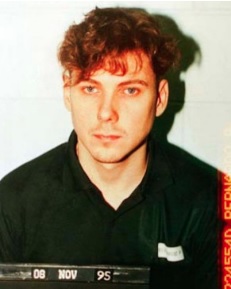
George Sidney Sitts: The Fugitive Killer
Overview
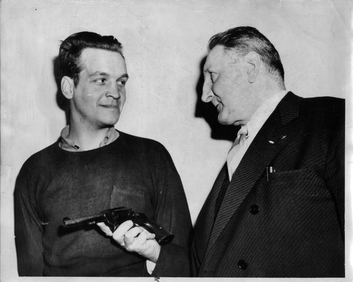
George Sidney Sitts was a career criminal whose final, violent spree in the winter of 1945-1946 left three men dead and culminated in his own state-sanctioned death. Already facing a life sentence for murdering a Minneapolis liquor store clerk, Sitts executed a daring jailbreak and fled west. His desperate flight from justice led to a cold-blooded confrontation on a South Dakota highway where he murdered two law enforcement officers. The killings sparked a massive, multi-state manhunt that ended with his capture in the snows of Wyoming. Sitts was tried, convicted, and on April 8, 1947, became the first and only person to be executed in South Dakota's electric chair. His case remains a grim and significant chapter in the history of crime and punishment in the Upper Midwest.
Early Life and Criminal Beginnings
George Sidney Sitts was born on October 29, 1913, in Le Roy, Minnesota, a small farming community near the Iowa border. By all accounts, his youth showed little sign of the violence to come. He was remembered by townspeople as a quiet, well-mannered, and studious boy who would rush home from school to do chores for his grandmother. He was an avid reader, drawn to dime-store novels that romanticized the exploits of frontier outlaws, a fascination that may have planted the seeds for his later criminal path. As a young man, he also had a brief career as an amateur boxer in Saint Paul.
Sitts’s turn toward a life of crime began at age 19. He was arrested in Iowa for carrying a concealed weapon and possessing stolen property, for which he served 90 days in jail. This was not a deterrent. Three years later, he was convicted of burglary in Minnesota and sentenced to ten years in prison. A handsome and charismatic man, he impressed the parole board and was released in 1941. His freedom was short-lived; he was returned to prison in 1944 for a parole violation. After his release later that year, he moved to Portland, Oregon, to find work. At one point he was married, but he and his wife later separated. His youthful fascination with outlaws had tragically manifested into a pattern of escalating criminal behavior, setting the stage for his eventual descent into murder.
The Murder of Erik Johansson
In late 1945, Sitts returned to Minneapolis, reportedly to find a woman he was interested in, only to learn she had moved to Texas. On December 12, 1945, needing money to travel south, he decided to rob a liquor store. The plan went horribly wrong. During the robbery, Sitts shot and killed the clerk, Erik Johansson.
Sitts fled but was captured just 60 miles outside of the city. Facing overwhelming evidence, he chose to plead guilty to second-degree murder, likely believing his extensive criminal record would ensure a conviction at trial. The judge accepted his plea and sentenced him to life in prison. Sitts was held at the Hennepin County Jail in Minneapolis, awaiting his transfer to the formidable Stillwater State Prison.
Escape from Hennepin County
Unwilling to spend the rest of his life behind bars, Sitts immediately began plotting his escape. With the help of three other inmates and a smuggled hacksaw blade, he spent the next three weeks meticulously sawing through two bars of his cell. On Sunday, January 20, 1946—just one day before his scheduled transfer to Stillwater—Sitts and the other men made their move and broke out of the county jail.
Now a fugitive convicted of murder, Sitts knew he had to move fast and far. On January 22, he stole a 1937 black Buick sedan in Minnesota and headed west. He drove across South Dakota, fueling his escape by stealing gasoline from service stations in Brookings, Kimball, Highmore, and Blunt. After a gas station attendant in Belle Fourche reported a drive-off, an alert was issued to all area law enforcement to be on the lookout for the stolen Buick.
A Fugitive's Rampage: The Murders of Two Officers
The evening of January 24, 1946, was cold and dark as Sitts’s desperate flight brought him into a fatal confrontation with two dedicated lawmen. Butte County Sheriff Dave Malcom, 57, and South Dakota Division of Criminal Investigation (DCI) Special Agent Thomas Matthews, 48, were on alert for the fugitive. Matthews was just sitting down to dinner when Sheriff Malcom called about the suspicious person who had stolen gas in Belle Fourche. Unbeknownst to the officers, Sitts had also stopped at a ranch near Newell and stolen a pistol, making him armed and exceedingly dangerous.
Matthews intercepted Sitts's Buick at the junction of Highways 85 and 14, just north of Spearfish. After a brief exchange through their car windows, Sitts agreed to follow Matthews back to pay for the gas. Instead, he turned his car around and headed back toward Belle Fourche, where Sheriff Malcom was waiting about a mile down the road. Sitts stopped his car between the two police vehicles. As Sheriff Malcom and Agent Matthews exited their cars, Sitts got out of the Buick, gun in hand.
Without hesitation, Sitts opened fire. He shot Sheriff Malcom first, who fell to the ground. He then wheeled around and fired at Agent Matthews. A truck driver passing by heard the shots and witnessed the horrific aftermath. Sitts walked over to the fallen officers, systematically shooting each one in the head to ensure they were dead. He then rifled through their pockets, stealing their money and service weapons before speeding away into the night.
The Victims
- Erik Johansson — December 12, 1945, Minneapolis, Minnesota. A liquor store clerk who was shot and killed during a robbery committed by Sitts.
- Thomas Matthews, 48 — January 24, 1946, near Spearfish, South Dakota. A Special Agent with the South Dakota DCI, Matthews was a World War I veteran who had also worked with the FBI on anti-espionage matters during World War II. A respected member of the Spearfish community and a former race car driver, he left behind a wife and two young children.
- Dave Malcom, 57 — January 24, 1946, near Spearfish, South Dakota. The Sheriff of Butte County, Malcom was a Scottish immigrant and a World War I veteran. He had worked as a deputy sheriff, farmer, and miner before being elected sheriff in 1945. He was killed in the line of duty, leaving behind his wife and a nine-month-old daughter.
Manhunt and Capture
The cold-blooded murder of two law enforcement officers triggered one of the largest manhunts in the region's history. A five-state alarm was issued, and hundreds of officers descended on the Black Hills. The next day, lawmen found Sitts's abandoned Buick on a cutoff road south of Spearfish. For a time, Sitts hid in the attic of an abandoned stone schoolhouse, which officers searched without finding him. He later found refuge in the cellar of a house belonging to a former Deadwood police chief, who was out searching for the fugitive.
After a week, Sitts fled again. In Deadwood, he hijacked another car, surprising gas station attendant Leonard Ronnenberg by hiding in the backseat of his vehicle. At gunpoint, Sitts forced Ronnenberg to drive him into Wyoming. During the harrowing trip, Ronnenberg, a devoutly religious man, spoke to Sitts about sin and redemption. Perhaps moved by the conversation, Sitts released him unharmed just across the state line near Beulah, stealing his 1939 Chrysler. Ronnenberg quickly alerted authorities, and dozens of patrol cars began scouring the Wyoming roadways.
Sitts continued west for 370 miles, but his luck ran out in the harsh Wyoming winter. On February 5, 1946, his stolen car became stuck in a snowdrift near the small town of Lysite. Two men in plain clothes approached the stranded vehicle and asked if he needed help. Believing them to be local ranchers, Sitts let his guard down. The men were Fremont County Undersheriff S. R. Owens and Deputy Sheriff Rush Laughlin. They arrested him without a struggle. The 11-day manhunt was over.
Trial and Sentence
Extradited back to South Dakota, Sitts was put on trial in Deadwood for the murder of Special Agent Tom Matthews. The prosecution, led by George T. Mickelson, who would later be elected governor of South Dakota, strategically chose to try Sitts for only one of the murders, knowing a single conviction would be enough to secure the death penalty.
The trial began on March 18, 1946, and was remarkably swift. Sitts's defense attorneys argued that the jury pool was improperly drawn, but their motions were denied. On March 22, after just four days of testimony, the jury deliberated for less than three hours before returning a guilty verdict. On March 30, Judge Charles Hayes sentenced George Sitts to die in the electric chair. South Dakota had reinstated the death penalty in 1939 and mandated electrocution as the method, but the three men sentenced to die before Sitts all had their sentences commuted to life imprisonment. Sitts's appeal to the South Dakota Supreme Court was denied in February 1947, sealing his fate.
Execution and Legacy
In the early morning hours of April 8, 1947, at the South Dakota State Penitentiary in Sioux Falls, George Sitts was prepared for his execution. He ate a final meal of chow mein, tea, bread, butter, ice cream, and cake. Before his death, he made arrangements to donate the corneas of his eyes.
The electric chair itself was a grim, handmade affair, built by prisoners. A football helmet purchased for $3.55 was adapted to hold one of the electrodes. As he was being strapped into the chair before 41 official witnesses, Sitts uttered his final, defiant words: "This is the first time authorities helped me escape prison." At 12:15 a.m., DCI Agent Floyd Short, a personal friend of the two slain officers, threw the switch, sending 2,300 volts of electricity through Sitts's body. His body went unclaimed and was buried in an unmarked grave in Sioux Falls.
George Sitts remains the only person ever executed by electrocution in South Dakota. The state would not carry out another execution for over 60 years. The brutal murders of Agent Tom Matthews and Sheriff Dave Malcom left a lasting scar on the Black Hills community. Their names are inscribed on the National Law Enforcement Officers Memorial in Washington, D.C., and a portion of Highway 85 where they were killed is dedicated in their honor, a permanent reminder of their sacrifice.