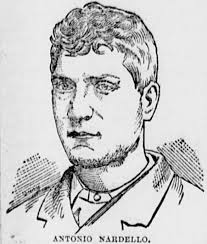
Antonio Nardello: The Italian Laborer Predator
Overview
Antonio Nardello was an Italian immigrant laborer who, in a span of just over a year, robbed and murdered at least three of his fellow countrymen in Maryland and Washington, D.C. Preying on the trust and camaraderie within the immigrant worker community, Nardello used brutal violence to steal what little money his victims had saved. His crimes were marked by a cold-blooded focus on robbery, often leaving his victims' bodies hidden in remote locations. Though he was only tried and convicted for one murder, he confessed to all three shortly before his execution in 1886, bringing a grim conclusion to his brief but violent spree and exonerating an innocent man who had been wrongfully convicted of one of his crimes.
Early Life and Background
Antonio Nardello was born in Naples, Italy, in 1864. His childhood was shaped by the absence of his father, who was serving a twenty-year prison sentence for brigandage and whom Nardello never met. Seeking a different life, Nardello immigrated to the United States in 1883 at the age of 19. Like many of his countrymen during that era, he sought work as a manual laborer, moving between New York and Chicago before settling in Maryland. There, he found employment with the Baltimore and Ohio Railroad, joining the large force of immigrant workers who were crucial to the expansion of America's infrastructure.
The Murder of "The Blacksmith"
Nardello’s killing spree began on April 1, 1884, along the Philadelphia Road in Gunpowder, Maryland. His target was a fellow laborer known only by his surname, Brosnan, and his nickname, "The Blacksmith." Nardello’s motive was simple robbery. In the course of the theft, he murdered Brosnan.
The crime was not immediately linked to Nardello. Instead, another Italian laborer, a man named Juliano, was arrested, tried, and convicted for the murder. He was sentenced to ten years in prison for a crime he did not commit. Juliano would serve two years of his sentence before Nardello’s eventual confession revealed the grave miscarriage of justice.
The Murder of Antonio de Balbo
Eight months later, Nardello killed again. On December 19, 1884, in Cecil County, Maryland, he targeted another fellow railroad worker, Antonio de Balbo. Nardello had boarded at de Balbo's home and knew his host had saved some money. On the pretense of a walk, Nardello lured de Balbo to an isolated spot. Once his companion was distracted, Nardello shot him, stole his watch and money, and concealed his body in some bushes.
De Balbo's remains were not discovered until five months later, on May 19, 1885. A local laborer named Charles Bushel was searching for a stray cow when he stumbled upon the body on a hill, partially covered with leaves. The skull was crushed, and the body was in an advanced state of decay. Authorities found a railroad ticket and a letter in Italian on the victim, but could not immediately identify him. Fellow railroad workers told investigators they suspected Nardello, but he had already moved on to Baltimore. With no positive identification and no suspect to question, the case went cold. De Balbo was buried without his name, his murder officially unsolved until Nardello's confession.
The Murder of Carmine Rotunno
Nardello's final and most brazen murder occurred in the summer of 1885 in Washington, D.C. His victim was Carmine Rotunno, an older Italian laborer who worked on the Boundary sewer project. Rotunno was known to be frugal and was believed to have saved a considerable sum of money. Nardello, who was often idle and penniless, arranged to meet Rotunno early one morning under the pretense of getting work.
Rotunno was never seen alive again. On August 1, 1885, residents near a newly built reservoir by Howard University complained of a foul odor coming from an abandoned shack on a local farm. Inside, police discovered the decomposing body of a man, later identified as Rotunno. He had a large gash on his neck, and bloodstains on the walls and floor testified to the violence of his death.
Investigation and Capture
The discovery of Rotunno's body quickly led investigators to Nardello. It was known that Nardello had suddenly come into a significant amount of money around the time of Rotunno's disappearance. The same day the body was found, authorities tracked Nardello to a house on Maryland Avenue, where he was living under the alias Frank Rosso with a woman named Willa Morrow.
Police apprehended Nardello and Morrow at the Baltimore and Potomac Depot as they were about to board a train to Baltimore. A search of the room they had occupied revealed bloodied clothing belonging to Nardello. Upon his arrest, Nardello initially confessed to participating in Rotunno's murder but attempted to deflect the sole blame. He claimed two other men, Pasquale Gesimonte and Pasquale Aboudante, were his accomplices. According to Nardello, he and Gesimonte held Rotunno down while Aboudante cut his throat. He stated they stole $150 from the victim, of which he only received $30. However, police could find no evidence to implicate the other two men.
Trial and Sentence
Antonio Nardello was indicted for the first-degree murder of Carmine Rotunno on October 10, 1885. As he could not speak English well, a Colonel Frank Mancossis was sworn in as his interpreter. The trial in Washington's criminal court attracted significant public attention, making jury selection difficult as many potential jurors had already formed opinions based on newspaper reports.
Over 200 witnesses were called to testify. A key witness was Carmine Gaudio, the owner of the lodging house where Rotunno had lived. He testified that the blood-stained pants found at Nardello's residence were indeed his. Throughout the trial, Nardello maintained that he was only an accomplice, but the jury was unconvinced.
On December 12, 1885, the jury returned a verdict of guilty on their first ballot. A contemporary report from the *Baltimore Sun* noted that Nardello heard the verdict with a "stolid face," but wept bitterly on his way back to jail. He was sentenced to death by hanging. His attorneys filed a motion for a new trial, claiming to have new evidence and witnesses, but the motion was denied.
Aftermath and Execution
In the weeks leading up to his execution, Nardello reportedly became deeply religious. He sent letters and photographs of himself to relatives in Italy. His case even drew the attention of President Grover Cleveland, who granted him a three-week reprieve on May 5, 1886. However, the sentence was not commuted.
The day before his scheduled execution, on May 27, 1886, Antonio Nardello made a full confession to his priests. He admitted his sole guilt in the murder of Carmine Rotunno and also confessed to the two murders in Maryland: those of Antonio de Balbo and the man known as "The Blacksmith." This final confession was crucial, as it officially solved the de Balbo case and, most importantly, exonerated Juliano, the man wrongfully imprisoned for Brosnan's murder.
On May 28, 1886, Nardello was led to the gallows in the D.C. Jail. He walked to the scaffold loudly uttering prayers in Italian. The trap door was sprung at 1:30 p.m. After hanging for eight minutes, his body was lowered, but a pulse was still detected. He was not pronounced dead until fifteen and a half minutes had passed. Antonio Nardello was 22 years old. His short life in America was a tragic story of an immigrant preying on his own community, ending a chain of violence with his own state-sanctioned death.
The Victims
- Brosnan, age unknown — Murdered on April 1, 1884, in Gunpowder, Maryland. A laborer known as "The Blacksmith," he was killed during a robbery by his co-worker, Nardello.
- Antonio de Balbo, age unknown — Murdered on December 19, 1884, in Cecil County, Maryland. A fellow railroad worker who had provided Nardello with lodging, he was shot and robbed by his boarder.
- Carmine Rotunno, age unknown — Murdered in July 1885 in Washington, D.C. An older, hardworking Italian laborer, he was lured to a secluded shack and killed for the money he had diligently saved.