Earl Gardner: The San Carlos Apache Reservation Killer
Overview
Earl Gardner was a Native American man whose life was marked by a violent temper that led to three brutal murders on the San Carlos Apache Indian Reservation in Arizona. In 1925, he killed a man during a drunken fight and served seven years in federal prison. After his release, his aggression continued, culminating in the 1935 axe murders of his wife and infant son. Gardner confessed immediately, pleaded for a swift execution, and was sentenced to death. His execution in 1936 was a gruesome, botched hanging that took over 30 minutes, leading to a change in federal law that made him the last person to be legally hanged in Arizona.
Early Life and First Murder
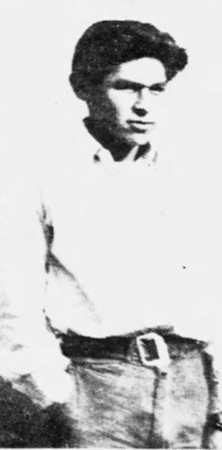
Born on August 2, 1906, on the San Carlos Apache Indian Reservation, Earl Gardner reportedly developed a fierce temper from a young age, partly in response to being bullied for his short stature. This aggression earned him the nickname "mad dog" and made him an outcast within his community.
In 1925, Gardner's violent nature had fatal consequences. Following a drinking party, he got into a fight with a man named Francis Knight and stabbed him to death. Gardner later claimed he committed the act in a "drunken frenzy." Because the crime occurred on a federal reservation, Gardner was tried in federal court. He was convicted of second-degree murder and sentenced to 13 years in prison. He began his sentence at the Federal Correctional Institution in Anthony, Texas, and was later transferred to the U.S. Penitentiary near Fort Leavenworth, Kansas. After serving seven years, he was released on parole in 1932.
A Pattern of Abuse
Upon his return to the San Carlos reservation, Gardner married a young woman named Alice. The marriage was not a peaceful one; Gardner was consistently and physically abusive toward his wife. The couple had a son, Edward, born in late 1935. The addition to the family did nothing to quell Gardner's violent tendencies.
The Murders of Alice and Edward Gardner
On the morning of December 8, 1935, Gardner's rage exploded with horrific consequences. His wife, Alice, wanted to attend church and asked Gardner to stay home and care for their 27-day-old son, Edward. The request sent Gardner into a fury. He grabbed a hatchet and attacked his wife inside their tent, striking her multiple times on the head.
In his own chilling confession, Gardner described the sequence of events. After striking Alice, he took the baby, who had been in his arms, outside the tent. He placed the infant on the ground and struck him once with the hatchet, killing him instantly. He said he "never look at baby" after the blow. He then went back inside and struck Alice one more time before throwing the hatchet to the ground.
Immediately after the murders, Gardner walked to a police officer, Salvador Grant, and turned himself in. He confessed to killing his family, stating, "I wasn't drunk this time. I was just crazy."
The Victims
- Francis Knight — 1925, San Carlos Apache Indian Reservation. Knight was stabbed to death by Gardner during a fight that erupted after a drinking party.
- Alice Gardner — December 8, 1935, San Carlos Apache Indian Reservation. A young mother, she was murdered with an axe by her husband after she asked him to watch their child while she went to church.
- Edward Gardner, 27 days old — December 8, 1935, San Carlos Apache Indian Reservation. The infant son of Earl and Alice Gardner, he was killed by his father with a single blow from a hatchet.
Investigation and Trial
There was no complex investigation, as Gardner immediately confessed to the murders of his wife and son. He was charged with two counts of first-degree murder and held in federal custody. From the outset, Gardner expressed a desire to die for his crimes. In December 1935, he attempted to plead guilty, insisting that the government should "take a good rope and get it over with." He told the court it was better to "die like an Apache" than to die slowly in prison.
Despite his confession and plea, Judge Albert Sames rejected the guilty plea, and the case proceeded to trial in January 1936. The trial was brief. Gardner took the stand on the second day, confessed again, and asked the jury for a death sentence. The jury deliberated, with ten jurors voting for a guilty verdict without a recommendation for mercy and two voting for a guilty verdict with a recommendation for mercy. This lack of unanimity resulted in a hung jury on the question of sentencing, and the judge ordered a new hearing.
The second hearing took place on February 6, 1936. This time, after just 30 minutes of deliberation, the jury found Gardner guilty and sentenced him to death. When Judge Sames formally imposed the sentence a week later and asked if he had anything to say, Gardner replied, "I want you to get a good strong rope and have this happen immediately." Against his explicit wishes, Gardner's attorney filed an appeal, which was unsuccessful.
A Botched Execution
At the time, Arizona had switched its method of execution to the gas chamber. However, because Gardner was a federal prisoner, his execution had to be carried out by hanging on federal land. Amid concerns about a potential uprising from the local Native American community, officials denied the U.S. Marshal's request to use the state prison.
Instead, U.S. Marshal Ben J. McKinney improvised a gallows near the Coolidge Dam, within the reservation's boundaries. The structure was fashioned from an abandoned rock crusher left over from the dam's construction, with a rope strung from a crossbeam and a hole cut in the floor for a trapdoor. A force of armed men was deputized to guard the site for days leading up to the execution.
On the night before his execution, Gardner was taken from the Gila County Jail and spent his last hours in a car near the gallows. His last meal consisted of ribeye steak, fried potatoes, and watermelon. He was brought to the gallows at 5:00 a.m. on July 13, 1936. Asked for a final statement before 42 witnesses, he said only, "Well, I'll be glad to get it over with."
The execution that followed was horrifically botched. When the trapdoor sprang at 5:06 a.m., the noose slipped, causing Gardner to fall off-center and strike the side of the opening. His neck did not break. Instead, he hung at the end of the rope, thrashing and slowly strangling. The gruesome spectacle continued for over half an hour. One witness, Maricopa County Sheriff Lon Jordan, a very large man, eventually stepped through the trapdoor and put his weight on Gardner's shoulders to tighten the noose and hasten his death. Earl Gardner was finally pronounced dead at 5:39 a.m.
Aftermath and Legacy
The botched and prolonged execution of Earl Gardner caused a public outcry. In the months that followed, the U.S. Congress passed a new law stipulating that all federal executions would henceforth be carried out using the method of the state in which the sentence was imposed. This change made Earl Gardner the last person to be executed by hanging in the state of Arizona. His case stands as a grim footnote in the history of capital punishment in the United States, remembered less for the brutality of his crimes than for the ghastly nature of his state-sanctioned death.