Crime Solvers Central
298 Cases Solved. Advancing justice for missing persons, unsolved homicides, unidentified and unclaimed remains.
⚠️ Warning: Viewer Discretion Advised ⚠️ The following section contains detailed information about serial killers, their crimes, and case details. Some content may be disturbing or graphic.

Description

See any errors? Let us know!
Summary based on 4 sources

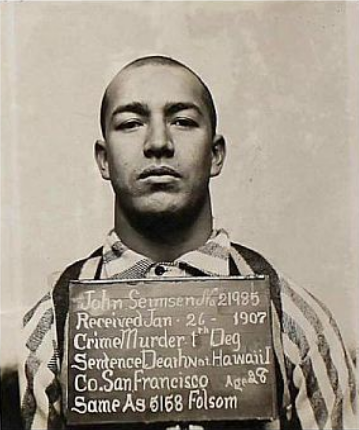
John Ho'olulu Siemsen and the San Francisco Gas-Pipe Murders


Background

John Ho'olulu Siemsen was a Hawaiian-born murderer and robber who became one of the principal figures in the San Francisco gas-pipe murders of 1906. He was born in Hawaii, reportedly in November 1885, although some official records gave an earlier birth year. Siemsen eventually traveled to California and became involved with Louis V. Dabner, who served as his partner during a short but exceptionally violent series of robberies, assaults, and killings. The crimes occurred only months after the devastating San Francisco earthquake and fires of April 1906. Large portions of the city had been destroyed, many residents had been displaced, and law-enforcement resources were strained. Siemsen and Dabner took advantage of this unsettled environment by targeting small businesses where proprietors often worked alone. Their preferred method was to approach victims under the appearance of being ordinary customers and then attack them suddenly with heavy metal objects. The pair became known as the “gas-pipe thugs,” “gas-pipe murderers,” or “Gas-Pipe Gang” because a length of iron gas pipe was used during several attacks. Their objective was robbery, but they repeatedly struck victims in the head with enough force to kill or permanently disable them. At least three men were murdered, while several other victims survived serious assaults.

The Beginning of the Crime Series

One of the earliest attacks attributed to Siemsen and Dabner occurred on July 10, 1906. The victim, identified in historical accounts as Dr. Leland, was assaulted during a robbery but survived. Details about the incident are limited, although it was later included among the violent offenses connected to the pair. The attacks soon became fatal. Siemsen and Dabner selected businesses where they could isolate the owner, pretend to examine merchandise, and wait until there were no witnesses nearby. After gaining the victim's attention, one man could distract or restrain him while the other delivered crushing blows. Money, watches, and other valuables were then taken from the premises.

The Murder of Johannes Pfitzner

Johannes Pfitzner was a German immigrant who operated a shoe business on McAllister Street in San Francisco. On August 20, 1906, he was discovered inside his store with devastating injuries to his head. Evidence at the scene suggested that he had been helping a customer try on a pair of shoes when he was attacked without warning. A heavy window weight was reportedly found near Pfitzner and was believed to have been used as the murder weapon. Approximately $100 to $140 and Pfitzner's gold watch were taken. Although he was still alive when discovered, he died from his injuries on August 20, 1906. Siemsen later stated that the stolen watch had been thrown into San Francisco Bay to prevent police from tracing it through local pawnshops.

The Murder of William Friede

William Friede operated a clothing and tailoring establishment at 1386 Market Street. On September 14, 1906, a boy named Robert Anderson and his sister, Thelma, entered the shop. When they received no response from the front of the store, they went toward the rear fitting and work area. There they found Friede lying unconscious in a pool of blood. Friede's head had been severely battered. His pockets had been turned out, the cash drawer had been emptied, and his watch was missing. A measuring tape lying near him suggested that he may have been measuring or fitting clothing for one of the supposed customers immediately before the attack. Friede never regained consciousness and was reported to have died during the night or on September 15, 1906. Some historical summaries use September 14, the date of the assault, as his date of death. The attackers discarded Friede's stolen watch, which was later recovered on Market Street near Dolores Street. By this point, investigators suspected that the apparently similar business robberies and fatal beatings were connected.

The Kimmon Ginko Bank Murder

On October 3, 1906, Siemsen and Dabner entered the Kimmon Ginko, a Japanese-operated bank at 1588 O'Farrell Street. The bank's manager or president, whose name appeared in historical records under several spellings including M. Munakata, M. Munekato, and M. Murakata, was inside with clerk A. Sasaki. The robbers attacked both men with a section of gas pipe approximately fourteen inches long. The pipe had been wrapped in ordinary brown paper, apparently to conceal it and provide a grip. Munakata and Sasaki were struck repeatedly and left on the floor while the assailants stole approximately $2,800 from the bank. Another man later entered the bank and discovered the victims. Munakata died about two hours after the attack on October 3, 1906. Sasaki survived, but his injuries were extremely serious. He required a lengthy recovery and was initially unable to remember the circumstances of the assault. He later recognized Siemsen as a man who had entered the bank before the robbery, apparently to examine the location and prepare for the crime. The bank murder intensified public fear. California Governor George Pardee offered a reward of $1,500 for information leading to the arrest and conviction of those responsible for the murders of Pfitzner, Friede, and Munakata.

Confirmed Murder Victims

  • Johannes Pfitzner — Attacked and died on August 20, 1906, inside his shoe store on McAllister Street in San Francisco, California. He was fatally bludgeoned, and money and a gold watch were stolen.
  • William Friede — Attacked on September 14, 1906, inside his clothing and tailoring shop at 1386 Market Street in San Francisco, California. Contemporary accounts reported that he died without regaining consciousness during the night or on September 15, although some records list September 14 as the death date.
  • M. Munakata — Also recorded as Munekato or Murakata. Attacked and killed on October 3, 1906, at the Kimmon Ginko bank at 1588 O'Farrell Street in San Francisco, California. He died approximately two hours after being beaten with a gas pipe.


Known Surviving Victims

  • Dr. Leland — Assaulted during a robbery attributed to the pair on July 10, 1906. He survived.
  • A. Sasaki — Attacked alongside M. Munakata at the Kimmon Ginko bank on October 3, 1906. He survived severe head injuries after an extended recovery.
  • Henry Behrend — Attacked in his jewelry store at 1323 Steiner Street on November 3, 1906. His resistance directly contributed to Siemsen's capture.


The Attack on Henry Behrend and Siemsen's Capture

On the evening of November 3, 1906, Siemsen, Dabner, and another associate entered the jewelry store of Henry Behrend at 1323 Steiner Street. The men pretended that they were interested in purchasing jewelry. Once they believed they had Behrend under control, they launched their attack. One robber took money from the cash drawer while another held Behrend in position. Siemsen attempted to strike the jeweler with an iron bar. Behrend resisted, moved his head, and struggled against the men. During the confusion, one blow struck and badly injured the hand or finger of one of Siemsen's accomplices. The other robbers fled, but Behrend continued fighting Siemsen despite suffering serious wounds to his face and head. He managed to hold Siemsen until police officers and a nearby fireman arrived. A crowd quickly gathered outside the store, and officers reportedly had difficulty preventing angry residents from attacking the captured suspect. Siemsen was taken to police headquarters and questioned. His capture gave investigators the break they needed. Evidence, witness identifications, and statements from the suspects connected Siemsen and Dabner to the earlier robberies and killings. Dabner and other associates were soon apprehended.

Confessions and Identification

Siemsen gave authorities extensive accounts of the crimes. He reportedly discussed the planning of the robberies, the selection of isolated merchants, the disposal of stolen property, and the methods used to prevent victims from identifying their attackers. His statements implicated Dabner as an active participant in the murders. Investigators also arranged confrontations between Siemsen and surviving victims. A. Sasaki identified Siemsen as the man he had seen in the bank before the fatal robbery. Other robbery victims recognized him as one of the men involved in their assaults. Siemsen displayed little reluctance during some of these encounters and openly acknowledged individuals whom he and Dabner had targeted.

Trial and Conviction

Although Siemsen and Dabner admitted involvement in three murders, prosecutors concentrated on the killing of M. Munakata because the bank robbery produced particularly strong physical evidence, surviving witnesses, and identifications. Siemsen was tried in the Superior Court of San Francisco and convicted of first-degree murder. His confession became an important part of the prosecution's case. The defense challenged aspects of the proceedings on appeal, but the conviction and death sentence were upheld. Dabner was separately convicted and also sentenced to death for his role in Munakata's murder. Requests were made to commute the men's sentences to life imprisonment, but California Governor James Gillett declined to intervene. Both prisoners remained at San Quentin State Prison while their executions were prepared.

Execution

John Ho'olulu Siemsen and Louis Dabner were executed together at San Quentin on July 31, 1908. Prison officials constructed a double-gallows arrangement so that both men could be hanged simultaneously. When the mechanism was released, they fell through adjoining trapdoors at nearly the same moment. Henry Behrend, the jeweler whose resistance had resulted in Siemsen's arrest, attended the execution. He reportedly expressed satisfaction that the men could no longer attack anyone else, recalling that he had once fought desperately against them to save his own life.

Legacy of the Gas-Pipe Murders

Siemsen's criminal career was brief, lasting only a matter of months, but it caused widespread alarm in San Francisco. The murders occurred at a time when the city was still struggling to recover from one of the worst natural disasters in American history. Residents who were already coping with destroyed homes, damaged businesses, and disrupted public services were confronted with the additional fear that ordinary merchants could be beaten to death in their own shops. The case became notorious because of the calculated manner in which Siemsen and Dabner selected victims and used ordinary commercial interactions to move within striking distance. Their weapons were simple pieces of metal, but the repeated use of gas pipe gave the crimes a recognizable pattern and supplied the newspapers with the name by which the killers would be remembered. John Ho'olulu Siemsen is generally credited with three confirmed murders committed with Louis Dabner. Their victims were not selected because of personal disputes; they were merchants and bank employees attacked for money. The capture following Henry Behrend's determined resistance ended the series and allowed investigators to connect the pair to the killings of Johannes Pfitzner, William Friede, and M. Munakata.

Victims

See any mistakes? Let us know!
Confirmed Victims: (3)
  • Johannes Pfitzner , Date of Death: August 20, 1906
  • William Friede , Date of Death: September 14, 1906
  • M. Munekato , Date of Death: October 3, 1906

  • Survivors:
  • Dr. Leland , Date of Attack: July 10, 1906
  • A. Sasaki , Date of Attack: October 3, 1906
  • Henry Behrend , Date of Attack: November 3, 1906