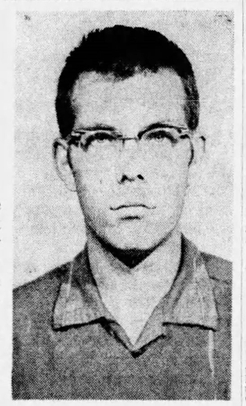
Frank Carter – The Omaha Sniper
Overview
Frank Carter, an Irish immigrant whose birth name was Patrick Murphy, became one of the most feared criminals in Omaha, Nebraska, during a brief but intense shooting spree in February 1926. Newspapers called him the "Omaha Sniper" or "phantom sniper" as residents struggled to understand who was firing at people and into buildings seemingly without warning. Carter was ultimately connected to two confirmed murders and several nonfatal shootings. After his capture, he made sensational claims that he had killed dozens of people, but investigators never found evidence supporting most of those additional confessions.
Carter's two confirmed murder victims were mechanic William McDevitt and physician Dr. Austin D. Searles. Both were killed in Omaha within a period of only a few days. Carter also admitted responsibility for other shootings during the same period, including the serious wounding of railroad detective Ross Johnson in Council Bluffs, Iowa. His attacks created such widespread fear that people avoided the streets, businesses suffered, entertainment establishments emptied, and residents were encouraged to keep their homes dark at night.
Early Life and Criminal Background
Carter was born Patrick Murphy in County Mayo, Ireland, although historical accounts disagree about his exact birth year and age. After immigrating to the United States, he lived and worked in the Midwest and spent time as a farm laborer. Years before the Omaha murders, he had already demonstrated a capacity for vindictive and destructive behavior.
In 1916, Carter was sentenced to prison in Iowa for maliciously killing dairy cattle belonging to farmer Otto Schoeneman, a former employer. The destruction of the animals was reportedly an act of revenge stemming from an earlier dispute. Carter was sentenced to a lengthy prison term and was eventually released. His history with the Schoeneman family continued to create fear after his imprisonment because he had reportedly made threats against them.
In 1925, Verne Schoeneman, Otto's son, believed Carter might be coming after him. When a man entered the Schoeneman residence at night, Verne fired at the intruder. The person was not Carter but a newly employed farmhand, Charles Van Meeteren, who was killed. Carter did not kill Van Meeteren and should not be counted among Carter's victims, but the incident illustrates the degree of fear created by Carter's earlier threats.
The Omaha Sniper Attacks
In February 1926, a series of shootings began frightening Omaha. Carter used a .22-caliber firearm, described in historical accounts as having been equipped with a silencer. The relatively quiet weapon helped create the impression that an unseen gunman could strike without warning. Victims were shot, bullets were fired through windows, and gunfire was directed into occupied buildings.
The attacks appeared unpredictable. Authorities initially had little information about the gunman's identity or motive. Newspapers closely followed every development, and the killer was increasingly portrayed as a mysterious sniper moving through the city. Omaha residents became especially fearful of standing near illuminated windows after reports indicated the gunman was deliberately firing toward people and lights.
Murder of William McDevitt
William McDevitt, a 35-year-old Omaha mechanic, became Carter's first confirmed murder victim. McDevitt was shot on February 15, 1926, in Omaha, Nebraska. Contemporary accounts described him as having been struck multiple times by bullets fired from a .22-caliber weapon. One of the bullets passed through his head. He did not survive the attack.
At first, McDevitt's murder was an isolated mystery. It soon became clear, however, that Omaha was dealing with something much larger. Additional shots were fired around the city, and only two days after McDevitt's death another man was murdered.
Murder of Dr. Austin D. Searles
On February 17, 1926, Dr. Austin D. Searles was shot and killed in Omaha, Nebraska. Searles was a physician and was found dead after being shot with a small-caliber weapon. His killing established beyond doubt that Omaha was facing a repeated killer rather than a single unexplained homicide.
The prosecution later maintained that Carter killed Searles while attempting to rob him. When Carter was eventually placed on trial, his responsibility for Searles' death was not seriously disputed by the defense. Instead, Carter's attorneys focused largely on his mental condition and argued that he was legally insane when the murder occurred.
Searles' death became the murder for which Carter was ultimately convicted and sentenced to death. The Nebraska Supreme Court record specifically identifies February 17, 1926, as the date Carter killed Austin D. Searles in Douglas County, Nebraska.
Confirmed Murder Victims
- William McDevitt, age 35 – Killed February 15, 1926, in Omaha, Nebraska. McDevitt was a mechanic who was shot multiple times with a .22-caliber firearm and died from his wounds.
- Dr. Austin D. Searles – Killed February 17, 1926, in Omaha, Douglas County, Nebraska. Searles was a physician who was shot and killed during what prosecutors described as an attempted robbery.
Nonfatal Shootings and the Terror in Omaha
Carter's violence was not limited to the two murders. During the same period, bullets were fired through windows and into businesses, and other people were shot at or wounded. The uncertainty surrounding the attacks intensified the panic because residents did not know where the gunman would appear next.
Reports that victims had been targeted around illuminated windows led to calls for residents to darken their homes. Omaha's normally active streets became noticeably quieter. People stayed indoors, entertainment establishments lost customers, and businesses were affected as fear spread through the community. The unknown shooter seemed capable of firing from concealment and disappearing before anyone could identify him.
Carter also crossed the Missouri River into neighboring Council Bluffs, Iowa. Railroad detective Ross Johnson was shot several times during the shooting spree and was seriously wounded but survived. Johnson's encounter with the gunman became particularly important because he was able to provide information about the person who had attacked him.
The Shooting of Ross Johnson
Railroad detective Ross Johnson was attacked in Council Bluffs during the later stages of Carter's spree. Historical accounts describe Johnson as being shot approximately six times. Although seriously injured, he survived. His ability to see and describe his attacker helped authorities as the search intensified.
Unlike McDevitt and Searles, Johnson is not included among Carter's murder victims because he survived his wounds. The attack nevertheless demonstrated that Carter's violence was not confined to Omaha and helped connect the Nebraska shootings with events occurring across the state line in Iowa.
Capture at Bartlett, Iowa
The search for the sniper ended on February 22, 1926. Carter was spotted near Bartlett in Fremont County, Iowa, south of Council Bluffs. A railroad employee reportedly noticed him walking along the tracks after he had been hiding in a haystack and alerted others. Carter was taken into custody and returned to Omaha.
His capture brought immediate relief to communities that had spent more than a week fearing another unexplained shooting. Contemporary reports described Omaha and Council Bluffs beginning to return to normal once authorities announced that the suspected sniper was behind bars.
Confessions and Claims of Dozens of Murders
After his arrest, Carter admitted responsibility for the Omaha sniper crimes. He also began making extraordinary claims about killings far beyond the two murders investigators could prove. Different historical accounts record him claiming responsibility for approximately 43 to 45 murders.
Authorities and journalists were skeptical. Evidence was never produced connecting Carter to anything close to that number of deaths, and contemporary reporters considered many of his alleged confessions unreliable or fictitious. For that reason, Carter should be regarded as having two confirmed murder victims rather than the dozens he claimed.
Carter's statements following his arrest were erratic and sometimes theatrical. He described violent impulses and at other times indicated that robbery had played a role in his crimes. His behavior became an important issue when his attorneys attempted to establish that he was mentally incapable of being held legally responsible for the murder of Dr. Searles.
Insanity Defense and Trial
Carter was prosecuted for the murder of Austin D. Searles. He also faced a first-degree murder charge involving William McDevitt, although that charge was later withdrawn after the Searles prosecution resulted in a conviction.
At Carter's trial, defense attorneys argued that he was insane when he committed the murder. Mental-health specialists called by the defense testified that Carter suffered from serious psychological abnormalities and contended that he could not properly distinguish right from wrong in connection with his actions.
The prosecution presented opposing medical testimony. A physician who examined Carter described him as having abnormal personality characteristics but testified that Carter understood the difference between right and wrong and was capable of planning crimes and appreciating their consequences.
The jury rejected the insanity defense. Carter was convicted of first-degree murder for killing Dr. Austin D. Searles and was sentenced to death.
Appeal and Death Sentence
Carter appealed his conviction to the Nebraska Supreme Court. His attorneys continued to challenge the verdict largely on the question of his sanity and whether the evidence justified finding him criminally responsible. On March 9, 1927, the Nebraska Supreme Court affirmed the conviction.
With the conviction upheld, Carter remained under a death sentence at the Nebraska State Penitentiary in Lincoln. Despite the gravity of his situation, contemporary reports frequently portrayed him as strangely unconcerned about his approaching execution.
Execution
Frank Carter was executed in the electric chair at the Nebraska State Penitentiary in Lincoln, Nebraska, on June 24, 1927. Contemporary newspaper accounts and later historical records consistently identify June 24 as the date of his death.
Several versions of Carter's final moments circulated afterward. The best-known account attributes the words "Let the juice flow" to him as prison officials prepared the electric chair. Another contemporary version reported that he began asking officials to turn on the electricity as the current was activated. Whatever the exact wording, his final behavior reinforced the bizarre public image that had developed around him during his prosecution.
Confirmed Crimes Versus Carter's Claims
Frank Carter is sometimes described as an extraordinarily prolific serial killer because of his own statements after his arrest. That description can be misleading if his unverified confessions are treated as established fact. Only two killings, those of William McDevitt and Austin D. Searles, are firmly associated with him as confirmed murder victims.
There is substantially stronger evidence for Carter's involvement in several additional nonfatal shootings committed during the Omaha sniper panic, including the attack on railroad detective Ross Johnson. His willingness to claim dozens of unrelated murders made separating fact from exaggeration difficult even for investigators and reporters at the time.
Legacy of the Omaha Sniper
Carter's criminal career became infamous not because of a large verified victim count but because of the extraordinary terror he created in a short period. His ability to move through Omaha and nearby Council Bluffs while firing at people, windows, and businesses transformed routine activities into perceived dangers. Standing beside a window, walking along a street, or remaining inside an illuminated building suddenly seemed potentially hazardous to frightened residents.
The case also illustrates the difference between a killer's confession and a confirmed victim count. Carter eagerly associated himself with scores of killings, but historical evidence supports only two murders. William McDevitt and Dr. Austin D. Searles therefore remain the two confirmed people whose deaths can reliably be attributed to Frank Carter. His February 1926 shooting campaign, the widespread panic it caused, his dramatic capture in Iowa, and his subsequent trial and execution secured his place in American criminal history as the "Omaha Sniper."