Gustave Marx and the Chicago Car Barn Bandits
Early Life and Entry into Crime
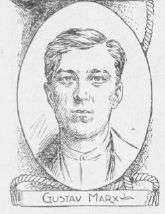
Gustave Marx, sometimes called Gus Marx, was a young Chicago criminal who became one of the central members of the group known as the Chicago Car Barn Bandits. The gang operated primarily during the summer and fall of 1903 and included Marx, Harvey Van Dine, Peter Niedermeier and Emil Roeski. Marx and his closest associates were also referred to as the Automatic Trio because they frequently carried and used semiautomatic pistols during robberies.
Marx, Van Dine and Niedermeier had known one another from Chicago’s northwest side. Their criminal activity began before the killings for which they became infamous. In 1901, the three young men were arrested after stealing lead pipe from the Audubon School in Chicago. They were sentenced to approximately three months in the Bridewell jail. Rather than ending their criminal behavior, the punishment was followed by increasingly serious robberies involving firearms.
The group’s violence was not driven by a large or carefully organized criminal enterprise. They frequently attacked railway offices, neighborhood saloons and other businesses for very small amounts of money. Their willingness to shoot employees, customers and police officers for only a few dollars created widespread fear throughout Chicago. Although Marx is sometimes described as a serial killer, his crimes were committed as part of a violent robbery gang, and historical accounts do not establish that he personally fired every fatal shot attributed to the Car Barn Bandits.
The Beginning of the 1903 Crime Spree
The gang’s major crime spree began in July 1903. On the night of July 3, Peter Niedermeier and Emil Roeski entered the Clybourn Junction station of the Chicago and North Western Railway. Employees L. W. Lathrop and Martin Doherty were working inside when the robbers ordered them to raise their hands. Lathrop resisted and was shot, although he survived. The gunmen escaped with approximately $70.
On July 9, 1903, Marx joined Harvey Van Dine and Emil Roeski in the robbery of Ernest Spires’ saloon at 1820 North Ashland Avenue in Chicago. Roeski initially entered the establishment and ordered a beer while Marx and Van Dine followed with weapons drawn. Spires and 19-year-old customer Otto Bauder were ordered to raise their hands. Bauder attempted to escape through a side door and was shot in the back. He died from the wound, while the robbers escaped with less than $50.
The men continued attacking saloons in the following days. On July 10, Van Dine and Roeski robbed Greenberg’s saloon near Robey and Addison Streets. Bartender Louis Cohen was forced into an ice chest while the robbers stole approximately $25. On July 12, the same pair held up Charles Alvin’s saloon at Sheffield Avenue and Roscoe Street, taking money from the proprietor and four customers. On July 20, Peter Gorski was shot in the head during a robbery of his saloon at 2611 Milwaukee Avenue. Gorski survived despite suffering a serious wound, and the robbers escaped with less than $5.
The La Gross and Jensen Murders
On the night of August 1, 1903, Harvey Van Dine and Peter Niedermeier entered a saloon operated by Benjamin C. La Gross at 2120 West North Avenue in Chicago. La Gross was playing cards with 21-year-old Adolph Jensen when the two gunmen opened fire. Both men were mortally wounded during the attack. The robbers took approximately $64 before fleeing.
La Gross was reported to have died at the saloon or shortly after the shooting. Jensen was transported to St. Elizabeth’s Hospital, where he died from his injuries within approximately twenty-four hours. Some historical reports place the deaths on August 2, while later accounts describe both men as dying within two days of the August 1 attack. Marx was a member of the gang but was not identified as one of the two gunmen who entered the saloon during this particular robbery.
The Chicago City Railway Car Barn Massacre
The crime that gave the gang its lasting name occurred at approximately 3:00 a.m. on August 30, 1903. Marx, Van Dine and Niedermeier targeted the Chicago City Railway Company’s car barn near 61st and State Streets. The men believed that the company’s office contained a large amount of money collected from streetcar fares.
Inside the office, employees Francis “Frank” W. Stewart, William Edmund and Henry Biehl were balancing the day’s receipts. Motorman James B. Johnson was asleep in an adjoining room. Niedermeier positioned himself near a side window, while Marx and Van Dine approached the entrance. One of the men carried a sledgehammer that was used to break through the office door.
The employees attempted to protect the company’s money, and the robbers responded with a barrage of gunfire. Bullets were fired through the window and from the doorway. Stewart was struck in the abdomen and died within minutes. Johnson awakened after hearing the shooting and entered the office, where he was immediately shot and killed. Edmund and Biehl were seriously wounded but survived.
The three bandits collected approximately $2,250 and escaped. They reportedly traveled to Jackson Park, hid in bushes until daylight and divided the stolen money. The amount was far larger than the proceeds from their previous robberies, but the killing of Stewart and Johnson intensified the police investigation and caused the gang to become known throughout the city as the Car Barn Bandits.
Victims Associated with Marx and the Car Barn Bandits
- Otto Bauder, 19 – July 9, 1903 – 1820 North Ashland Avenue, Chicago, Illinois: Bauder was a customer inside Ernest Spires’ saloon when Marx, Harvey Van Dine and Emil Roeski carried out a robbery. Bauder attempted to escape and was shot in the back. Roeski was generally identified as the shooter, although the three men participated in the robbery together.
- Benjamin C. La Gross, approximately 40 – August 1 or August 2, 1903 – 2120 West North Avenue, Chicago, Illinois: La Gross was the proprietor of a saloon robbed by Van Dine and Peter Niedermeier. He was shot during the attack and died from his wounds. Marx was not identified as being present during this particular killing.
- Adolph Jensen, 21 – August 2, 1903 – Chicago, Illinois: Jensen was playing cards with La Gross when the saloon was attacked on August 1. He was fatally shot and died at St. Elizabeth’s Hospital within approximately twenty-four hours. Some historical publications incorrectly rendered his surname as Jennsen or referred to him as Adolph Johnson.
- Francis “Frank” W. Stewart, approximately 20 – August 30, 1903 – Chicago City Railway car barn, 61st and State Streets, Chicago, Illinois: Stewart was helping balance the railway company’s receipts when Marx, Van Dine and Niedermeier entered the office. He was shot in the abdomen and died within minutes.
- James B. Johnson, approximately 38 – August 30, 1903 – Chicago City Railway car barn, 61st and State Streets, Chicago, Illinois: Johnson was a railway motorman who had been sleeping in an adjoining room. He awakened during the attack, entered the office and was shot to death. Some early reports identified him only as J. Johnson or John Johnson.
- Patrolman John Quinn, 37 – November 22, 1903 – Chicago, Illinois: Quinn was shot by Marx shortly before 11:00 p.m. on November 21 inside Greenberg’s saloon at Robey and Addison Streets. He was taken to Alexian Brothers Hospital and pronounced dead at approximately 1:00 a.m. on November 22. This killing was committed directly by Marx while Quinn attempted to arrest him.
- Patrolman Joseph D. Driscoll, 33 – December 1, 1903 – Chicago, Illinois: Driscoll was shot near Miller Station in Lake County, Indiana, on November 27 while pursuing Van Dine, Niedermeier and Roeski. He died four days later at Mercy Hospital. Niedermeier was identified as the gunman. Marx was already in custody and was not present during the shooting.
- John Sovea, 25 – November 27, 1903 – near Miller Station, Lake County, Indiana: Sovea was killed during the violent flight and capture of Marx’s accomplices in Indiana. Historical lists include him among the eight people killed during the gang’s crime spree, although Marx had already been arrested and did not participate in Sovea’s death.
The Killing of Patrolman John Quinn
By November 1903, Chicago police had received information that Marx was spending money despite being unemployed and had displayed an automatic pistol while drinking. Patrolmen John Quinn and William Blaul were assigned to locate and arrest him. The officers knew Marx and searched for him over several days.
Shortly before 11:00 p.m. on November 21, Quinn and Blaul found Marx drinking inside Greenberg’s saloon at the corner of Addison and Robey Streets, now Damen Avenue. The officers entered through separate doors to prevent Marx from escaping. Quinn approached Marx and reportedly told him that he was wanted. Before Quinn could take hold of him, Marx drew a revolver and fired several shots.
One bullet struck Quinn in the abdomen and caused a fatal wound. Blaul returned fire, hitting Marx in the shoulder and hip. He then tackled and disarmed Marx after a prolonged struggle. Quinn was transported to Alexian Brothers Hospital, where he died at approximately 1:00 a.m. on November 22, 1903. Marx was taken into custody and interrogated about Quinn’s murder and the unresolved series of robberies.
Confession and Capture of the Gang
Marx initially resisted questioning, but investigators connected his automatic pistol, unexplained money and criminal associates to the Car Barn Bandits. Facing an almost certain death sentence for killing Quinn, Marx eventually confessed to participating in the gang’s robberies and murders. He identified Van Dine, Niedermeier and Roeski as his accomplices and provided information that helped police locate them.
After learning that Marx had confessed, the other gang members fled Chicago and hid in a dugout near Miller Station in the Indiana Dunes. A local schoolteacher recognized them from newspaper photographs and notified authorities. Chicago officers traveled to Indiana and surrounded the hiding place on November 27, 1903.
The fugitives responded with gunfire. Patrolman Joseph Driscoll was mortally wounded, and Detective Matthew Zimmer was seriously injured. The bandits escaped temporarily into the surrounding woods. John Sovea was also killed during the violent events associated with their flight. By the end of the manhunt, Van Dine, Niedermeier and Roeski had been captured and returned to Chicago.
Trial, Conviction and Execution
The prosecution presented extensive evidence connecting Marx and his companions to the robberies and killings. Marx was held directly responsible for the murder of Patrolman John Quinn and was also prosecuted for his participation in the car barn robbery and related crimes. The defendants’ confessions and statements frequently conflicted as they attempted to place greater responsibility on one another.
Marx, Harvey Van Dine and Peter Niedermeier were convicted and sentenced to death. Emil Roeski received a life sentence. On April 22, 1904, Marx, Van Dine and Niedermeier were hanged at the Cook County Jail. More than a thousand people reportedly gathered outside the jail as the executions were carried out separately over a period of approximately eighty minutes.
The Car Barn Bandits’ known crime spree lasted only several months, but its reckless brutality made it one of the most feared criminal episodes in early twentieth-century Chicago. The gang killed during robberies that sometimes produced only a few dollars, wounded employees who attempted to resist and used rapid-firing pistols against both civilians and police officers. Marx’s decision to shoot Patrolman Quinn led directly to his arrest, his confession and the eventual destruction of the gang.