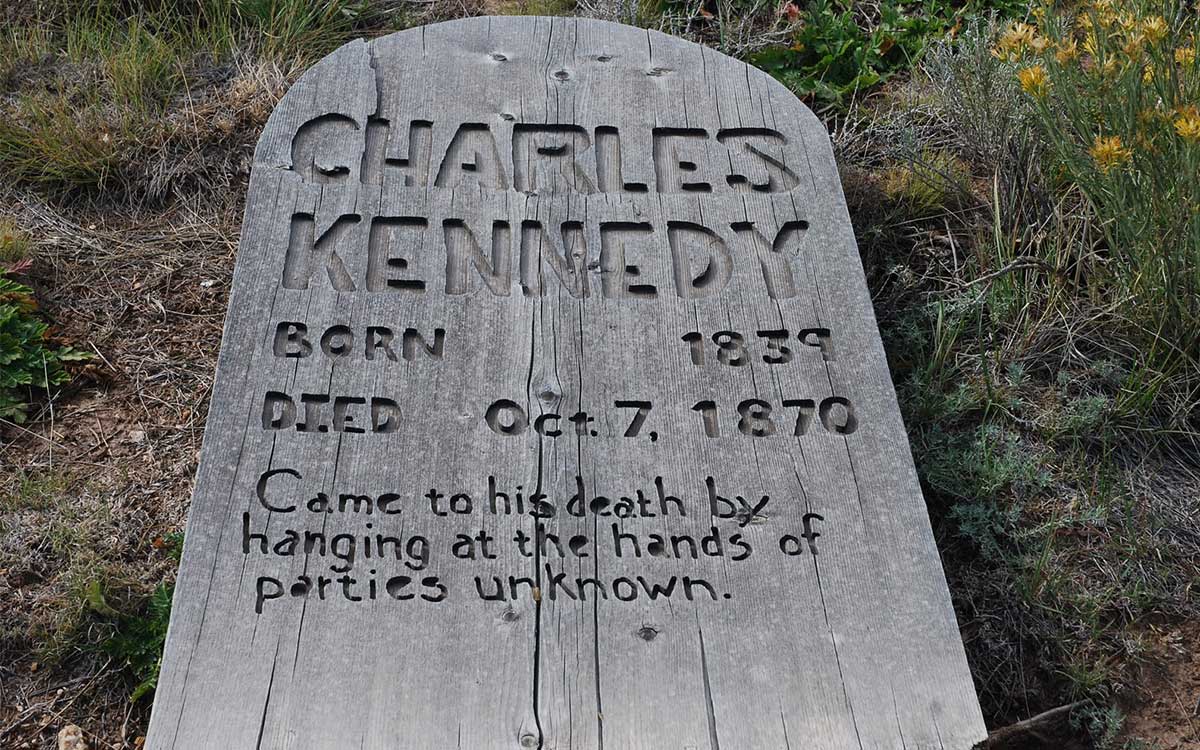
Charles Kennedy: The Serial Killer of New Mexico’s Taos Trail
Frontier Innkeeper and Suspected Serial Murderer
Charles Kennedy was a nineteenth-century innkeeper, mountain man and accused serial killer who operated in the remote mountains of northern New Mexico. He lived near the base of Palo Flechado Pass, along a rugged route connecting the Moreno Valley with Taos. During the late 1860s, this trail carried miners, merchants, laborers and other travelers through an isolated region where shelter was scarce and the disappearance of a stranger could easily go unnoticed.
Kennedy established a small cabin, tavern or roadside lodging place near the junction of the Mora and Taos roads. The precise description of the establishment varies among historical accounts, but it reportedly offered food, alcohol and overnight accommodations. Travelers approaching the dangerous mountain pass would have viewed the cabin as a welcome refuge from cold temperatures, rough terrain and the threat of robbery. According to the allegations that later surrounded Kennedy, the appearance of hospitality concealed a deadly criminal operation.
Kennedy was accused of attacking travelers who stopped at his property, stealing their money, animals and belongings, and disposing of their remains around the cabin. Some accounts claim that victims were killed while sleeping. Others describe Kennedy shooting or striking travelers after determining that they possessed property worth taking. The bodies were allegedly buried beneath the building or elsewhere on the land, while portions of some remains may have been burned in the fireplace.
The Disappearance of Travelers
Rumors gradually circulated that people who stopped at Kennedy’s cabin were never seen again. The region had a constantly changing population, and many travelers had no relatives nearby to report them missing. Mining camps also attracted men who moved frequently and did not always reveal their destinations. These circumstances would have made it possible for a killer to prey upon strangers without immediately attracting official attention.
Suspicion reportedly increased after the disappearance of a traveler whose horse, pack animal or personal property was later connected to Kennedy. When questioned, Kennedy claimed that he had found the animals wandering loose. With no body, limited law enforcement and few witnesses, authorities apparently lacked enough evidence to hold him. The incident nevertheless strengthened the belief that Kennedy knew more about the missing travelers than he admitted.
Later stories credited Kennedy’s wife with revealing that her husband had killed numerous guests. Her name is frequently given as Gregoria in historical records, although later retellings sometimes call her Rosa. The number of alleged victims also differs sharply. Some accounts claim approximately fourteen travelers were murdered, while others raise the estimate to twenty or more. No complete list of victims was ever established, and most of the alleged dead remain unidentified.
The Christmas Eve Killing
The most historically specific murder associated with Kennedy occurred on the night of December 24, 1869. Two travelers were reportedly staying at his establishment. One was a local man named Jose Cortez. The second was described as a tall stranger with a full red beard, but his name has not survived in the available accounts.
According to testimony later attributed to Cortez, Kennedy attacked the red-bearded traveler inside or near the cabin. The circumstances differ by source, but the stranger was reportedly shot and killed. Cortez survived and later became an important witness against Kennedy. This version is more restrained than the dramatic folklore that developed around the case, yet it provides the clearest reported date for one of Kennedy’s alleged murders.
Accounts describing what happened after the shooting vary. Some state that Kennedy attempted to conceal the victim’s body and take possession of his property. Others describe Cortez escaping and eventually reporting the crime. Kennedy was later arrested and prosecuted for the murder, with Cortez reportedly identifying him as the killer.
Victims and Alleged Victims
- Unidentified red-bearded traveler — December 24, 1869 — Kennedy’s roadside establishment near Palo Flechado Pass, New Mexico Territory: The victim was described as a tall man with a full red beard who was staying at Kennedy’s cabin with Jose Cortez. Kennedy was accused of shooting and killing him. This is the most clearly dated homicide connected to Kennedy, although the victim’s identity remains unknown.
- Unidentified travelers — dates unknown, probably during the late 1860s — Taos Trail and Moreno Valley area, New Mexico Territory: Kennedy was accused of murdering travelers who stopped at his isolated lodging place. Later estimates placed the number at approximately fourteen, although some retellings claimed twenty or more. Their names, individual dates of death and precise burial locations were never reliably documented.
- Kennedy’s young son — date and location uncertain: A popular version of the story claims that Kennedy killed his own child after the boy revealed that a murdered traveler had been hidden beneath the floor. The child is sometimes described as being nine or ten years old. However, census-based research indicates that Kennedy and his teenage wife had an infant son named Samuel in 1870, creating serious doubt about the traditional account. Because the story cannot be conclusively verified, the child should be regarded as an alleged rather than confirmed victim.
The Story of the Body Beneath the Floor
The most famous version of the Kennedy legend describes a traveler eating supper with the family and asking whether Native Americans were nearby. Kennedy’s young son supposedly replied that the traveler could smell the Native American whom his father had placed beneath the floor. Realizing that the child had exposed him, Kennedy allegedly shot the guest and then killed the boy by striking his head against the stone fireplace.
Kennedy was then said to have placed the bodies in the cellar, confined his wife and consumed enough alcohol to lose consciousness. His wife supposedly escaped by climbing through the chimney and traveled to Elizabethtown, where she told residents that Kennedy had murdered numerous travelers. An armed party then went to the cabin and discovered human bones, buried skeletons and recently killed victims.
This story has been repeated for generations, but important details conflict with contemporary records. Kennedy’s wife appears to have been approximately seventeen years old in 1870, and their documented son was an infant rather than a boy old enough to make the famous remark. The colorful account may preserve elements of genuine events, but it was likely altered and expanded through oral storytelling.
Discovery of Human Remains
After Kennedy came under suspicion, searchers reportedly examined the property and found evidence that appeared to support accusations of multiple murders. Stories describe human bones in or near the fireplace, skeletons beneath the cabin and a skull discovered on the grounds. The remains were said to belong to travelers who had disappeared after accepting Kennedy’s hospitality.
Nineteenth-century frontier investigations rarely met modern forensic standards. There was no systematic excavation, no scientific identification of the remains and no complete official record naming the dead. Consequently, it is impossible to determine precisely how many bodies were found or whether every set of remains described in later accounts actually existed.
The condition of the alleged remains nevertheless influenced public opinion. Residents believed that Kennedy had used his isolated property as both a place of murder and a hidden graveyard. The discovery of unidentified bones, combined with witness testimony and the presence of travelers’ property, transformed him from a suspicious innkeeper into one of the territory’s most feared accused killers.
Arrest and Trial
Kennedy was arrested and brought before territorial authorities on a murder charge connected to the killing witnessed by Jose Cortez. Court proceedings reportedly included testimony from Cortez and Kennedy’s wife. Accounts suggest that Kennedy was convicted or faced a strong likelihood of conviction, although the surviving descriptions of the legal process are inconsistent.
Residents of the mining communities had little confidence in territorial courts. Judges traveled long distances, jails were poorly secured and rumors of bribery were common. When Kennedy obtained legal representation, some townspeople allegedly feared that an attorney would secure his release despite the testimony and the remains reportedly discovered near his home.
A group of armed and disguised men eventually seized Kennedy from his guards or jailers. He was taken to an isolated building, commonly described as an old slaughterhouse, and hanged from a rafter. A coroner’s inquiry concluded that he had been killed by unidentified persons. His lynching prevented a complete trial and ended any possibility of compelling him to identify additional victims or burial sites.
Clay Allison and the Later Legend
Famous New Mexico gunfighter Clay Allison became closely associated with the Kennedy story. Later accounts claim that Allison organized the posse, removed Kennedy from custody and personally participated in his killing. Some versions state that Kennedy was hanged and then decapitated. Others claim that Allison tied a rope around Kennedy’s neck and dragged him behind a horse until his head was severed.
The severed head was supposedly displayed on a stake outside an Elizabethtown saloon as a warning to other criminals. These dramatic details fit Allison’s violent reputation, but they are difficult to confirm. More restrained accounts describe Kennedy being removed by masked men and hanged in a slaughterhouse without conclusively naming the participants.
Allison may have participated in the lynching, but the extent of his involvement remains uncertain. Over time, frontier storytellers combined Kennedy’s crimes with Allison’s reputation, creating a dramatic tale of a monstrous innkeeper brought down by an equally dangerous vigilante.
Number of Victims
Charles Kennedy is frequently credited with killing approximately fourteen travelers, although estimates range from several victims to more than twenty. The larger figures appear to come from statements attributed to his wife or from later folklore rather than surviving court records. Only one alleged victim, the unidentified red-bearded traveler killed on December 24, 1869, has a consistently reported death date.
The absence of names does not necessarily mean that the disappearances were imaginary. Travelers regularly passed through the region without leaving detailed records, and many had no local family members. A person could vanish along the Taos Trail and be presumed killed by weather, animals, robbery or an accident. Kennedy’s location gave him access to vulnerable strangers and provided numerous places where evidence could be hidden.
At the same time, the lack of reliable documentation requires caution. Kennedy was clearly accused of murder, and witness testimony connected him to at least one killing. Claims that he murdered fourteen or twenty people cannot be independently verified. His reputation as a serial killer therefore rests upon a mixture of documented accusation, physical evidence described by witnesses and legends that developed after his death.
Legacy
Charles Kennedy remains one of the earliest figures described as a serial killer in the history of the American Southwest. His case demonstrates how isolation, weak law enforcement and constant migration created opportunities for violent offenders. A roadside inn that should have protected travelers was allegedly transformed into a trap where victims were robbed, murdered and hidden.
The uncertainty surrounding Kennedy’s crimes also illustrates the difficulty of separating frontier history from folklore. Names changed, victim totals grew and the account of his capture became increasingly sensational. Gregoria became Rosa in some versions, an infant son became an older child, and a vigilante hanging developed into a tale of dragging, decapitation and public display.
Despite these contradictions, the central allegations remained consistent: Kennedy operated an isolated lodging place, travelers disappeared after stopping there, stolen property was connected to him, human remains were reportedly discovered near his cabin, and a surviving witness accused him of killing a traveler on Christmas Eve in 1869. Before the justice system could fully determine the scale of his crimes, a mob took him from custody and killed him.
The unidentified victims remain the most tragic part of the story. Their names, destinations and personal histories were lost, leaving them remembered only as travelers who may have accepted shelter at the wrong cabin. Kennedy’s legend endures not because every detail can be proven, but because the available evidence and testimony suggest that the dangerous roads of territorial New Mexico concealed a predator who used hospitality to bring strangers within his reach.