Elvira Bender: Matriarch of the Bloody Benders
Elvira Bender and the Bloody Bender Family
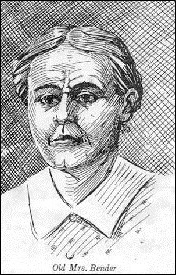
Elvira Bender, commonly called "Ma Bender" and sometimes identified in historical accounts as Kate Bender Sr., was the older woman associated with the notorious Bender family of Labette County, Kansas. The group, remembered as the "Bloody Benders," consisted of Elvira, John Bender Sr., John Bender Jr., and the younger Kate Bender. During the early 1870s, the family operated a small roadside store and lodging place along a heavily traveled route through southeastern Kansas. After the family suddenly disappeared in 1873, investigators discovered human remains buried around their property, establishing the Bender homestead as the scene of one of the most infamous series of murders in the American frontier era.
Although Elvira has long been described as one of the Bender killers, no member of the family was ever brought to trial. Consequently, investigators were never able to determine precisely which person delivered the fatal injuries in each murder. Accounts written after the discovery generally portray the four Benders as working together, with different family members helping lure travelers into vulnerable positions, attack them, rob them, conceal their bodies, and maintain the appearance of an ordinary roadside business.
The Bender Homestead
The Benders settled in Osage Township in northwestern Labette County, several miles northeast of what became Cherryvale, Kansas. Their property stood beside an important road used by travelers moving between settlements such as Independence, Osage Mission, and Fort Scott. The location was ideal for a small general store and stopping place because travelers often needed meals, supplies, shelter, and water for themselves and their animals.
The Bender cabin was divided into two sections by a large canvas curtain. The front portion functioned as a public area where groceries and supplies were sold and meals were served. The rear section was the family's private living area. A dining table was positioned close to the curtain, an arrangement that later became an important part of investigators' reconstruction of the murders.
Travelers stopping for food were reportedly encouraged to sit in a particular place at the table with their backs toward the canvas partition. This placed the person's head close to the curtain and allowed someone concealed on the other side to approach without being seen. Investigators and surviving travelers later concluded that this arrangement was deliberately designed to place selected guests in a defenseless position.
The Method of Murder
Evidence discovered at the homestead indicated that victims were generally attacked by a powerful blow to the head with a hammer or similar heavy instrument. Their throats were then cut. A concealed opening in the floor led to a pit beneath the cabin, allowing a body to be temporarily dropped below the floor before it could be removed and buried elsewhere on the property.
Most of the victims were eventually concealed in graves dug in the Benders' orchard or garden. At least one victim was recovered from the well. When the abandoned cabin was searched, investigators found blood in the area beneath the trapdoor, and the later discovery of graves throughout the property left little doubt that the house had been systematically used as a killing place.
The exact role performed by Elvira during individual murders cannot be established. Later accounts frequently alleged that one of the Bender men delivered the initial hammer blow while Elvira or Kate assisted with cutting the victim's throat, robbery, or disposal of the body. Those specific assignments of responsibility were never tested in court and should therefore be regarded as reconstructions rather than proven facts. What is much more firmly established is that the murders occurred at the family home and that the four Benders disappeared together before authorities could question or arrest them.
Choosing the Victims
The Benders appear to have concentrated primarily on travelers who were alone and who possessed money, horses, wagons, or other property that could be stolen. A lone traveler could disappear on the frontier without immediately attracting attention, particularly if relatives lived far away. Missing-person investigations were difficult, communication between communities was slow, and southeastern Kansas already had a reputation for horse theft, robbery, and violence.
Several people nevertheless escaped situations at the Bender home that later appeared dangerously similar to the circumstances surrounding the murders. Stories circulated of guests becoming suspicious of the stained curtain or refusing to sit in the place selected for them. These accounts took on far greater significance after the graves were discovered.
Victims Associated With the Bender Murders
Historical records disagree over the exact number and identities of the Benders' victims. Kansas historical accounts generally credit the family with at least eleven murders, while later estimates sometimes place the possible total considerably higher. Exact calendar dates of death were not preserved for most victims. Where surviving historical accounts establish only a month or general period, an exact day should not be invented.
- William Baldwin Jones - May 1871 - Drum Creek area, Kansas: Jones was found dead in or near Drum Creek. His death is traditionally associated with the beginning of the Bender murder series. His skull had been severely injured and his throat had been cut. Because his body was not recovered from the Bender property and the killers were never tried, his attribution to the family is less certain than the victims later discovered at their homestead.
- Two unidentified men - February 1872 - Prairie near the Labette County area, Kansas: Two unidentified men were discovered dead with injuries resembling those found on other suspected victims. Their skulls had been crushed and their throats cut. Their names and exact dates of death remain unknown, and their connection to the Benders is generally regarded as probable rather than conclusively proven.
- Ben Brown - Late 1872, commonly reported as December 1872 - Bender homestead, Labette County, Kansas: Brown was from Howard County, Kansas. His remains were recovered from the Bender property. Historical accounts also reported that a substantial amount of money belonging to him disappeared.
- W. F. McCrotty, also recorded as McCratty - Late 1872, commonly reported as December 1872 - Bender homestead, Labette County, Kansas: McCrotty was a Civil War veteran who had served with an Illinois infantry regiment. He disappeared along with money, a wagon, and a team of horses. His remains were among those attributed to the Bender homestead murders.
- Henry McKenzie - Late 1872, commonly reported as December 1872 - Bender homestead, Labette County, Kansas: McKenzie was traveling in connection with a move from Indiana to Kansas. He disappeared with money and a matched team of horses. His remains were later identified among those recovered after the Benders fled.
- Johnny Boyle, also identified in early accounts as William Boyle - Late 1872 - Bender homestead, Labette County, Kansas: Boyle was associated with Howard County and disappeared while possessing money, a horse, and valuable riding equipment. His body was recovered from the Benders' well rather than from one of the orchard graves.
- George Newton Longcor - Late 1872 - Bender homestead, Labette County, Kansas: Longcor, whose surname was rendered in some contemporary reports as Longcher or Loucher, was traveling with his young daughter after the death of his wife. Father and daughter disappeared while apparently preparing to travel toward Iowa. Their remains were later found buried together on the Bender property.
- Mary Ann Longcor - Late 1872 - Bender homestead, Labette County, Kansas: Mary Ann was George Longcor's young daughter. Historical accounts disagree about her exact age, although later research commonly identifies her as approximately 18 months old. She was found buried with her father. Because accounts of the condition of her remains differ, claims describing precisely how the child died remain uncertain.
- John Geary, sometimes spelled Greary - 1872, exact date unknown - Bender homestead, Labette County, Kansas: Geary is named in a number of accounts as one of the men whose remains were recovered from the orchard. The surviving historical record does not establish a dependable exact date of death.
- Dr. William Henry York - March 1873 - Bender homestead, Labette County, Kansas: York was a physician from the Independence, Kansas, area who had been searching for George Longcor and his daughter. York traveled to Fort Scott and disappeared while returning toward Independence in March 1873. His disappearance ultimately focused attention on the Benders. His body was the first clearly identified victim unearthed during the search of their property in May 1873. Some later victim lists mistakenly use May 1873 as York's death date because that was when his remains were discovered; the evidence places his death in March 1873.
Additional and Unidentified Victims
The number of people killed at the Bender property remains uncertain. Searchers reported unidentified remains and human body parts in addition to the clearly identified victims. Four unidentified men found in the surrounding Drum Creek and prairie areas have also been linked to the Benders because their injuries resembled the method associated with the family. One of those men has sometimes been suggested to have been a missing traveler named Jack Bogart, but that identification was never conclusively established.
Later victim lists sometimes include names such as Red Smith and Abigail Roberts. The earliest Kansas accounts and later retellings are not completely consistent about these identities. For that reason, they should not be presented with the same degree of certainty as Dr. York, Longcor and his daughter, McKenzie, Brown, McCrotty, Boyle, and the other remains positively associated with the Bender property.
The Disappearance of Dr. William York
The murder that finally brought sustained attention to the Bender homestead was that of Dr. William Henry York. George Longcor and his daughter had disappeared during the previous winter, and York attempted to determine what had happened to them. After traveling to Fort Scott, York began his return journey toward Independence in March 1873 but never arrived.
York belonged to a prominent family. His brothers included Alexander M. York, a Civil War veteran, attorney, and Kansas politician. When William failed to return, his relatives organized a substantial search. The searchers questioned residents and travelers throughout the region and eventually visited the Benders.
The Benders admitted that Dr. York had stopped at their home but claimed that he had departed afterward. With no body and no direct evidence, the searchers initially had little basis for an arrest. Suspicion nevertheless continued to grow as stories of other missing travelers accumulated.
Suspicion Falls on the Benders
Residents of Osage Township became increasingly concerned about the large number of people disappearing along the surrounding roads. A community meeting was eventually held to discuss the problem and the possibility of searching local farms. Members of the Bender family knew that scrutiny of rural properties was increasing.
Not long afterward, the Benders vanished. Their departure was not immediately detected. When neighbors finally noticed that animals on the property appeared neglected and that the house had been abandoned, local authorities and residents entered the cabin.
The Discovery of the Killing Site
Inside the house, searchers discovered the concealed opening in the floor and the pit below it. Blood had soaked into the area beneath the trapdoor. Investigators then turned their attention to the surrounding land, particularly places where the soil appeared to have been disturbed.
The first major discovery was the body of Dr. William York. His remains were identified by his relatives. Additional digging revealed grave after grave in the orchard and garden. Other victims were recovered from the property, including George Longcor and his daughter. A body was also found inside the well, and investigators encountered additional unidentified remains.
The discovery demonstrated that the missing travelers had not simply passed through the area. People had been killed at or near the Bender home and deliberately concealed on the family's land. The blood beneath the cabin, the recovered weapons, the trapdoor, the burial sites, and the condition of the victims provided investigators with a reconstruction of a carefully organized system of murder and disposal.
Elvira's Suspected Role
Elvira was not merely an occasional visitor to the property. She lived inside the small cabin where the murders occurred while victims were buried only a short distance from the house. The repeated nature of the killings, the use of the interior arrangement of the home, and the effort required to rob and conceal multiple victims have led historians to regard the Bender murders as a family operation.
Reports concerning Elvira also described at least one frightening confrontation with a woman who had previously visited the Benders. When the incident was later discussed in front of members of the York search party, Elvira reportedly became angry and ordered the men from the property. Such stories helped strengthen the later portrayal of her as an active participant, although they cannot establish her precise involvement in a particular homicide.
The absence of a trial is especially important when discussing Elvira. No confession from her has survived, no witness observed her committing one of the known murders, and investigators never had an opportunity to interrogate her. Assertions that she personally cut every victim's throat or performed a particular part of every killing go beyond what the surviving evidence can prove.
Robbery as a Motive
Robbery appears to have been an important motive. Several victims vanished along with cash, horses, wagons, saddles, or other valuable property. A roadside business offered the Benders an effective method of identifying travelers who were alone and determining whether they possessed something worth stealing before an attack occurred.
The number of killings, however, has caused generations of writers to debate whether robbery was the family's only motivation. Kate Bender's interest in spiritualism and the extraordinary brutality associated with the murders helped generate increasingly sensational stories after the discovery. Many of those stories cannot be distinguished from frontier folklore, and there is no reliable evidence establishing a supernatural, ritualistic, or sexual motive for the murders.
The Search for Elvira and the Bender Family
Authorities attempted to trace the Benders after the discovery of the bodies. Investigators concluded that the family had left the area before the search of the property. Their movements were reportedly traced toward a railroad connection, after which the trail became uncertain.
The case immediately attracted national attention. Rewards were offered, and reports claiming that one or more Benders had been seen appeared across the United States for years. Suspects were repeatedly investigated, but none of these sightings produced a conclusively identified member of the family.
In the late 1880s, two women in Michigan were accused of being Elvira and Kate Bender and were taken to Kansas. Despite testimony from people who believed the women resembled the fugitives, evidence concerning their identities was contradictory. The case ultimately collapsed, and the women were released. Their arrest did not solve the mystery of what happened to the actual Benders.
Did the Benders Escape or Were They Killed?
One of the longest-running mysteries surrounding Elvira is whether she actually escaped justice. Stories emerged claiming that a vigilante party caught the family shortly after they fled Kansas and killed them without reporting the deaths to authorities. Different versions described shootings, hangings, or secret burials. Other accounts claimed that the Benders escaped through Indian Territory, Texas, New Mexico, or farther west and lived under new identities.
No version has been conclusively proven. Despite decades of alleged sightings, arrests, confessions, and rumors, no authenticated grave, body, or later record has established Elvira Bender's ultimate fate. Kansas historical records therefore continue to treat the fate of the Bloody Benders as unresolved.
Legacy
Elvira Bender became one of the most notorious women associated with serial murder in nineteenth-century America, but her story cannot be separated from that of the rest of the Bender household. The crimes depended upon the isolation of the Kansas frontier, the vulnerability of travelers, and a home specifically arranged in a way that allowed unsuspecting guests to be attacked and their bodies concealed.
The discovery of numerous victims transformed an apparently ordinary roadside cabin into one of the best-known murder sites of the American West. The surviving evidence establishes that multiple people were killed and buried at the Bender property, while the family's disappearance prevented authorities from determining the individual responsibility of Elvira, John Sr., John Jr., and Kate.
More than a century later, substantial uncertainty remains about the exact victim count, the true identities and relationships of the Bender family members, and what ultimately happened to them. What is not uncertain is that the discovery made in Labette County in 1873 revealed a repeated pattern of murder, robbery, and concealment. Elvira Bender consequently remains permanently associated with the Bloody Benders and with one of the most disturbing unresolved criminal cases of the nineteenth-century American frontier.