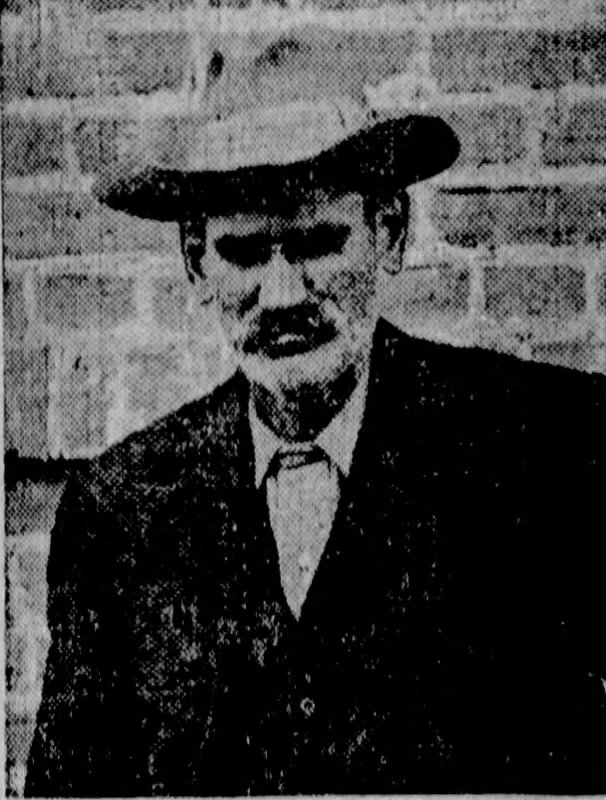
Frederick William Jahns: The Maple Falls Monster
Overview
Frederick William Jahns was a German-born murderer, suspected serial killer, confidence man, and property thief who operated under several identities during a life of international travel. He was also known as William Frederick Jahns, Friedrich Wilhelm Jahns, Frank Romandorf, Frank Romandorff, and James Logan. His crimes in Washington became associated with the isolated settlements around Maple Falls and Cedonia, earning him the unofficial name “the Maple Falls Monster.”
Jahns was convicted of the 1909 murder of Agnes Jensen, a housekeeper whose disappearance exposed a broader pattern of suspicious deaths, vanished employees, forged property transactions, and stolen identities. Investigators eventually connected him to at least two additional killings in Washington. He was also suspected of murdering several men who disappeared after working for him or becoming involved in disputes over land and money.
Early Life and International Travels
Jahns was born Friedrich Wilhelm Jahns on February 2, 1848, in the German region of Saxony-Anhalt. Details about his early life remain incomplete, largely because he repeatedly changed his name and gave conflicting stories about his past. Historical accounts describe him as a widely traveled man who had lived in locations that included Rio de Janeiro, South Africa, Hong Kong, Australia, Asia Minor, Canada, and the United States.
He reportedly worked in mining, ranching, logging, and land speculation. These occupations allowed him to move through remote areas where recordkeeping was limited and disappearances could go unnoticed for long periods. Jahns was intelligent, physically capable, and skilled at presenting himself as a prosperous businessman. Behind that appearance, however, he allegedly used violence, identity theft, forgery, and fraudulent land transfers to enrich himself.
South African authorities reportedly suspected a man using Jahns’s name of participating in the murders of several diamond dealers or miners and stealing diamonds valued at approximately $85,000. Contemporary reports claimed that investigators followed the suspect’s trail to New Orleans before losing him. These overseas accusations were never prosecuted in an American court, and the names and precise death dates of the alleged South African victims have not been reliably established.
Arrival in Maple Falls
Jahns arrived in the Maple Falls area of Whatcom County, Washington, during the winter of approximately 1903 or 1904. There he used the name Frank Romandorf and established himself as a landowner and employer. Maple Falls was then a sparsely populated logging and agricultural settlement near the Canadian border. The surrounding forests and mountains provided considerable isolation, making it possible for a person to disappear without attracting immediate attention.
Several men who worked for or dealt with Romandorf subsequently vanished. The disappearances were initially treated separately, and rumors circulated that the missing men had moved away. Only after Jahns was arrested years later did authorities and residents recognize the similarities between the cases.
The Disappearance of Fred Helms
Fred Helms was reportedly hired by Romandorf in 1905. Helms owned or controlled land that Romandorf wanted, creating a possible financial motive for murder. After entering Romandorf’s employment, Helms disappeared and was never seen alive again.
Accounts of the case indicate that Jahns later admitted killing Helms, although no complete body was publicly identified and the precise date of death remains uncertain. The disappearance demonstrated a pattern that would later become central to the allegations against Jahns: a man with property or money entered his orbit, vanished, and was followed by suspicious changes in ownership or identity.
The Disappearance of Jack Green
Jack Green was another employee associated with Romandorf’s Maple Falls property. Green became involved in a serious dispute with Romandorf’s son, Ed Romandorf. According to historical accounts, Green claimed that Ed had pushed him into or against a saw, an incident Green regarded as an attempt on his life.
Green reportedly informed local authorities that he intended to bring an attempted-murder complaint against Ed. Before proceeding, he went to speak with Frank Romandorf about the confrontation. Green was never seen again. His remains were not conclusively identified, and an exact date of death has not been verified. Jahns was nevertheless suspected of killing him to protect his son and prevent criminal charges.
The Murder of James Logan
James Logan was a neighboring landowner in the Maple Falls area. During a severe storm in November 1906, Logan and Romandorf both appeared to disappear. Residents initially believed that the men might have died in the storm. Suspicion increased when searchers discovered Logan’s horse dead from a gunshot wound on or near his property.
A letter later arrived requesting that Logan’s mail be forwarded to Hoboken, New Jersey. Logan’s farm was then supposedly sold for approximately $5,000. These actions created the impression that Logan was alive and had voluntarily left Washington.
In reality, Romandorf had survived and assumed Logan’s identity. He moved to another part of Washington and began calling himself James Logan. He reportedly used forged documents to control or sell the murdered man’s property. Historical accounts place Logan’s death on November 10, 1906, although the exact circumstances of the shooting were reconstructed only after Jahns’s later arrest and confession.
Life Under the Name James Logan
After leaving Maple Falls, Jahns settled near Cedonia in Stevens County, Washington. Using James Logan’s identity, he acquired property and presented himself as a successful rancher and businessman. He became associated with an enterprise known as the Cascade Land and Cattle Company.
The false identity allowed Jahns to distance himself from the disappearances in Maple Falls. It also enabled him to conduct land transactions and build a new reputation without revealing his earlier history. The deception continued until the suspicious death of his housekeeper, Agnes Jensen, brought neighbors and law-enforcement officers to his property.
The Murder of D. R. Shively
D. R. Shively was a landowner who disappeared after becoming involved in a property transaction with the man known locally as James Logan. Investigators later determined that documents connected to Shively’s property had been manipulated through fictitious names before the land was transferred into Jahns’s control.
Shively’s remains were reportedly discovered inside a trunk buried behind or near Jahns’s residence. The concealed body and fraudulent transfer of property provided powerful evidence that Jahns killed for financial gain. The precise date of Shively’s murder has not been reliably established, but it occurred before Jahns’s arrest in 1909.
The Murder of Agnes Jensen
Agnes Jensen worked as Jahns’s housekeeper at his Stevens County property. She possessed or had recently received a significant amount of money, making her another possible target of Jahns’s greed. On October 28, 1909, Jahns beat and mortally wounded Jensen.
After killing her, Jahns attempted to destroy her body by burning it on a large outdoor fire described as a funeral pyre. The fire was built on or near a neighboring ranch. Smoke, an unusual odor, and Jahns’s suspicious conduct attracted the attention of local residents. When neighbors investigated the smoldering remains, they found fragments of human bone.
Authorities recovered evidence linking the burned remains to Jensen. Jahns’s effort to eliminate her body had failed, and the discovery led investigators to examine his identity, land holdings, and previous associations. The Jensen murder became the charge that ultimately sent him to the gallows.
Known and Suspected Victims
- Fred Helms — Disappeared in approximately 1905 near Maple Falls, Whatcom County, Washington. Helms worked for Jahns and reportedly owned land Jahns wanted. His exact date of death and the location of his remains have not been verified.
- Jack Green — Disappeared after threatening legal action against Jahns’s son in the Maple Falls area of Washington. Green was last known to be going to speak with Jahns. His exact date of death and burial location remain unknown.
- James Logan — Killed on or about November 10, 1906, near Maple Falls, Whatcom County, Washington. His horse was found shot, and Jahns subsequently assumed Logan’s identity and gained control of his property.
- D. R. Shively — Murdered before Jahns’s 1909 arrest in Stevens County, Washington. His remains were reportedly concealed in a trunk buried behind Jahns’s residence. His exact date of death has not been reliably established.
- Agnes Jensen — Murdered on October 28, 1909, in Stevens County, Washington. Jahns beat her and attempted to burn her body. Her death resulted in his first-degree murder conviction.
- Eight unidentified men in South Africa — Jahns was reportedly suspected of killing eight men during a diamond-related robbery before coming to the United States. Their identities, dates of death, and precise locations have not been conclusively documented.
Investigation and Confessions
The discovery of Agnes Jensen’s burned remains caused Jahns’s carefully constructed life to collapse. Investigators learned that “James Logan” was not his true name. They traced him to Maple Falls, where residents remembered Frank Romandorf and the unexplained disappearances surrounding his property.
Questioned about his past, Jahns reportedly admitted responsibility for several killings. Some accounts state that he confessed to killing Helms, Green, Logan, Shively, and Jensen. He also made broader claims about murders committed during his travels in other countries. The full number of his victims remains impossible to determine because many of his statements could not be independently confirmed.
Jahns’s method was primarily practical rather than ritualistic. He selected victims whose deaths could provide him with land, money, valuables, or protection from legal exposure. He then used remote locations, false identities, forged documents, and stories about sudden departures to conceal the crimes.
Trial and Conviction
Frederick William Jahns was prosecuted in Stevens County for the first-degree murder of Agnes Jensen. The prosecution alleged that he deliberately beat and killed her before attempting to destroy her body. The discovery of human remains in the fire, together with evidence of Jensen’s disappearance and Jahns’s financial motive, supported the state’s case.
A jury convicted Jahns of first-degree murder and sentenced him to death. He appealed the conviction to the Washington Supreme Court. Among other arguments, his attorneys challenged the wording of the murder charge and questioned the impartiality of jurors who had heard reports about the case.
On January 20, 1911, the Washington Supreme Court affirmed the conviction. The court concluded that the murder charge sufficiently alleged that Jahns had intentionally killed Jensen and found no reversible error in the jury-selection proceedings.
Execution
Jahns was transferred to the Washington State Penitentiary in Walla Walla. On April 21, 1911, at the age of 63, he was executed by hanging for the murder of Agnes Jensen.
His execution ended the legal case but left many questions unresolved. Authorities could prove only Jensen’s murder in court, while the deaths of Logan and Shively and the disappearances of Helms and Green were reconstructed through confessions, property records, physical discoveries, and circumstantial evidence.
Legacy
Frederick William Jahns is remembered as one of Washington’s earliest suspected serial killers. His case combined murder with identity theft, land fraud, forgery, and the exploitation of isolated frontier communities. Rather than killing strangers at random, he appears to have targeted employees, neighbors, and property owners whose deaths could benefit him financially or protect his family and criminal activities.
The number of victims attributed to Jahns varies widely. At least three deaths—James Logan, D. R. Shively, and Agnes Jensen—have been repeatedly identified as murders connected to him. Fred Helms and Jack Green are generally listed as suspected victims whose bodies were never conclusively recovered. Allegations concerning multiple killings in South Africa remain unverified and should be treated as historical suspicions rather than proven crimes.
The enduring mystery surrounding Jahns results partly from his constant use of aliases and partly from the remote settings in which he operated. By adopting the identities of other men and manipulating ownership records, he was able to hide crimes that might otherwise have been discovered much earlier. His eventual exposure began not with a sophisticated investigation, but with neighbors noticing a suspicious fire and finding human bones among the ashes.