Levi Boone Helm: The “Kentucky Cannibal”
Early Life and Descent into Violence
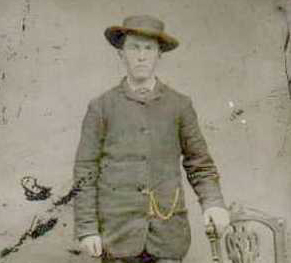
Levi Boone Helm, commonly known as Boone Helm, was an American outlaw, gunfighter, robber, and suspected serial killer whose violent career unfolded across the western frontier during the nineteenth century. He was born on January 28, 1828, in Lincoln County, Kentucky, and spent much of his childhood in Monroe County, Missouri. Later writers called him the “Kentucky Cannibal” because he admitted consuming human flesh during desperate wilderness journeys.
Helm developed a reputation for drunkenness, cruelty, and unpredictable violence. In 1851, he married Lucinda Frances Browning in Monroe County. Their marriage quickly became abusive, and Lucinda obtained a divorce. Afterward, Helm decided to travel west during the California Gold Rush. That decision led to the first killing that can be connected to him by name.
The Murder of Littlebury Shoot
Helm asked his neighbor and relative, Littlebury Shoot, to accompany him west. Shoot initially agreed but later changed his mind. According to historical accounts, Helm confronted him at his home and demanded a final answer. When Shoot refused to go, Helm stabbed him in the chest with a large knife. Shoot reportedly died almost immediately.
The exact calendar date of Shoot’s death has not survived in dependable records. The killing is generally placed in the early 1850s, after Helm’s marriage had collapsed. Helm was captured, convicted of murder, and confined, but he behaved so strangely that he was transferred to a mental institution. He gained the trust of a guard, was allowed to take supervised walks outside, and eventually escaped into the woods.
Killings During His Journey West
After escaping, Helm traveled through California and other western territories. Frontier histories accuse him of killing several men during arguments, robberies, and personal disputes. Most of these victims were never reliably identified. The unsettled mining camps through which Helm traveled often lacked organized courts, permanent police forces, or complete death records, making it difficult to distinguish documented crimes from later legend.
Helm reportedly admitted that he had killed numerous people and had sometimes eaten portions of their bodies. Some stories claim that he deliberately killed for food, while others describe cannibalism committed only when he faced starvation. Surviving evidence does not establish the precise number of people he murdered. Estimates of eleven or more victims are frequently repeated, but only a small number of victims can be identified by name.
Burton and the Wilderness Cannibalism Incident
During the early 1850s, Helm joined a group attempting to cross the wilderness toward Fort Hall. Severe winter weather, hunger, and an attack along the route scattered the travelers. Helm eventually remained with a companion identified only as Burton. Both men were exhausted, starving, and suffering from exposure.
Burton became too weak and snow-blind to continue. Helm left him near an abandoned shelter while searching for assistance at a nearby military post. Finding the post empty, Helm returned. He later claimed that Burton shot himself while Helm was gathering firewood. Helm then cut flesh from Burton’s body and consumed it. He carried part of one leg as food while continuing toward the settlements near Salt Lake City.
Burton’s full name and exact date of death are not preserved in reliable records. His death is usually placed during the winter of 1853–1854 near the abandoned Cantonment Loring site in what was then Utah Territory. Because Burton apparently died by suicide, he should not be counted as a confirmed murder victim of Helm. Nevertheless, Helm’s treatment of the body became central to his reputation as a cannibal.
The Unidentified California Rancher
After reaching California, Helm was reportedly sheltered by a rancher who offered him food and assistance. Frontier accounts state that Helm later robbed and killed the man. The rancher’s name, exact location, and date of death were not recorded consistently enough to permit reliable identification. Consequently, the rancher cannot be included among Helm’s verified named victims, although the killing appears in several historical narratives.
The Murder of “Dutch Fred”
One of Helm’s best-known killings occurred in 1862 at Florence, a remote gold-mining settlement in what was then Washington Territory and is now Idaho County, Idaho. The victim was known as “Dutch Fred.” His complete legal name has not been established.
Accounts differ about the events leading to the shooting. Some state that Helm and Fred had quarreled but had apparently settled their disagreement. Others suggest that an enemy of Fred encouraged or paid Helm to kill him. The surviving narratives agree that Fred was not attacking Helm when the fatal confrontation occurred.
Helm confronted Dutch Fred inside or near a drinking establishment. He fired once and missed. Instead of withdrawing, Helm deliberately aimed again and shot Fred, killing him. The cold-blooded nature of the second shot shocked even the residents of Florence, a mining camp already known for lawlessness. Helm fled but was later arrested and returned for trial.
Dutch Fred died in Florence during 1862, although surviving records do not establish a trustworthy month or day. Witnesses who might have testified against Helm reportedly disappeared, changed their accounts, or were bribed. Without sufficient testimony, authorities released him.
Later Crimes and Unconfirmed Victims
After leaving Florence, Helm traveled through Oregon, Idaho, British Columbia, and Montana. He continued to be accused of robbery and murder. During another wilderness journey near the Fraser River, a companion disappeared and Helm reportedly survived by eating human flesh. Some accounts claim that Helm murdered this man; others state only that the companion died while they were starving. Neither the man’s name nor an exact death date has been verified.
Helm was also suspected of killing travelers, miners, and settlers who possessed money, horses, food, or weapons. Many of these stories were written years after the events and contain no victim names. For this reason, it is impossible to produce a complete, reliable list of his killings. His reputation was built from a mixture of murder convictions, eyewitness testimony, his own boasts, frontier rumor, and sensational retellings.
Named and Partially Identified Victims
- Littlebury Shoot — Date: Early 1850s; the exact date is not preserved. Location: Monroe County, Missouri. Helm stabbed Shoot after Shoot refused to accompany him west. This is Helm’s clearest early murder and resulted in his capture and conviction.
- Burton, full name unknown — Date: Winter of approximately 1853–1854; the exact date is not preserved. Location: Near the abandoned Cantonment Loring site in Utah Territory. Burton reportedly died by suicide after becoming stranded and snow-blind. Helm consumed portions of his body, but Burton is not a confirmed murder victim.
- Unidentified California rancher — Date: Exact date unknown, probably during the 1850s. Location: California, reportedly near San Francisco. Helm was accused of killing and robbing a rancher who had given him shelter. The victim’s identity and precise death date cannot be verified.
- “Dutch Fred,” full name unknown — Date: 1862; no dependable month or day has been established. Location: Florence, Washington Territory, now Idaho County, Idaho. Helm shot Fred after an earlier disagreement had reportedly been settled. He missed with his first shot and killed Fred with a deliberately aimed second shot.
- Unidentified Fraser River companion — Date: Late 1862 or early 1863; the exact date is uncertain. Location: Fraser River region, British Columbia. Helm was accused of killing and consuming a traveling companion during a period of starvation, but the man’s identity and manner of death remain unverified.
Association with the Montana Road Agents
By 1863, Helm was living among the mining settlements of the northern Rocky Mountains. He became associated with men accused of belonging to the road-agent network traditionally connected with Bannack sheriff Henry Plummer. The supposed gang was blamed for robberies and killings along the trails surrounding Bannack, Virginia City, and Alder Gulch.
Modern historians dispute how organized this group truly was and whether every accused man belonged to it. Helm’s violent history made him an easy target when the Montana Vigilance Committee began arresting suspected road agents. He was accused not only of earlier murders but also of participating in robberies and protecting other outlaws.
Capture and Execution
On January 14, 1864, vigilantes arrested Helm in Virginia City, which was then part of Idaho Territory. Four other accused road agents—Jack Gallagher, Frank Parish, George “Clubfoot” Lane, and Hayes Lyons—were taken with him. They received no formal public trial before a recognized court. Instead, members of the vigilance committee questioned them and sentenced them to death.
The five men were taken to an unfinished building on Wallace Street, where ropes were placed over a heavy beam. Thousands of spectators reportedly gathered. Helm remained defiant while the other condemned men were hanged. When his turn arrived, he reportedly shouted support for the Confederacy and jumped from his box before the executioners could remove it.
Levi Boone Helm died by hanging on January 14, 1864, in Virginia City, Montana. He was approximately thirty-five years old. He was buried at Boot Hill Cemetery outside Virginia City.
Historical Reputation
Helm is often described as one of the earliest known American serial killers, but the label must be used cautiously. Historical records clearly connect him with the murder of Littlebury Shoot and the shooting of Dutch Fred. Other killings were admitted by Helm, attributed to him by frontier writers, or inferred from the disappearance of his companions. In many cases, names and exact dates were never recorded.
His acts of cannibalism are better documented than the identities of many supposed murder victims. At least one incident involved a man who apparently died by suicide, while other incidents may have followed deaths from starvation or violence. Helm’s own boasting made it difficult to determine which stories were true and which he exaggerated to frighten others.
Despite these uncertainties, the surviving record portrays Helm as a dangerous and remorseless man who repeatedly used violence to settle arguments, escape responsibility, and obtain property. His movements across Missouri and the western frontier left behind scattered reports of killings, robberies, intimidation, and cannibalism. His execution in 1864 ended his criminal career, but the incomplete records surrounding his victims allowed his story to grow into one of the darkest legends of the American West.