Helene Auguste Geisen-Volk: The New York Baby-Farm Deaths
Background
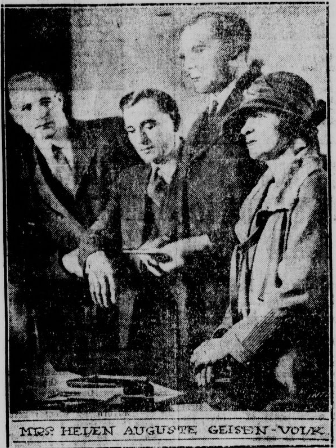
Helene Auguste Geisen-Volk was a German-born nurse and child-care operator whose New York City infant homes became the center of a shocking criminal investigation in 1925. Although she is frequently described today as a serial killer, the historical record requires an important qualification: Geisen-Volk was suspected of deliberately causing numerous infant deaths, and she was indicted for manslaughter in the death of one child, but she was never convicted of murder. Her eventual prison sentence was for substituting one baby for another. Contemporary investigators nevertheless uncovered an extraordinary number of deaths, allegations of brutality, severe neglect, unexplained disappearances, and deceptive substitutions of children.
Geisen-Volk was the widow of a Prussian army officer and had reportedly served as a German Red Cross nurse. By the 1920s she operated what newspapers called a "baby farm" or "infantorium" at 235 East 86th Street in Manhattan. Such establishments accepted infants from parents or relatives who paid for their care. Geisen-Volk was licensed to keep only seven children at the East 86th Street establishment, but investigators found that she had been caring for far more. Health records examined during the investigation indicated that dozens of infants had died in homes associated with her since 1918.
The Investigation Begins
The case exploded into public view in May 1925 because of William Angerer, a Bronx father who attempted to retrieve his infant son, Stephen Angerer. Instead of returning Stephen, Geisen-Volk presented Angerer with a different baby. Angerer recognized that the child was not his son and went to the authorities. His complaint led police, prosecutors, physicians, and child-protection officials to examine Geisen-Volk's operation more closely.
Stephen Angerer's fate became one of the central mysteries of the case. Geisen-Volk gave changing explanations for his disappearance. She eventually claimed that Stephen had died of marasmus between April 12 and April 14, 1925. She said that, because she lacked a death certificate, she put his body into a yellow satchel and abandoned it in the hallway of a Manhattan tenement in the East Seventies so that police would eventually take the body to the morgue. Judge Charles C. Nott Jr.'s court did not accept her story; the sentencing judge openly told her that he believed she was lying. No verified body or death record established the date or circumstances of Stephen's death, so he cannot responsibly be listed as a confirmed death on those dates.
Evidence of Neglect and Violence
As investigators interviewed parents, nurses, and former employees, allegations went far beyond improper record keeping. Witnesses described children who were severely undernourished and frightened of the woman they knew as "Aunt Helen." Former associates accused Geisen-Volk of harshly punishing crying or troublesome infants. Investigators were told that her methods included shutting children in closets, forcing them under water, striking them, and treating discipline as though the children were animals rather than vulnerable patients.
One of the most serious accusations involved 18-month-old Agnes Toohey. A witness told prosecutors that Geisen-Volk became enraged by Agnes's crying and violently struck or threw the child against a wall shortly before her death. The allegation was investigated after Agnes's body was exhumed. The autopsy, however, did not find traumatic injuries that confirmed the witness's account. Her death certificate had listed mastoiditis. Agnes's case therefore became part of the disturbing pattern surrounding the infantorium, but the surviving evidence does not establish that she was murdered.
The investigation produced much stronger physical evidence in the case of infant William Winters. His death certificate originally attributed his death to congenital heart disease. After his mother expressed doubts, his body was exhumed in May 1925. Medical examiner Dr. Otto M. Schultze discovered an enormous fracture extending through the infant's skull. Investigators concluded that the injury was consistent with violent contact with a hard, flat surface and had occurred shortly before death. This discovery resulted in a manslaughter indictment against Geisen-Volk.
Named Victims With Verified Death Dates
- Agnes Toohey — Died December 15, 1924, aged 18 months. She died while associated with Geisen-Volk's East 86th Street infantorium in Manhattan. Her death certificate listed mastoiditis. A witness alleged that Agnes had been violently thrown or struck against a wall shortly before her death, but the subsequent exhumation and autopsy did not reveal injuries supporting that allegation. Her mother, Margaret Toohey, also told investigators that Geisen-Volk sold her a private burial plot at St. Michael's Cemetery after the child's death.
- William Winters — Died February 3, 1925, in New York City while in Geisen-Volk's care. Contemporary accounts differed slightly concerning his exact age, describing him as approximately four to six months old. His original death certificate attributed his death to congenital heart disease. After his body was exhumed, an official autopsy revealed a severe skull fracture extending from the rear toward the front of the head. His death became the basis of the manslaughter indictment filed against Geisen-Volk.
- Robert Burton — Died March 11, 1925, at Lenox Hill Hospital, Manhattan. Robert had reportedly been born the previous August and was placed at the infantorium in December 1924. His mother, Mary Burton, died in January 1925, leaving his grandmother concerned for his welfare. When the baby became sick, the family was reportedly prevented from seeing him and was told that he was receiving specialist treatment. Authorities later discovered that Robert had died at Lenox Hill Hospital. Contemporary descriptions connected his illness with serious malnutrition.
- Robert Snyder — Died May 8, 1925, at Metropolitan Hospital, New York City. He was removed from Geisen-Volk's East 86th Street establishment after a physician examined conditions there. Newspaper accounts described his body as severely emaciated, and acute malnutrition was identified as the apparent cause of death. His death occurred as police and child-welfare officials were beginning their major investigation of the infantorium.
- Unidentified two-year-old boy — Died May 9, 1925, at Bellevue Hospital, Manhattan. His father had taken him from Geisen-Volk's establishment and brought him to the hospital for treatment. Contemporary reports said his medical problems were associated with malnutrition and neglect. His death increased the publicly reported death toll connected with the home, but surviving accounts reviewed for this summary do not reliably preserve his name.
Missing Children and Baby Substitution
The dead were only part of the investigation. Several families complained that children they had entrusted to Geisen-Volk could no longer be located. Six-month-old Louis Weiss was reported missing after his parents were unable to trace him. A Philadelphia grandmother, Mary Beukers, similarly reported that a young grandson placed with Geisen-Volk had disappeared after she was told that he had supposedly been sent away to receive specialist treatment. Stephen Angerer remained the most important missing child because the attempt to substitute another infant for him directly triggered Geisen-Volk's arrest.
Investigators developed evidence that infant substitution was not merely an accidental confusion of records. Prosecutors alleged that children could be exchanged when another child died or disappeared, allowing payments from unsuspecting relatives to continue. Geisen-Volk ultimately admitted that the baby she had attempted to pass off as Stephen Angerer was actually another woman's child. The case also produced allegations that babies were treated as commercial property: children could be boarded for fees, transferred, offered for adoption, or substituted while the true identities and whereabouts of other infants became increasingly difficult to determine.
The Scale of the Deaths
Exactly how many children died because of criminal acts by Geisen-Volk can no longer be established with certainty. During the 1925 investigation, health records reportedly showed 44 infant deaths associated with two baby homes she had operated since January 1, 1918. A later probation report asserted that at least 53 infants entrusted to her care had died and accused her of deliberately disposing of unwanted or financially unprofitable children. Geisen-Volk rejected that figure and claimed that only twelve or fourteen children had died.
The distinction is important. Fifty-three is often repeated as Geisen-Volk's "victim count," but it was not a judicial finding that she murdered fifty-three children. Many infants of the era died from disease, malnutrition, and other causes, and only a small number of the deaths were examined closely enough to produce surviving individual evidence. William Winters's fractured skull provided the strongest forensic basis for a homicide prosecution.
Indictment, Guilty Plea, and Sentence
On May 26, 1925, Geisen-Volk appeared in connection with the manslaughter indictment arising from William Winters's death and pleaded not guilty. Despite the disturbing medical evidence and the growing collection of witness statements, prosecutors ultimately did not obtain a manslaughter conviction. Contemporary accounts later indicated that authorities believed proving beyond a reasonable doubt exactly who inflicted the fatal injury would be difficult.
Geisen-Volk instead pleaded guilty to the child-substitution offense. On July 22, 1925, she received the maximum sentence of three and one-half to seven years in Auburn Prison. At sentencing, a probation report portrayed her infant business as an operation in which children were neglected, exchanged, or allegedly disposed of when their continued care was no longer profitable. The judge condemned her conduct in unusually severe language and rejected her explanation for the disappearance of Stephen Angerer.
Legacy of the Case
The Geisen-Volk scandal became one of the darkest American examples of the abuses associated with commercial "baby farming." What began as a father's complaint that the wrong child had been returned to him exposed overcrowding, malnutrition, unexplained deaths, missing babies, falsified identities, and allegations of deliberate physical violence. The case also demonstrates why Geisen-Volk is more accurately described as a suspected serial killer rather than a woman legally proven to have murdered all of the children later attributed to her.
The verified deaths of Agnes Toohey, William Winters, Robert Burton, Robert Snyder, and the unidentified boy who died at Bellevue reveal a grim pattern surrounding the East 86th Street infantorium. William Winters's fractured skull supplied direct evidence of fatal violence, while the other cases revealed severe neglect and circumstances that generated substantial suspicion. The full fate of children such as Stephen Angerer and Louis Weiss was never satisfactorily resolved, leaving the true number of victims permanently uncertain.