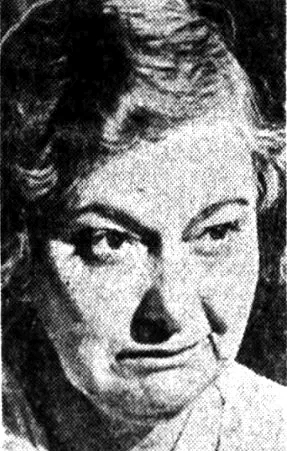
Margaret Summers: The Suspected Flypaper Murderess of Chicago
A Pattern of Death Inside a Chicago Home
Margaret Summers was a Chicago woman who became known in newspapers as the “Flypaper Murderess” after investigators connected her to a disturbing series of deaths involving relatives, husbands, and male boarders. Between approximately 1928 and 1931, six men died after spending time in or living at her residence on North Avenue. Summers was reportedly the beneficiary of life insurance policies carried by each of the deceased men, creating suspicions that the deaths were not coincidental.
Although Summers was ultimately convicted of only one murder, investigators suspected that she had poisoned several other people for financial gain. Examinations of exhumed bodies reportedly revealed arsenic in multiple victims. Authorities believed Summers may have extracted arsenic from commercially available flypaper by soaking the sheets in water and repeatedly administering the resulting solution in food, beverages, or medicine.
The Death of Thomas Meyers
The investigation centered on Summers’s 17-year-old nephew, Thomas Meyers, whose surname was sometimes reported as Meyer. Thomas died at Summers’s Chicago residence during the first weeks of May 1931. The exact date of his death is unclear in surviving accounts, although the investigation became public on May 22, 1931. Some later summaries incorrectly identify May 22 as the date of death, but contemporary descriptions indicate that he had already been dead for approximately two or three weeks.
Relatives became suspicious after discovering that Thomas had named Summers as the sole beneficiary of several life insurance policies. Summers reportedly controlled or paid the premiums on many of those policies. Investigators learned that nine policies had been issued on the teenager’s life and that Summers stood to receive a combined payment of approximately $3,630.
Thomas had been examined after his death, but doctors initially found no obvious evidence of violence or poisoning. As suspicions intensified, authorities ordered his body exhumed. Toxicological testing reportedly revealed chronic arsenic poisoning, meaning that the poison had been administered in small quantities over an extended period rather than in one immediately fatal dose.
Insurance Policies and Financial Motive
The discovery of the insurance policies on Thomas led investigators to examine Summers’s finances and relationships. They reportedly found that she was the beneficiary of 19 policies covering 10 different men. In many instances, Summers had paid the premiums herself, even though the policies were officially carried in the names of the insured men.
Evidence presented during her trial indicated that Summers had forged Thomas’s signature on at least one insurance document. Prosecutors argued that the policies supplied a clear financial motive and demonstrated that the teenager’s death was part of a calculated insurance scheme rather than an unexplained family tragedy.
Police also reportedly found a page torn from Summers’s Bible containing the names of 12 deceased men and figures representing insurance money she had received. The discovery strengthened investigators’ belief that Thomas was not her only victim. However, the existence of a name on the page did not by itself establish that Summers had murdered that person.
Her Husband Thomas “Shags” Summers
One of the most prominent suspected victims was Summers’s husband, Thomas “Shags” Summers, who died at the age of 37. Accounts of the case contain conflicting information regarding the precise date and year of his death. One widely repeated date is August 9, but the reported year of 1931 conflicts with the documented May 1931 investigation and appears to be erroneous. For that reason, an exact verified date cannot be stated with confidence.
Thomas Summers had carried life insurance naming his wife as beneficiary. After the arsenic found in her nephew’s body prompted a wider inquiry, authorities exhumed her husband. Testing reportedly established that he had also died from arsenic poisoning.
During grand-jury proceedings, a woman named Mathilde Kuhn testified that Summers had admitted poisoning her husband after allegedly discovering that he was involved with Kuhn’s 22-year-old daughter, Anna. Agnes Summers, the dead man’s sister, also testified that she had heard Margaret Summers tell her nephew to take her husband’s clothing because he would no longer need it. Summers continued to deny responsibility for his death.
The Deaths of William Reimer and Thomas Lanagan
Two additional suspected victims were male peddlers who boarded at Summers’s home. Their names were William Reimer, whose surname was also reported as Riemer, and Thomas Lanagan. Both men carried life insurance policies that named Summers as the beneficiary.
After investigators reopened the deaths, chemical examinations reportedly found arsenic in both men. Reimer was said to have died from chronic arsenic poisoning, suggesting repeated exposure over time. Lanagan reportedly died from acute arsenic poisoning, indicating that he had received a larger and more rapidly fatal quantity.
Summers attempted to explain the policies by claiming that her husband had been a friend of an insurance agent and encouraged acquaintances to purchase coverage. She maintained that the boarders had voluntarily named her as beneficiary because she had treated them kindly. Investigators considered the number of policies, her payment of premiums, and the arsenic findings too significant to dismiss as coincidence.
The Deaths of Her Brothers
Summers’s brother Louis Meyers, the father of Thomas Meyers, also died at her residence. Louis reportedly held a life insurance policy naming Summers as beneficiary. The surviving accounts do not provide a reliably verified date for his death, and Summers was never tried for killing him.
Another brother, identified as John, traveled to Chicago to attend Louis’s funeral. According to reports, John became ill and died at Summers’s home within approximately one week of his arrival. His exact date of death and the official cause recorded at the time remain uncertain.
The deaths of two brothers, a nephew, a husband, and two boarders within a period of roughly three years caused authorities to view the household as the center of a possible serial-poisoning operation. All six men were reported to have named Summers as an insurance beneficiary.
Confirmed and Suspected Victims
- Thomas Meyers, age 17: Summers’s nephew and her only legally confirmed murder victim. He died at her North Avenue residence in Chicago during the first weeks of May 1931. The exact date has not been reliably established. An exhumation reportedly revealed chronic arsenic poisoning.
- Thomas “Shags” Summers, age 37: Margaret Summers’s husband. He died in Chicago before the May 1931 investigation. His precise death date is disputed in surviving accounts. His exhumed remains reportedly tested positive for arsenic.
- William Reimer, also reported as William Riemer: A peddler and boarder at Summers’s Chicago home. His exact death date is not reliably documented in accessible accounts. Investigators reportedly determined that he had suffered chronic arsenic poisoning.
- Thomas Lanagan: A peddler and boarder who died at Summers’s residence in Chicago. His exact death date is uncertain. His death was reportedly attributed to acute arsenic poisoning after the case was reopened.
- Louis Meyers: Summers’s brother and the father of Thomas Meyers. He died at her Chicago residence on an unverified date and had reportedly named her as an insurance beneficiary. She was suspected but never prosecuted in connection with his death.
- John Meyers: Summers’s brother, who reportedly came to Chicago for Louis Meyers’s funeral and died at her residence within approximately one week. His full identity, exact death date, and cause of death have not been conclusively documented.
Other Possible Victims and Intended Targets
Investigators learned that Summers had reportedly been married six times. Five of the husbands were believed to be dead, while the fate of another was uncertain. One former husband was identified as James Lynch, who had died approximately 17 years before the 1931 investigation. Authorities explored whether Summers’s earlier husbands could have been poisoning victims, but no sufficient evidence emerged to prosecute her for their deaths.
Police also examined the case of a cab driver named Samuel Strauss. Strauss was still alive but seriously ill when investigators learned that Summers had prepared medicine prescribed for him. The available evidence did not prove that he had been poisoned, and he should not be classified as a murder victim.
Summers had also paid premiums on insurance policies covering several living people, including a 50-year-old man named Robert Barker, her stepdaughter Margaret Ritty, and Ritty’s children. These individuals were reportedly healthy when the investigation began. The policies nevertheless contributed to fears that Summers had identified possible future sources of insurance money.
Arsenic-Laced Flypaper
Investigators struggled to prove how Summers had obtained the arsenic. There was no clear record showing that she had purchased large quantities of the poison from a pharmacy or chemical supplier. The case changed when witnesses reported buying unusually large amounts of arsenic-treated flypaper for her during the two months before Thomas Meyers died.
At that time, certain flypaper products contained arsenic. Prosecutors alleged that Summers soaked multiple sheets in water, producing a poisonous liquid that could be mixed with something consumed by a victim. Small doses administered repeatedly could cause weakness, vomiting, abdominal distress, and gradual physical deterioration resembling natural illness or disease.
The alleged method explained why Thomas’s poisoning was described as chronic. Rather than causing an immediate and obviously suspicious death, repeated low doses could weaken the victim over days or weeks. The use of ordinary household flypaper also allowed the poison to be obtained without creating the type of purchasing record associated with buying arsenic directly.
Arrest and Grand-Jury Investigation
Police arrested Summers shortly after the investigation became public in May 1931. She denied poisoning anyone and claimed that the men had named her in their policies because she had cared for them and treated them generously. She also attempted to portray the insurance arrangements as the result of her husband’s friendship with an insurance agent.
The case was presented to a grand jury on May 26, 1931. Witnesses described Summers’s statements, her interest in insurance money, and comments allegedly made before her husband’s death. The exhumations and arsenic findings transformed what had initially appeared to be a series of natural deaths into a possible pattern of calculated homicide.
The Murder Trial
Summers was brought to trial in February 1932 for the murder of Thomas Meyers. Prosecutors concentrated on the nephew’s death because it offered the strongest combination of physical evidence, insurance documents, witness testimony, and proof that Summers had obtained arsenic-bearing flypaper shortly before he died.
The prosecution argued that Summers had repeatedly soaked flypaper and administered the arsenic solution to Thomas. Defense attorneys challenged whether soaking the product would have produced a sufficiently strong poison. Prosecutors responded that a single sheet might not have been fatal but that repeated doses made from numerous sheets could accumulate in the body and eventually kill the teenager.
The insurance evidence was particularly damaging. Summers was the beneficiary of nine policies on Thomas and had received approximately $3,630 following his death. Testimony that she forged his signature on one application supported the prosecution’s argument that the policies were part of a deliberate plan.
Conviction and Sentence
After approximately three hours of deliberation, the jury found Margaret Summers guilty of murdering Thomas Meyers. Reliable narrative accounts state that she was sentenced to 14 years in prison, although some later databases list a 17-year sentence. The 14-year term is the figure associated with detailed accounts of the 1932 trial.
Summers was not prosecuted for the deaths of her husband, brothers, or boarders. Although arsenic was reportedly discovered in several exhumed bodies, prosecutors may have believed that the evidence was strongest in the nephew’s case and insufficient to secure additional convictions for the older deaths.
A Convicted Murderer and Suspected Serial Killer
Margaret Summers is best described as a convicted murderer and suspected serial killer. She was judicially proven responsible for one death, while five additional deaths at her Chicago residence were regarded as suspicious. The repeated appearance of life insurance policies, the arsenic findings, and the concentration of deaths around one beneficiary formed the basis for the belief that she had conducted a prolonged poisoning scheme.
The case also illustrates the difficulty of investigating poison murders during the early 20th century. Symptoms of arsenic exposure could be mistaken for common gastrointestinal illnesses, and bodies were often buried before anyone suspected foul play. Only after relatives questioned the insurance arrangements surrounding Thomas Meyers did authorities recognize a possible pattern and order exhumations.
Legacy of the Flypaper Murderess
The nickname “Flypaper Murderess” came from the prosecution’s theory that Summers extracted arsenic from poisoned flypaper rather than purchasing the chemical directly. The method was inexpensive, accessible, and capable of producing symptoms that developed gradually. It became the most memorable feature of an otherwise largely forgotten Chicago murder case.
Despite the sensational allegations, the historical record requires an important distinction between proof and suspicion. Thomas Meyers was the only victim whose murder resulted in a conviction. The other men may have been victims of the same poisoning scheme, but Summers was never tried or convicted for their deaths. She nevertheless remains associated with one of Chicago’s most unusual suspected insurance-murder cases of the early 1930s.