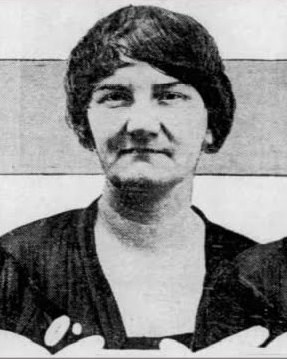
Hattie Blackburn Stone: The Havre de Grace Family Poisoner
Overview
Hattie Blackburn Stone was a Maryland woman convicted of murdering her teenage son in 1929 and suspected of poisoning three other members of her household. The deaths unfolded over approximately five years in Havre de Grace, a small community in Harford County. Each victim belonged to Hattie’s immediate family, and several died after suffering sudden stomach distress, violent convulsions, or other symptoms later associated with poisoning.
Stone was not convicted of every death attributed to her. Her only murder conviction concerned her 15-year-old son, George Stone, whose body reportedly contained strychnine. Nevertheless, investigators and relatives believed that George’s death was the final act in a longer sequence that included Hattie’s mother-in-law, her older son, and her husband.
The case became especially disturbing because Stone occupied trusted roles within the community. She was described as a nurse and midwife who had helped deliver local children. She also reportedly taught Sunday school. Behind that respectable public image, prosecutors portrayed a woman who poisoned members of her family for insurance money, access to savings, and freedom from domestic responsibilities.
Early Life and Family
Hattie was born Hattie Blackburn in Maryland, probably during the late 1880s or early 1890s. Surviving accounts differ concerning her exact birth year. Her parents were identified as John A. Blackburn and Margaret Blackburn. She spent much of her childhood around Angel Hill Cemetery near Havre de Grace, where a member of her family worked as a cemetery sexton or superintendent.
In 1910, Hattie married Edward Arthur Stone. The couple settled in Havre de Grace and had two sons. Edgar Ellsworth Stone was born on April 23, 1909, and George S. Stone was born on January 26, 1914. Edward worked while Hattie maintained the household and developed a local reputation as a caregiver.
Edward’s widowed mother, Mary “Emma” Johnston Stone, eventually lived with the family. By the beginning of the 1920s, the Stone household included Hattie, Edward, their two sons, and Edward’s mother. Within the next several years, every one of those family members except Hattie would be dead.
The Death of Mary “Emma” Johnston Stone
The first death later connected to Hattie occurred on January 8, 1924, when her mother-in-law, Mary “Emma” Johnston Stone, died in Havre de Grace. Emma reportedly experienced severe stomach problems before her death. At the time, her illness did not result in a murder investigation, and she was buried in the family plot at Angel Hill Cemetery.
Suspicion developed later when members of the family discovered irregularities involving Emma’s finances. Hattie was accused of forging or improperly using documents connected to her mother-in-law’s bank savings. Investigators came to believe that Hattie may have poisoned Emma to obtain access to money that otherwise would not have belonged to her.
No court ever convicted Hattie of killing Emma. The older woman’s death was reconsidered only after similar illnesses struck other members of the Stone family. By then, the passage of time and the absence of an immediate toxicological examination made it difficult to establish precisely what had happened.
The Death of Edgar Ellsworth Stone
Hattie’s older son, Edgar Ellsworth Stone, died on June 7, 1927, in Havre de Grace. He was 18 years old. His death was abrupt and was reportedly preceded by symptoms that later appeared suspicious in light of the other family deaths.
At the time, there was not enough evidence to establish that Edgar had been murdered. His death was treated as a family tragedy rather than part of a deliberate poisoning campaign. After George’s death two years later, however, authorities and relatives reconsidered whether Edgar had also been given poison.
Edgar’s death left George as the couple’s only surviving child. Hattie was later accused of viewing both sons as financial burdens or obstacles to the personal life she wanted. Prosecutors would eventually argue that she placed her own desires above the lives of her children.
The Death of Edward Arthur Stone
Hattie’s husband, Edward Arthur Stone, died on January 30, 1928, in Havre de Grace. He was 39 years old. Like other members of the family, Edward reportedly became suddenly and seriously ill before his death.
Edward’s death brought Hattie a financial benefit through a life-insurance policy. The combination of insurance money, the earlier death of his mother, and the unexplained death of Edgar caused Edward’s relatives to become increasingly suspicious of Hattie.
Edward’s sister, Nellie “May” Stone Baker, emerged as one of the most important figures in the later investigation. She believed that the number of sudden deaths within the same household could not reasonably be dismissed as coincidence. Her suspicions became more urgent after George became the fourth member of the family to die.
Hattie was never separately convicted of murdering Edward. Accounts of the case nevertheless commonly identify him as one of her suspected poisoning victims. His burial beside other deceased family members at Angel Hill Cemetery gave the family plot a grim significance after the allegations against Hattie became public.
The Murder of George Stone
On June 4, 1929, 15-year-old George Stone ate a meal prepared in the family home. Soon afterward, he became desperately ill. His body reportedly stiffened as he suffered powerful convulsions, symptoms consistent with the effects of strychnine.
Strychnine attacks the nervous system and can produce agonizing muscular spasms while the victim remains conscious. George’s sudden collapse was alarming enough to prompt closer scrutiny than the earlier family deaths had received. An examination of his internal organs reportedly revealed the presence of strychnine.
George’s death transformed years of rumor into a murder investigation. Four members of Hattie’s household had now died within a little more than five years. Investigators no longer viewed the similarities among their illnesses as accidental.
Authorities learned that poison had allegedly been kept or hidden on the Stone property. A tenant reportedly discovered arsenic in or near a shed associated with the house. Although George was found to have died from strychnine rather than arsenic, the discovery strengthened suspicions that Hattie had possessed and used toxic substances.
Victims
- Mary “Emma” Johnston Stone — Hattie’s mother-in-law died on January 8, 1924, in Havre de Grace, Maryland. She reportedly suffered severe stomach problems before her death. Hattie was suspected of poisoning her to obtain access to her savings, but she was never convicted in connection with the death.
- Edgar Ellsworth Stone — Hattie’s older son died on June 7, 1927, in Havre de Grace, Maryland. He was 18 years old. His sudden death was later regarded as suspicious, although no definitive evidence presented in court established that he had been poisoned.
- Edward Arthur Stone — Hattie’s husband died on January 30, 1928, in Havre de Grace, Maryland, at the age of 39. Hattie reportedly collected money from a life-insurance policy after his death. He was considered a suspected poisoning victim, but Hattie was not convicted of killing him.
- George S. Stone — Hattie’s younger son died on June 4, 1929, in Havre de Grace, Maryland, at the age of 15. He suffered violent convulsions after eating food prepared in the household. An examination reportedly detected strychnine, and Hattie was convicted of second-degree murder for his death.
Investigation and Alleged Confession
Investigators focused on Hattie after the discovery of strychnine in George’s body. They examined the financial circumstances surrounding the deaths and questioned relatives about Hattie’s behavior. Life-insurance benefits and access to family money became central elements of the prosecution’s theory.
Nellie “May” Stone Baker reportedly testified that Hattie admitted poisoning George. This alleged confession became one of the most damaging pieces of testimony presented against her. Hattie denied the accusation and pleaded not guilty.
The state portrayed the death as deliberate rather than accidental. Prosecutors argued that Hattie administered poison to remove George from her life and obtain insurance money. They also presented the earlier family deaths as part of the background demonstrating why George’s fatal poisoning was unlikely to have been an isolated event.
Reports from the period suggested another possible motive involving Hattie’s relationships with men after her husband’s death. Prosecutors accused her of regarding her remaining son as an unwanted obstacle to the life she desired. Some of the language used during the trial reflected the moral attitudes of the era, but the state’s central claim was that George was intentionally poisoned for personal and financial reasons.
Trial and Conviction
Hattie Stone was tried in Bel Air, the county seat of Harford County. The proceeding lasted approximately four days and drew widespread attention. The prosecution relied upon the toxicological findings, testimony from relatives, evidence involving poison found near the home, and the alleged confession described by Nellie Baker.
The defense challenged the claim that Hattie had deliberately poisoned her son. Because the other deaths had not produced separate murder convictions, the trial ultimately centered on the physical and testimonial evidence connected directly to George.
In 1929, the jury convicted Hattie of second-degree murder in George Stone’s death. The conviction legally established her responsibility for one killing, even though she continued to be suspected in the deaths of three other family members.
She received a prison sentence of up to 18 years. Some later descriptions reduce the sentence to a simple statement that she was given 18 years, although contemporary reporting indicated that 18 years was the maximum punishment associated with the verdict.
Suspected Motives
Financial gain was the most consistent motive associated with the deaths. Hattie allegedly sought access to her mother-in-law’s savings and received insurance proceeds following deaths within the family. George was also reportedly insured, giving prosecutors a direct financial explanation for his murder.
Personal freedom was presented as another motive. After Edward’s death, Hattie was accused of pursuing relationships and wanting a life without the responsibility of caring for a dependent son. Prosecutors alleged that she placed her own social and romantic interests above George’s safety.
The exact motives behind the earlier deaths remain uncertain because Hattie was not tried for them. It is possible that different financial and personal considerations were involved in each case. It is also important to distinguish between the proven murder of George and the suspected killings of Emma, Edgar, and Edward.
Classification as a Serial Killer
Hattie Blackburn Stone is commonly described as a serial killer because four members of her family died under suspicious circumstances over a period of several years. The deaths were separated by months or years rather than occurring in a single incident, fitting the general pattern associated with serial poisoning.
However, only George Stone’s death resulted in a murder conviction. The other three victims remain suspected rather than judicially confirmed. Historical accounts often describe Hattie as responsible for all four deaths, but the strength of the surviving evidence varies from one case to another.
Poisoners were particularly difficult to detect during the early twentieth century. Symptoms caused by arsenic and other toxic substances could resemble food poisoning, gastrointestinal disease, or natural illness. When victims were members of the same household, a caregiver could administer repeated doses while appearing to nurse the person through an unexplained sickness.
Legacy
The Stone case became one of the most notorious criminal episodes in the history of Havre de Grace. The public was disturbed by the contrast between Hattie’s trusted community roles and the allegation that she had methodically eliminated her own family.
The deaths also revealed the importance of autopsies and toxicological examinations. The earlier victims were buried without the level of scrutiny later applied to George. Had his convulsions not prompted an investigation, his death might also have been recorded as another unexplained family tragedy.
Hattie’s conviction brought legal accountability for George’s murder, but it did not resolve every question surrounding the Stone household. Whether Mary “Emma” Johnston Stone, Edgar Stone, and Edward Stone were all poisoned by Hattie remains a historical conclusion based on circumstantial evidence, family testimony, financial motives, and the striking pattern of deaths.
Today, Hattie Blackburn Stone is remembered as the Havre de Grace family poisoner: a nurse, midwife, wife, mother, and Sunday-school teacher whose respectable appearance concealed at least one proven murder and possibly three additional killings.