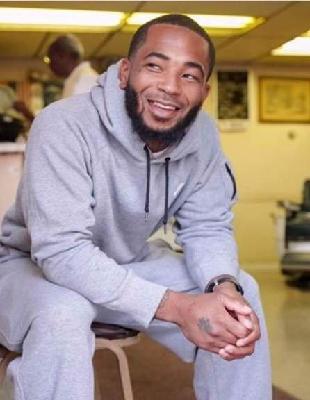
Kyrell D. Lewis, a 23-year-old Black/African American man, was fatally shot on the evening of January 9, 2015, outside his home in the Arbor Place townhouse community on Parma Avenue in New Castle, Delaware. Although Lewis has sometimes been associated with nearby Wilmington, official police and court records place the shooting in New Castle. At approximately 6:50 p.m., New Castle County Police were dispatched to the 200 block of Parma Avenue after reports of gunfire.
Officers found Lewis suffering from multiple gunshot wounds to his torso. He was taken by ambulance to Christiana Hospital, where he was pronounced dead at approximately 11:45 p.m.
The events leading to the shooting began with a dispute between Lewis, who was also known as “Bubba,” and Maurice Cruz-Webster, a young Wilmington resident known to Lewis by a nickname. Court records show that a series of text messages was exchanged shortly before the shooting. The messages reflected an ongoing disagreement involving an alleged debt and culminated with Cruz-Webster indicating that he had arrived outside Lewis’s residence. Lewis then went outside, where witnesses heard and saw an argument developing in the driveway.
Lewis’s aunt, Phyllis Shaw, was inside the residence and heard him leave the house. Looking from a window, she testified that she saw Lewis arguing with Cruz-Webster. She did not witness the actual shooting or see a firearm, but the argument continued after she stepped away from the window. Moments later, gunshots rang out. Another nearby witness watched portions of the confrontation and testified that the man who had been arguing with Lewis initially started to walk away. After Lewis said something to him, the man turned, rushed back toward Lewis and opened fire from only a few feet away. Four shots were fired initially, followed by three additional shots as the gunman fled. The witness was certain that the person who had been arguing with Lewis was the shooter, although poor lighting prevented her from identifying his face.
Lewis, wounded by the gunfire, managed to make his way back inside his home and told his aunt that he had been shot. Shaw called 911 at approximately 6:48 p.m. Lewis was conscious long enough to speak with emergency personnel and officers, but his descriptions of what had happened varied. At one point he said two individuals dressed in black had shot him; he also told another officer that the shooter was unknown and told an emergency medical technician that he had simply heard several popping sounds. Those statements later became an issue during Cruz-Webster’s trial because the prosecution contended other evidence pointed to Cruz-Webster despite Lewis not identifying him as his attacker before his death.
The gunfire also endangered other people in the neighborhood. Douglas Pressley was outside nearby when the shooting occurred. He heard the argument but did not see the actual gunfire, and one of the bullets passed through his pants without striking him. Witness accounts differed somewhat regarding how many people were standing near Lewis during the confrontation and what the shooter was wearing. One witness described the man arguing with Lewis as wearing light-colored pants, while Lewis’s aunt recalled Cruz-Webster wearing gray sweatpants and a purple hooded jacket. Despite these differences, investigators quickly focused on Cruz-Webster.
Lewis’s cellular telephone became an important part of the investigation. Investigators recovered messages exchanged just minutes before the shooting between Lewis and a telephone number associated with Cruz-Webster. Telephone-company records identified Cruz-Webster as the subscriber connected to that number, and cell-site analysis placed the telephone in the general area around the time Lewis was shot, although investigators acknowledged that the technology could not determine an exact location. Prosecutors later relied on the texts, telephone evidence and eyewitness testimony to build the case that Cruz-Webster had arranged to meet Lewis outside immediately before the killing.
Detectives identified Maurice Cruz-Webster as their suspect within roughly a day of the shooting. At approximately 7:00 p.m. on January 10, he went to the New Castle County Police Cpl. Paul J. Sweeney Public Safety Building. Police subsequently charged him with first-degree murder, two counts of possession of a firearm during the commission of a felony and first-degree reckless endangering. A New Castle County grand jury formally indicted him on those charges on April 15, 2015.
Another significant piece of the prosecution's case emerged after Cruz-Webster was jailed awaiting trial. Donald Cooper, who was housed in the same correctional intake unit with him for approximately two weeks, later told detectives that Cruz-Webster had admitted involvement in Lewis’s death. Cooper testified that Cruz-Webster said Lewis owed him approximately $80 in connection with marijuana, that he did not want to fight Lewis, and that he had used a 9mm handgun. Cooper supplied the information to police while hoping that his cooperation might benefit his own criminal situation, and his credibility and cooperation agreement consequently became contested issues at Cruz-Webster’s trial.
Cruz-Webster went before a New Castle County Superior Court jury in January 2016. The trial lasted seven days. Prosecutors presented the witnesses who had heard or observed the confrontation, Lewis’s aunt, the cellular-telephone evidence and Cooper’s testimony regarding the alleged jailhouse admission. After considering the evidence, the jury found Cruz-Webster guilty of first-degree murder, first-degree reckless endangering and both firearm offenses.
On March 11, 2016, the Superior Court sentenced Cruz-Webster to imprisonment for the remainder of his natural life for Lewis’s murder, with an additional 15 years of incarceration imposed for the other convictions. Cruz-Webster appealed, challenging several aspects of the prosecution and testimony presented during his trial. The Delaware Supreme Court rejected his arguments and affirmed the convictions on February 2, 2017.
Cruz-Webster continued challenging the case through post-conviction proceedings. The Delaware Superior Court denied an amended post-conviction motion on August 31, 2020, and the Delaware Supreme Court affirmed that ruling on April 22, 2021. A later federal habeas corpus petition was denied by the U.S. District Court for the District of Delaware on December 18, 2024. Litigation over his sentence continued, but in May 2026 the Delaware Supreme Court again rejected a challenge seeking correction of what Cruz-Webster argued was an illegal sentence. The court left intact his life sentence for first-degree murder and the additional 15 years associated with the remaining offenses.