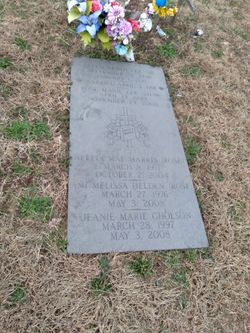
Nellia Harris, a 33-year-old female, became part of the wider terror that surrounded the Prospect Avenue murders in Kansas City, Missouri, a series of killings that exposed how vulnerable women in the area had been targeted and discarded. Online records identify her as Nellia Mae Rose Harris, born in March 1971, with public memorial and genealogy records giving differing death dates in September or October 2004, while news coverage of Terry Blair's trial reported that Harris was killed in 2003, unlike the other women in the case. Available online sources do not clearly establish her specific cause of death, but she was publicly tied to the same investigation that centered on serial killer Terry Anthony Blair.
The violence around Prospect Avenue came to light in September 2004, when bodies were found in a small area of Kansas City and an anonymous male caller contacted 911 to direct police to additional victims. The caller claimed responsibility and seemed to taunt authorities by revealing where women's bodies could be found. The investigation soon focused on Blair, a man already known to law enforcement because he had previously been convicted in the 1982 murder of Angela Monroe, the mother of two of his children. He had served roughly two decades in prison before being released, only to come under suspicion again as women connected to the Prospect Avenue area were found dead.
Harris's name entered the case after prosecutors pursued Blair for a large set of homicides and attacks. In late 2004, Blair was charged in Jackson County with eight counts of first-degree murder, along with first-degree assault and forcible rape counts. Nellia Harris was one of the two murder victims named in the original broader case whose charges were later dismissed, the other being Sandra Reed. The dismissal did not mean Blair was cleared in a moral or investigative sense; rather, prosecutors narrowed the trial to the six murders they believed they could prove beyond a reasonable doubt under the agreement that avoided the death penalty.
Blair was initially arrested on a parole violation before the homicide case fully developed against him. Investigators said the case relied heavily on circumstantial evidence, survivor accounts, proximity, forensic evidence in at least one of the murders, and evidence connecting Blair to the pattern of attacks. Police also examined the 911 calls made by the anonymous caller who gave locations of bodies, and prosecutors later argued that Blair was the man behind those calls. Blair denied involvement, and his defense challenged the strength of the evidence, including arguing that DNA evidence in one victim's case did not prove murder.
In 2008, after Blair waived his right to a jury trial, Jackson County Circuit Judge John O'Malley found him guilty of six counts of first-degree murder. He was convicted in the deaths of Anna Ewing, Patricia Wilson Butler, Sheliah McKinzie, Darci Williams, Carmen Hunt, and Claudette Juniel, and he received six consecutive life sentences without the possibility of parole. The murder charges involving Nellia Harris and Sandra Reed, along with rape and assault counts involving surviving victims, had already been dropped before the final conviction. Blair appealed, but his convictions and sentences were upheld.
For Harris, the legal ending was incomplete. Her name remained attached to the shadow of Blair's crimes, but he was not convicted specifically for her death. The available record leaves her case in a painful space between accusation and adjudication: authorities once charged Blair in connection with her killing, later stepped away from that count, and then secured convictions for six other murders in the same broader series. Blair remained imprisoned for the rest of his life and died in Missouri state custody in May 2024, leaving behind a record as one of Kansas City's most notorious serial killers and leaving Nellia Harris among the women whose deaths were part of the fear, grief, and unanswered questions surrounding the Prospect Avenue murders.