Kit Kelly and the Kelly Family Murders
Background
Kit Kelly was an alleged American serial killer who reportedly participated in a series of murders committed by the Kelly family during the final months of 1887. Kit was approximately 18 years old when the crimes were discovered. She lived with her father, William Kelly, her mother, Kate Kelly, and her older brother, Bill Kelly, who was also known as Billy.
The Kellys were originally from Pennsylvania. According to accounts later attributed to William Kelly, the family moved west in 1869 and traveled through communities along the southern Kansas frontier. They eventually settled near Oak City in the isolated region then called No Man’s Land. The territory was outside the effective control of an organized state government and later became part of the Oklahoma Panhandle.
The family established a ranch and roadside tavern near a route used by cattlemen, merchants, salesmen and other travelers. Visitors could stop for food, rest or overnight lodging. The Kellys reportedly appeared to be an ordinary, hardworking frontier family, and there was little reason for travelers to suspect that entering their home might place them in danger.
The Murders at the Kelly Tavern
Between approximately August and December 1887, travelers began disappearing after entering the sparsely populated region surrounding the Kelly property. Because travel through No Man’s Land was already dangerous, the disappearances were not immediately connected. A missing person might have become lost, suffered an accident, encountered hostile weather or been attacked by highway robbers.
Later reports claimed that the Kelly family deliberately selected guests who appeared to possess money, valuable merchandise, horses or other property. Kit allegedly helped her father or brother keep a traveler occupied in conversation while Kate prepared a meal. The intended victim was then seated in a chair positioned over a concealed trapdoor in the floor.
At a signal, a mechanism reportedly released the trapdoor, dropping the traveler into a cellar beneath the house. Some victims may have died from the fall. Those who survived were allegedly killed with an axe or another blunt instrument. The family then robbed the bodies and concealed them in the cellar or buried them near the barn.
The exact role Kit played in each killing is not documented. Historical accounts nevertheless portray her as an active participant rather than an innocent person who merely lived at the property. She was reportedly capable of distracting guests and assisting other family members as they prepared the trap. These claims, however, came largely from newspaper stories and an alleged confession obtained from her father by a vigilante posse.
Discovery of the Bodies
In December 1887, the Kelly family abruptly abandoned the property. A traveler identified in later accounts as S. T. Gregg visited the deserted tavern and noticed a strong odor coming from beneath the building. A search of the cellar reportedly uncovered three badly decomposed bodies.
Authorities and local searchers were notified. Additional digging near the barn revealed eight more bodies, bringing the reported total to eleven victims. Two of the dead were said to have been women. Most of the remains were too decomposed to be conclusively identified.
Searchers also reportedly found a rusty axe bearing what appeared to be human tissue. The arrangement of the trapdoor, the condition of the remains and the victims’ missing possessions led investigators to conclude that the tavern had been operated as a place where selected travelers were murdered and robbed.
Known and Unidentified Victims
- Jim Coven – A cattleman who traveled through the region and conducted business in the surrounding territory and Texas. His remains were reportedly identified by clothing or personal effects. The exact date of his death has not been reliably established, but he is believed to have been killed near Oak City during the period from August through December 1887.
- J. T. Taylor – A traveling salesman, frequently described as a wealthy Chicago drummer. Taylor had been reported missing before one of the bodies was identified through clothing and possessions associated with him. His exact date of death is unknown, although he was apparently killed at the Kelly property during the final months of 1887.
- Johnson – A Texas merchant whose first name was not consistently recorded in surviving accounts. He was reportedly identified through clothing or property found with the remains. His precise date of death is unavailable, but the killing is believed to have occurred between August and December 1887 near Oak City.
- Unidentified male victim – One of several men whose decomposed remains were recovered from the cellar or graves near the barn. His date of death was not established.
- Unidentified male victim – Reportedly murdered and concealed on the Kelly property sometime during the family’s suspected killing period in 1887.
- Unidentified male victim – One of the travelers believed to have been robbed after being dropped through the tavern’s trapdoor. No exact death date is available.
- Unidentified male victim – Found among the remains discovered after the Kelly family abandoned the property. His identity and date of death remain unknown.
- Unidentified male victim – Believed to have been killed between August and December 1887. No reliable personal information has survived.
- Unidentified male victim – One of the nine male victims William Kelly reportedly admitted that the family had murdered. The date and circumstances of his death cannot be individually verified.
- Unidentified female victim – One of two women reportedly found among the buried remains. Her name, age and exact date of death were not established.
- Unidentified female victim – The second woman included in the reported total of eleven victims. Her identity and date of death remain unknown.
The Flight from No Man’s Land
After the bodies were discovered, reports reached nearby Beaver that the Kelly family had recently passed through the settlement while traveling toward New Mexico or Mexico. Witnesses reportedly noticed that the family possessed several horses and appeared to be carrying an unusual amount of money and property.
A posse of approximately 20 armed men organized to pursue them. The trail led south toward Palo Duro Creek and the Texas Panhandle. During the pursuit, Kate Kelly’s horse reportedly stumbled or fell. Kate was thrown to the ground and suffered a fatal injury, described in later accounts as a broken neck.
The posse continued after William, Bill and Kit. Bill and Kit were overtaken after an extended chase. According to one version of the story, Kit begged for mercy and considered telling the posse what she knew. Bill allegedly condemned her for attempting to speak and reminded the pursuers that she had participated in the murders.
The Lynching of Kit Kelly
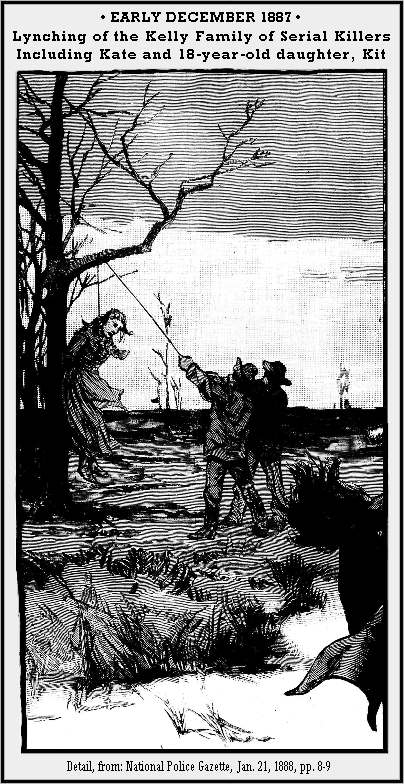
Kit and Bill were not taken before a judge or given a criminal trial. The vigilantes placed ropes around their necks and hanged them from the same tree. Their deaths are generally reported as occurring on January 4, 1888, in the Texas Panhandle during the posse’s pursuit of the family.
William Kelly temporarily escaped, but the posse followed the distinctive tracks of his horse. After a brief confrontation, he surrendered. The vigilantes demanded a confession, but William initially denied committing the murders. They reportedly hanged him for a short period, lowered him while he was still alive and again demanded that he confess.
William then allegedly admitted that the family had murdered nine men and two women. He reportedly said that every member of the household, including Kit, had participated. He also directed the posse to stolen money and possessions. A gold watch said to belong to J. T. Taylor was reportedly found among William’s property. After obtaining the confession, the posse hanged William until he was dead.
No Trial or Formal Conviction
Because Kit Kelly and the other members of her family were killed by vigilantes, none of them was formally tried or convicted. No court heard testimony, examined the alleged murder weapon or determined Kit’s individual responsibility for any particular death. The identities of most victims were never established, and exact death dates could not be determined from the decomposed remains.
The absence of a trial also means that much of the story rests on frontier newspaper reports, secondhand statements and William Kelly’s alleged confession. That confession was obtained while he was being tortured and threatened with death, circumstances that make its reliability difficult to evaluate.
Historical Uncertainty
The Kelly family story closely resembles the earlier crimes attributed to the Bloody Benders, another frontier family accused of operating a roadside establishment where travelers were robbed and murdered. The similarities have led some historians to question whether parts of the Kelly account were exaggerated, confused with the Bender story or embellished by newspapers seeking a sensational crime narrative.
Contemporary reports also disagreed about the family’s final moments. Some stories claimed that Kate and Kit were shot, while others described Kate dying in a riding accident and Kit being hanged beside her brother. The account most frequently repeated states that Kate died after falling from her horse and that Kit, Bill and William were lynched on January 4, 1888.
Even with these uncertainties, Kit Kelly is commonly identified as a member of a family suspected of murdering eleven travelers near Oak City in 1887. She was described as helping lure or distract victims inside the tavern before they were dropped into a cellar, killed and robbed. Her life ended violently at approximately 18 years of age, without a trial and without a complete accounting of the people whose bodies were found on her family’s property.