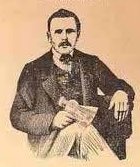
Joseph Eisele: The Parkersburg Murderer
Overview
In the years following the Civil War, as the new state of West Virginia struggled to forge its identity, a series of savage murders sent a wave of terror through its immigrant communities. The perpetrator, Joseph Eisele, was a German woodworker who presented a facade of quiet respectability to his neighbors in Parkersburg. But beneath the surface was a man burdened by debt and willing to commit horrific acts of violence for petty sums of money. Known as "The Parkersburg Murderer," Eisele used a hatchet to kill three fellow immigrants in 1867, luring them with false friendship before robbing them. His seven-month reign of terror ended only when a fourth intended victim fought for his life. Eisele's swift capture, detailed confession, and public execution marked a grim and sensational chapter in the region's history, a stark tale of desperation and brutality.
Early Life and Background
Joseph Eisele’s history, as he told it in a confession published after his death, was one of wandering and instability. He was born around 1834 in the Grand Duchy of Baden, a state in the German Confederation. He claimed to have served for two years in the Papal Army, spending one of those years in Rome before deserting his post and fleeing into the mountains to evade capture. Details of his life in Europe are sparse and rely entirely on his own account, which hinted at a criminal past he wished to escape.
Around 1864, Eisele made his way to the United States, seeking a new start. He settled in Parkersburg, West Virginia, a bustling port city on the Ohio River. There, he attempted to build a conventional life. He found work as a carpenter and woodworker, and two years after his arrival, he married. To those who knew him superficially, he was an ordinary, if unremarkable, craftsman. A Cincinnati newspaper reporter who saw him after his arrest described him as "stoutly built," about five feet nine inches tall, with a "manly and prepossessing countenance," fair complexion, and light brown hair.
This mundane exterior, however, concealed a life of financial desperation. Eisele was a frequent patron of local saloons and had quietly amassed significant debts. The pressure of these obligations gnawed at him, pushing him toward a path of extreme violence. It was also during this time that he occasionally used the alias "John Schafer," a name he adopted to further distance himself from whatever troubles he had left behind in Germany.
The Murder of Joseph Lillenthal
Eisele’s descent into murder began on June 5, 1867. His first victim was Joseph Lillenthal, a fellow German immigrant who owned a saloon on Market Street in Parkersburg. Eisele knew Lillenthal, as he was a regular customer at the establishment. On that day, Eisele entered the saloon and waited for other patrons to leave, ensuring he and Lillenthal were alone. Seizing his opportunity, he attacked the saloon owner with a hatchet he had brought with him.
The assault was an act of shocking brutality. Eisele struck Lillenthal repeatedly, fracturing his skull and nearly severing his head from his body. He then slashed the man's throat and inflicted further wounds to his spinal column. After the frenzied attack, Eisele rifled through the saloon, stealing what cash he could find to pay off some of his pressing debts. The discovery of Lillenthal's mutilated body horrified the citizens of Parkersburg. In the immediate aftermath, suspicion fell on an innocent Black man named Taylor, who was arrested for the crime. He was later released when no evidence could be found to connect him to the murder, leaving the city gripped by fear and uncertainty.
The Murder of Aloys Ulrich
Less than a month later, the money from the first robbery was gone, and Eisele's financial woes returned. He soon identified his next target: Aloys Ulrich, a German merchant and acquaintance. Eisele concocted a story about a lucrative business opportunity in Wheeling and convinced Ulrich to accompany him on a trip. On June 29, 1867, the two men set off together, walking along the tracks of the Hempfield Railroad.
In a secluded spot near a stone culvert, a short distance from Wheeling, Eisele's friendly demeanor vanished. He turned on his unsuspecting companion, once again wielding his hatchet. The attack was as vicious as the first; Ulrich was bludgeoned and decapitated. Eisele stole approximately $75 and a silver watch from his victim's body. He later pawned the watch but kept the chain for himself.
Ulrich’s body was not discovered for several days. By then, the summer heat had caused significant decomposition, making visual identification impossible. Authorities were eventually able to confirm the victim's identity through personal effects found in his pockets, including a postage stamp and a note from his brother. The brutal murder along the well-traveled rail line caused another panic, this time in the Wheeling area, as residents realized a predator was at large.
The Murder of Rudolph Tsutor
For nearly six months, Eisele laid low. He continued his work as a carpenter, and the trail for the murders of Lillenthal and Ulrich went cold. But by December, his chronic indebtedness had caught up with him again. Among his creditors was a local physician, Dr. Koch, to whom he owed a significant sum. Eisele began searching for another victim.
He found one in Rudolph Tsutor, a Hungarian horse trader who was visiting Parkersburg on business. Eisele introduced himself and quickly worked to gain the man's trust. On the evening of December 6, 1867, Eisele invited Tsutor to his rented apartment, located near the railroad depot, under a friendly pretense. Once Tsutor was inside and his back was turned, Eisele retrieved his hatchet and struck him a powerful blow to the back of the head, killing him instantly. To be certain, Eisele then crushed his victim's temple and slit his throat from ear to ear. He stole $75 from Tsutor's body and, with the blood money, went out to settle his debts, including the one he owed to Dr. Koch.
The Victims
- Joseph Lillenthal — June 5, 1867, Parkersburg, West Virginia. A German immigrant and the proprietor of a saloon on Market Street. He was an acquaintance of Eisele, who frequented his establishment.
- Aloys Ulrich — June 29, 1867, near Wheeling, West Virginia. A German merchant from Wheeling who was lured to a secluded spot along the Hempfield Railroad with a false story of a business deal.
- Rudolph Tsutor — December 6, 1867, Parkersburg, West Virginia. A Hungarian horse trader visiting the city. He was befriended by Eisele and murdered in the killer's own apartment. It was reported that his wife and daughter had traveled to Ohio about a month before his death.
Investigation and Capture
Joseph Eisele's killing spree was brought to an end by the courage of his fourth intended victim. On January 6, 1868, exactly one month after murdering Rudolph Tsutor, Eisele set out to kill again. Using his alias, John Schafer, he went to the home of John White, a coal merchant to whom he owed money. His plan was the same: attack from behind and rob the body.
As White turned his back to write a receipt for a payment Eisele had made, Eisele drew his hatchet and swung it at White's head. But White instinctively moved, and the blow, meant to be fatal, landed on his shoulder instead. Though seriously wounded, White was alive and able to fight back. He screamed "Murder!" at the top of his lungs. His desperate cries alerted men working nearby, who rushed to his aid. Startled by the resistance and the approaching help, Eisele dropped his weapon and fled. He was pursued through the streets and quickly apprehended by police.
When he was searched, officers found incriminating evidence in his possession: the watch chain belonging to Aloys Ulrich and other items taken from Rudolph Tsutor. At first, Eisele refused to speak. But faced with the evidence and the testimony of John White, he soon broke his silence. He provided a full written confession, penned in his native German, admitting to all three murders and the attack on White. News of his capture and confession spread like wildfire through Parkersburg. An enormous, angry mob gathered outside the jail, shouting for a lynching. To prevent vigilante justice, authorities placed Eisele in protective custody under heavy guard.
Trial and Sentence
The legal proceedings against Joseph Eisele were swift and decisive. His trial began on January 20, 1868, a mere two weeks after his arrest. The courtroom was packed with spectators eager to see the man who had terrorized their community. Eisele, showing little emotion, pleaded guilty to all charges.
His written confession was translated and read aloud to the court. In it, he detailed his crimes and expressed a degree of remorse, asking for forgiveness from both the German and American communities. He was careful to insist that his wife had no knowledge of his horrific activities. Throughout the brief trial, Eisele remained calm and detached, answering questions from the judge with quiet, one-word responses.
Given his guilty plea and the overwhelming evidence, the grand jury wasted no time. They found him guilty on three counts of murder and one count of maliciously maiming with intent to kill. The judge sentenced him to death by hanging. The presiding official reportedly expressed his astonishment that a man of Eisele's apparent intelligence and education could commit such heinous acts for such small amounts of money.
Execution and Aftermath
Joseph Eisele’s execution was scheduled for March 6, 1868. It was to be the last public hanging in the history of Wood County, and the event took on the atmosphere of a public spectacle. A gallows was constructed in a field just outside Parkersburg, and on the appointed day, a massive crowd, estimated at over 5,000 people, gathered to witness the sentence being carried out. The mood was tense, and a militia squadron was required to escort Eisele from the jail to the scaffold to keep the unruly crowd at bay.
On the gallows, Eisele remained composed. He spoke with his spiritual advisers, a Catholic priest and a Methodist minister. He then delivered a final address to the crowd in German, requesting that it be translated and published for all to read. At precisely 1:00 p.m., the trapdoor was sprung. His death was reported to be instantaneous. His body was taken down and buried, believed to be in an unmarked grave in a prison cemetery.
The case of "The Parkersburg Murderer" left an indelible mark on the region. For the immigrant communities of Parkersburg and Wheeling, it was a terrifying betrayal from one of their own. The murder of Aloys Ulrich, in particular, passed into local folklore, with persistent ghost stories claiming his headless spirit haunts the old Hempfield Railroad tunnel near the site of his death, a lasting and spectral legacy of Joseph Eisele's brief but brutal rampage.