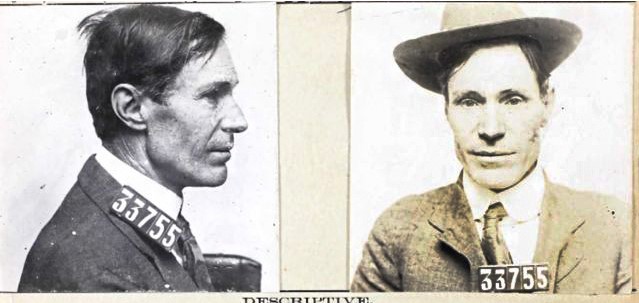
James P. Watson: The West Coast “Bluebeard” Killer
A Killer Hidden Behind Marriage
James P. Watson was a serial bigamist and murderer who used promises of marriage to deceive women throughout the western United States and Canada. Operating under numerous aliases, he courted widows and unmarried women through newspaper advertisements, quickly gained their confidence, and persuaded many of them to marry him. Some of the women were abandoned after Watson obtained their money or property. Others disappeared during supposed honeymoons and sightseeing trips.
Watson confessed in 1920 to killing seven women, although contemporary reports sometimes attributed as many as nine confessed murders to him. The true number of his victims remains uncertain because he used false names, traveled constantly, maintained several marriages at the same time, and gave inconsistent accounts of his activities. Investigators believed that additional missing wives may also have died at his hands, but many of those suspected cases could never be conclusively established.
Early Life and Numerous Identities
Watson was reportedly born Charles Gillam in Paris, Arkansas, on July 3, 1871. Accounts of his background vary, partly because Watson repeatedly changed his identity and supplied authorities with conflicting personal information. He was also known as Joseph Holden, Walter Andrew Watson, James B. Hilton, Andrew Hilton, Charles Newton Harvey, William B. Huirt and several other names.
His ability to move between identities became central to his crimes. By changing his name whenever he entered a new city, Watson concealed his existing marriages and prevented one wife from discovering another. He presented himself as a prosperous businessman, government employee, secret-service agent or financially secure traveler. His expensive clothing, automobile and attentive courtship helped create an appearance of respectability.
The Matrimonial Scheme
Watson regularly placed personal advertisements in newspapers seeking correspondence with a “refined” woman or widow for the stated purpose of marriage. Once a woman answered, he overwhelmed her with flattering letters, flowers, gifts and promises of financial security. His relationships progressed rapidly, sometimes ending in marriage after only a brief courtship.
After marrying, Watson frequently encouraged his new wife to withdraw savings, transfer property, purchase expensive gifts or give him control of her finances. He then either deserted her or arranged a secluded trip during which she could be killed without witnesses. Lakes, rivers, isolated roads and remote vacation areas were particularly useful because they allowed him to describe a disappearance as an accidental drowning.
Several surviving wives later described Watson as unusually charming and romantic. That contrast became one of the most disturbing features of the case. He could behave as a devoted husband while simultaneously maintaining other marriages and planning the disappearance of a woman who trusted him.
Victims and Confessed Murders
Exact calendar dates of death were not preserved or independently established for most of Watson’s victims. Their bodies were generally never recovered, and the known time frames are based largely on marriage records, disappearances and Watson’s statements. The dates below therefore use the most specific historically supported period available rather than claiming an exact day when one cannot be verified.
- Marie Austin — 1918, near Coeur d’Alene, Idaho: Watson said that Marie Austin was killed during a trip to the Coeur d’Alene area. He reportedly struck her, weighted her body with rocks and placed it in deep water. Her remains were not recovered, leaving the precise date and location of death uncertain.
- Unidentified Seattle wife — 1918, near Spokane, Washington: Watson described taking one of his wives to view a waterfall near Spokane during what appeared to be a honeymoon or recreational trip. While she stood near the edge, he allegedly approached from behind and pushed her over. Her name was not consistently preserved in his accounts, and no exact date of death was established.
- Beatrice Andrewartha — spring 1919, Lake Washington near Seattle, Washington: Watson married Beatrice Andrewartha in approximately February 1919. During a later visit to Lake Washington, he took her onto the water and drowned her. Her body was never recovered, and the available historical record identifies only the spring of 1919 as the period of her death.
- Elizabeth Prior — 1919, near Olympia or Plum Station, Washington: Watson married Elizabeth Prior in Coeur d’Alene, Idaho, in March 1919. During a trip through Washington, Watson claimed that an argument occurred and that he struck her. He then crushed her skull with a hammer or sledgehammer. Contemporary accounts differed on whether her body was buried near Plum Station or otherwise concealed. No reliable exact date of death has been established.
- Bertha Goodrich, also reported as Bertha Goodnich or Goodnish — summer 1919, Lake Washington near Seattle, Washington: Watson married Bertha in North Yakima, Washington, in June 1919. He later admitted killing her during a trip near Seattle. Accounts state that he struck or overpowered her, held her beneath the water and disposed of her weighted body in Lake Washington. Her remains were never found.
- Alice Marie Ludvigson — 1919, St. Joe River, Idaho: Watson admitted drowning Alice Ludvigson in the St. Joe River. Reports stated that he forced her beneath the water and secured or concealed her body beneath heavy logs. Although some sources disagree about the date of their marriage, her death is consistently placed in 1919. Her body was never conclusively recovered.
- Agnes Wilson — approximately 1917–1919, Lake Washington near Seattle, Washington: Agnes Wilson was reportedly from Alberta, Canada, and married Watson under the alias Charles Newton Harvey. Watson said that he took her onto Lake Washington and drowned her. Historical reports indicate that she disappeared shortly after the marriage, but an exact date of death was never verified.
- Unidentified woman — approximately 1918–1919, Lake Washington near Seattle, Washington: Watson admitted drowning another woman whose name he claimed he could not remember. He said that she died during a boat trip on Lake Washington. Because he could not or would not identify her, investigators were unable to establish her background, the date of her death or whether she was among the women already reported missing.
- Nina Lee Deloney — December 1919 or early 1920, Imperial County, California: Nina Lee Deloney was a 43-year-old widow who married Watson in Oakland in December 1919. Watson promised her a honeymoon in Hawaii but instead drove her into the Imperial Valley. In an isolated area near Shepherds Bridge, he attacked her with a heavy object, wrapped or smothered her in a blanket and buried her in a shallow grave among rocks. Her body was recovered in May 1920 after Watson led officers to the location. A coroner’s jury determined that she died from a blow to the head. The exact day of her murder was not conclusively preserved, but she disappeared shortly after the December 1919 marriage.
The Murder of Nina Lee Deloney
The killing of Nina Lee Deloney became the central prosecutable case against Watson because her body could be recovered and physically examined. Deloney responded to one of Watson’s matrimonial advertisements and was quickly drawn into his familiar pattern of intense courtship. He claimed to be a successful and important man and promised her an affluent married life.
Following their marriage, Watson took Deloney toward Southern California rather than on the promised Hawaiian honeymoon. In a remote portion of Imperial County, he struck her in the head, wrapped her in bedding or a blanket and concealed her body in a shallow grave. He then returned to his other relationships and continued behaving as though Deloney had simply disappeared from his life.
After his arrest, Watson initially gave evasive and contradictory explanations. He eventually admitted killing Deloney and accompanied officers into the desert. Searchers found her badly decomposed body beneath dirt and rocks. The recovery transformed the investigation from a complicated bigamy case into a murder prosecution supported by a body, a confession and Watson’s knowledge of the burial site.
The Suspicious Wife Who Exposed Him
Watson’s downfall began when one of his surviving wives, commonly identified as Kathryn Wombacher, became suspicious of his conduct. She noticed that he was frequently absent and that aspects of his identity and business affairs did not make sense. She hired a private investigator to examine his background.
The investigator uncovered evidence that Watson was using matrimonial advertisements to contact numerous women. Searches connected with the investigation revealed marriage documents, correspondence, photographs, wedding rings and personal property belonging to different wives. These items demonstrated that Watson was not merely conducting a single affair but maintaining an extensive system of fraudulent marriages.
Watson was arrested in Los Angeles in April 1920, initially on suspicion of bigamy. As detectives contacted police departments and families throughout California, Washington, Idaho and Canada, they discovered that several of his wives had vanished under remarkably similar circumstances.
Confessions and the Search for Bodies
During questioning, Watson began describing murders in a calm and sometimes detached manner. He spoke of sudden impulses to kill and claimed that some deaths occurred without extensive planning. However, the repeated use of remote waterways, weighted bodies and false identities suggested a deliberate method of avoiding detection.
Watson explained that bodies submerged in cold, deep water and weighted with rocks or logs were unlikely to return to the surface. Investigators searched Lake Washington, the St. Joe River and other suspected disposal locations, but most of the bodies were never recovered. The passage of time, uncertain locations and Watson’s unreliable descriptions made successful recovery extremely difficult.
Authorities also investigated whether Watson had killed women beyond those included in his formal confession. Newspaper reports identified additional missing wives and women whose relationships with Watson could not be fully reconstructed. Some survived because he abandoned them. Others could not be located, leaving investigators unable to determine whether they had escaped, changed their names or been murdered.
Motive and Criminal Method
Financial gain was an important part of Watson’s scheme. He sought women who possessed savings, property, jewelry or a steady income. By marrying them, he gained access to their money while creating a socially respectable explanation for traveling with them. When a wife became inconvenient, suspicious or financially depleted, he could abandon her and begin searching for another.
His killings also appear to have involved domination and excitement beyond ordinary financial fraud. Watson reportedly kept personal possessions, marriage records and jewelry connected to his wives. Such objects served as evidence of his many identities and may also have functioned as trophies through which he could remember his deceptions and crimes.
Although Watson described some murders as impulsive, his conduct included repeated preparation. He selected isolated destinations, traveled under aliases, avoided witnesses and used water or remote burial sites to conceal evidence. His statements about impulse may have been an effort to appear mentally ill or reduce his legal responsibility.
Conviction and Life Sentence
Watson entered a guilty plea in connection with the murder of Nina Lee Deloney. On May 10, 1920, he was sentenced to life imprisonment at San Quentin State Prison. The plea allowed prosecutors to secure a murder conviction without conducting a lengthy trial involving numerous missing women, uncertain jurisdictions and unrecovered bodies.
Contemporary newspapers often described Watson as a modern “Bluebeard,” referring to the legendary man who murdered a succession of wives. He was also called the “Monster of the West Coast” and “The Enigma.” His case received national attention because of the number of marriages, the extensive use of aliases and the chilling manner in which ordinary courtship had been transformed into a method of selecting victims.
Death in Prison
Watson spent the remainder of his life in San Quentin. Reports described him as a generally compliant prisoner, a sharp contrast with the manipulative and violent behavior revealed by his crimes. He died of pneumonia at San Quentin in October 1939.
He never provided a completely reliable account of every woman he married or every person he killed. The surviving confession established at least seven murders, while some contemporary accounts credited him with nine. Later estimates were even higher, but those larger totals remain unproven.
Legacy of the Case
The James P. Watson investigation demonstrated how mobility, false identities and limited communication between jurisdictions could allow a repeat offender to remain hidden. A marriage recorded in one city might never be compared with another marriage hundreds of miles away. A woman who disappeared during a trip could be treated as the victim of an accident without investigators knowing that her husband had reported similar accidents under other names.
The case also exposed the vulnerability of women who used matrimonial advertisements during the early twentieth century. Watson specifically searched for women seeking companionship, stability and marriage. He transformed their trust into a weapon, isolating them from relatives and taking them to places where their deaths could be concealed.
Because most of Watson’s admitted victims were never recovered, the full human cost of his crimes cannot be measured with certainty. The known names represent only part of a larger network of wives, fiancées and correspondents whom he deceived. Some survived his fraud, while others disappeared without leaving enough evidence for investigators to determine their fate.
James P. Watson remains one of the earliest widely publicized American serial killers to use courtship and marriage as his primary means of approaching victims. His crimes were not random encounters. They were calculated betrayals in which romance, financial promises and the legal bond of marriage concealed a continuing pattern of theft, disappearance and murder.