Hezekiah “Hez” Rasco: The Murders in Nodaway County
Overview
Hezekiah “Hez” Rasco was an American murderer whose known crimes occurred fourteen years apart in rural Nodaway County, Missouri. He was convicted of two separate murder cases: the 1896 killing of Katrina “Katy” Baumli and the 1910 murder of Oda Hubbell. Rasco was also accused of killing Hubbell’s wife and two young children during the same 1910 attack. Although he was prosecuted only for Oda Hubbell’s death in the later case, authorities considered him responsible for the destruction of the entire Hubbell family.
Rasco’s record is notable because his first murder occurred while he was still a teenager. After serving years in the Missouri State Penitentiary, he returned to Nodaway County and eventually became involved in another exceptionally violent crime. The second case ended with his conviction, death sentence and execution by hanging in Maryville, Missouri, on March 26, 1912.
Early Life
Hezekiah Rasco was born on October 8, 1880, in Sidney, Iowa. His family later lived in the farming communities of northwestern Missouri. Accounts of his youth described him as intelligent, personable and capable of appearing calm even when facing serious accusations. Those qualities later contributed to the controversy surrounding his trials, as some people viewed him as manipulative while others questioned whether investigators had focused on him too quickly.
Rasco was only fifteen years old, approaching his sixteenth birthday, when he became connected to the death of Katy Baumli near Arkoe, Missouri. The crime was shocking not merely because of the victim’s injuries, but because the accused killer was a local boy who knew her and lived within the same rural community.
The Murder of Katrina “Katy” Baumli
Katrina “Katy” Baumli was a wife and the mother of three children who lived near Arkoe in Nodaway County. In October 1896, an argument reportedly developed over a butter churn. During the confrontation, Baumli was attacked and beaten to death. Some historical accounts also described evidence of a sexual assault.
Rasco initially attempted to distance himself from the killing, but investigators became suspicious of his statements and behavior. Approximately a week after the crime, he confessed. The confession stunned residents who had difficulty accepting that a teenager could have committed such an exceptionally brutal act.
The prosecution of Rasco was prolonged. His first trial ended without a unanimous verdict, and a second proceeding also failed to produce a final resolution. During a third trial in October 1897, a jury found him guilty of first-degree murder. He was sentenced to a lengthy term in the Missouri State Penitentiary rather than executed, largely because of his age when the crime occurred.
Rasco entered the state prison at Jefferson City in late 1897. He remained incarcerated for several years before receiving his freedom. His release eventually allowed him to return to the region where his first murder had occurred.
Return to Nodaway County
After leaving prison, Rasco returned to northwestern Missouri and worked in the rural communities around Barnard, Guilford and Maryville. The Baumli murder remained well remembered, and many residents continued to regard him with suspicion. Nevertheless, he socialized with local men and took part in card games and other activities common in the area.
On the night of November 19, 1910, Rasco met Oda Hubbell and another acquaintance, Charles Wallace, in Guilford. The men entered an empty railroad boxcar near the depot and began playing poker. Wallace eventually departed, leaving Rasco and Hubbell to continue playing through the night and into the early morning of November 20.
According to the prosecution’s reconstruction, Rasco lost heavily and became angry when Hubbell refused to continue gambling. Hubbell then returned to his home near Barnard, where he lived with his wife, Clara, and their children, Jessie and Welton. Prosecutors alleged that Rasco subsequently obtained a shotgun, followed Hubbell and attacked the family.
The Hubbell Family Murders
Oda Hubbell was apparently confronted outside or near his home. He was shot with a shotgun, after which his body was dragged into the residence. Evidence at the scene indicated that a violent struggle had taken place.
Clara Hubbell was also killed inside the home. Contemporary descriptions stated that she suffered devastating injuries inflicted with the shotgun, including blows delivered with its stock. Six-year-old Jessie and four-year-old Welton were killed as well, leaving no surviving witnesses inside the house.
After the killings, the murderer set the Hubbell home on fire, apparently intending to destroy the victims’ bodies and other evidence. A passing neighbor noticed the flames and fought the fire before the building was completely consumed. Even so, the damage was severe. Oda Hubbell’s remains were badly burned, and the children’s bodies were nearly destroyed by the flames.
The discovery of four members of one family dead inside a burned farmhouse caused panic and anger throughout Nodaway County. Because Rasco had been with Hubbell shortly before the murders and was already known as a convicted killer, suspicion quickly centered on him.
Evidence Against Rasco
Investigators brought bloodhounds to the Hubbell property. The dogs reportedly followed a trail from the crime scene toward the Rasco residence and entered the room where Hez Rasco had been staying. Officers seized clothing that appeared to contain bloodstains, including a pair of overalls later presented as important evidence at trial.
Authorities also investigated Rasco’s movements following the poker game. Witnesses placed him with Hubbell during the hours before the murders, and the prosecution argued that his gambling losses provided a motive. Testimony concerning his search for a firearm further strengthened the state’s theory that the murders had been planned after Hubbell left the game.
Rasco was arrested within a short time of the discovery. Because local anger created fears that a mob might seize and kill him, officers removed him from the immediate area and confined him in St. Joseph for protection. He was later returned to face trial in Nodaway County.
Trial and Conviction
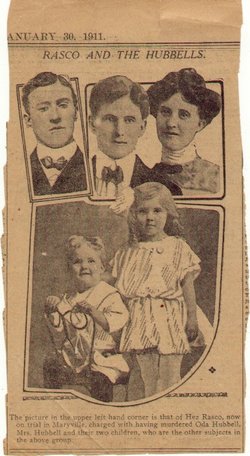
Rasco’s trial began in Maryville in January 1911. Prosecutors presented the bloodstained clothing, testimony from men who had attended the poker game and evidence concerning the trail between the Hubbell home and Rasco’s residence. The state maintained that Rasco had killed the family, dragged Oda’s body into the house and set the fire to conceal what he had done.
The defense challenged the reliability of the physical evidence and attempted to create doubt about whether investigators had correctly reconstructed the crime. Rasco denied murdering the Hubbells and continued to insist that the state’s case was based on suspicion arising from his previous conviction.
Although Rasco was accused of killing all four members of the family, the trial formally concerned the murder of Oda Hubbell. On February 9, 1911, the jury found Rasco guilty of first-degree murder. The conviction exposed him to the death penalty, and he was subsequently sentenced to be hanged.
Rasco appealed, but the conviction and sentence were upheld. As the execution approached, he continued to maintain his innocence in the Hubbell case. He was baptized shortly before his death and wrote letters expressing hope for spiritual forgiveness while refusing to admit that he had destroyed the Hubbell family.
Known and Attributed Victims
Katrina “Katy” Baumli, approximately 36: Killed in October 1896 near Arkoe, Nodaway County, Missouri. Baumli was beaten to death following an argument reportedly involving a butter churn. Rasco confessed and was convicted of first-degree murder after three trials.
Oda Hubbell, 29: Killed on November 20, 1910, at the Hubbell family home near Barnard, Nodaway County, Missouri. He was shot with a shotgun after participating in an all-night poker game with Rasco. Rasco was convicted specifically of Hubbell’s murder.
Clara E. Hubbell, 29: Killed on November 20, 1910, inside the family home near Barnard, Missouri. She was struck and fatally injured during the attack. Rasco was accused of her murder but was not separately tried for it.
Jessie O. Hubbell, 6: Killed on November 20, 1910, at her family’s home near Barnard, Missouri. Her body was badly damaged when the murderer set fire to the residence.
Welton O. Hubbell, 4: Killed on November 20, 1910, at the Hubbell home near Barnard, Missouri. Like his sister, he died during the attack and his remains were severely burned in the fire.
Execution
Hezekiah Rasco was hanged on March 26, 1912, in Maryville, Missouri. He was thirty-one years old, although some contemporary records listed him as thirty-two. The execution concluded a case that had dominated local attention for more than a year and revived memories of the Baumli murder committed during his adolescence.
Rasco maintained until the end that he had not killed the Hubbell family. His body was returned to Sidney, Iowa, and buried near his mother. Questions about the strength of portions of the prosecution’s evidence continued to be discussed, but the jury’s verdict remained intact.
Legacy
Rasco is generally attributed with five murders committed in two separate episodes. His crimes fit the commonly used definition of serial murder because the Baumli killing and the Hubbell family massacre were separated by approximately fourteen years and a lengthy period of incarceration.
The case became one of the most notorious chapters in the criminal history of Nodaway County. It combined a teenage murderer, repeated trials, a release from prison, an entire family killed after a poker game and an attempted destruction of evidence by fire. The brutality of the crimes and Rasco’s continued denials ensured that the murders remained subjects of historical research and debate long after his execution.