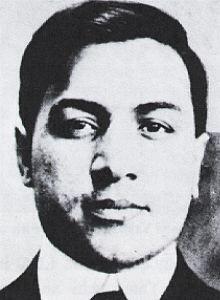
On a summer afternoon in Brooklyn, New York, on July 1, 1928, Francesco 'Frankie Yale' Ioele, an Italian-American man of 35, was driving his new Lincoln car down 44th Street. Suddenly, another vehicle, a black sedan, pulled up alongside him. A hail of bullets from a shotgun and a Thompson submachine gun erupted from the pursuing car, marking the first time the latter weapon was used in New York City gang warfare.
The initial blast from the shotgun struck Yale on the left side of his head, while a submachine gun bullet also tore through his brain. Either wound would have been fatal instantly. His car, now without a driver, veered off the road and crashed into the stoop of a brownstone at 923 44th Street, where he was found deceased.
The brazen and violent nature of the murder immediately pointed to a significant underworld conflict. Suspicion quickly fell upon Chicago's Al Capone, a former associate and protégé of Yale's. The relationship between the two powerful gangsters had soured, reportedly because Yale had been hijacking Capone's liquor shipments. In the months leading up to the killing, Capone had allegedly sent a spy, James DeAmato, to infiltrate Yale's operation, but DeAmato was discovered and killed in July of 1927, an act that likely sealed Yale's fate.
In the aftermath of the shooting, the New York Police Department launched an investigation and repeatedly questioned Al Capone, but no charges were ever filed against him for the murder. Law enforcement theorized that the hit was carried out by some of Capone's most notorious gunmen, a crew that was believed to include individuals such as Tony 'Joe Batters' Accardo, Fred 'Killer' Burke, Gus Winkler, George 'Shotgun' Ziegler, and Louis 'Little New York' Campagna. Further fueling these suspicions, ballistic testing later linked one of the submachine guns used in Yale's murder to the infamous St. Valentine's Day Massacre in Chicago the following year, which was orchestrated by Capone's organization. Despite the strong suspicions and the ballistic evidence, no one was ever formally arrested or convicted for the murder of Frankie Yale, leaving his death as another unsolved chapter in the violent history of American organized crime.